Stryker Configurations and Mission
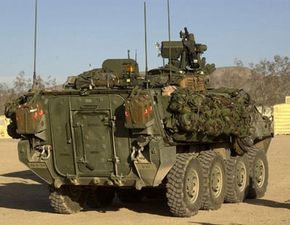
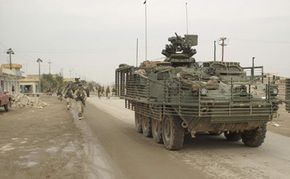
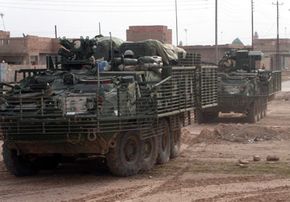
ICVThe Infantry Carrier Vehicle is built both for troop transport and as an offensive force in itself. In addition to the driver and commander, an ICV carries nine infantry soldiers. For weaponry, the ICV features a Konigsberg gun turret, which is operated via remote control from inside the vehicle. The gun turret can be equipped with a .50-caliber heavy machine gun, a 7.62-mm machine gun or a 40-mm Javelin missile launcher.
![]() Photo courtesy U.S. Army, by Sgt. Jeremiah Johnson Soldiers dismount a Stryker Infantry Carrier Vehicle to conduct a patrol in Mosul, Iraq. |
MGS
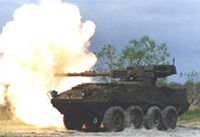
![]() Photo courtesy Combined Joint Task Force Seven Cannon fire from a Stryker |
The cannon can fire four different types of ammunition:
- HE/HEP (high-explosive) rounds, which penetrate and destroy bunkers and walls
- KE (kinetic-energy) ammunition, which destroys armored vehicles
- HEAT (high-explosive, anti-tank) ammunition, which attacks vehicles and personnel with its fragmentation capabilities
- Anti-personnel canisters, which are designed to attack infantrymen outside of their vehicles
The Other Strykers
- RV - Reconnaissance Vehicle
Carries squads of scouts and surveillance equipment linked in to the FBCB2 system - MC - Mortar Carrier
Has a 60-mm and 120-mm mortar capable of firing the full array of mortar ammunition, including heat-, infrared- and precision-guided shells - CV - Commander's Vehicle
Contains a large video display system for viewing the FBCB2 tactical maps and a voice system that alerts the commander to danger; for weaponry, has a .50-caliber machine gun and a grenade launcher - FSV - Fire Support Vehicle
Is outfitted for advanced command-and-control support including target acquisition, target identification and communications - ESV - Engineer Squad Vehicle
Has mine detection and removal systems, a touch screen display for the squad leader, a remote-operated, 50-caliber machine gun and Javelin missiles
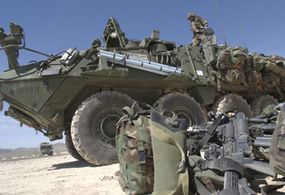
![]() Photo courtesy U.S. Army, by Sgt. 1st Class Gary Ogilvie A Stryker Engineer Squad Vehicle crew reconfigures their vehicle after being transported aboard an Air Force C-130 Hercules aircraft to Bicycle Lake Army Airfield at the National Training Center, Fort Irwin, CA. |
- MEV - Medical Evacuation Vehicle
An ambulance built into a Stryker body; carries either four or six patients and three medics, along with medical equipment and an automatic litter-lifter - ATGM - Anti-tank Guided Missile Vehicle
Has a two-tube missile launcher for TOW bunker busters and anti-tank missiles - NBCRV - NBC Reconnaissance Vehicle
Contains detection systems for nuclear, chemical and biological weapons, equipment for analyzing field samples for dangerous content and meteorological equipment to monitor and predict weather patterns
As you can see, the array of Strykers is designed to fulfill the needs of virtually every brigade in the Army.
In the next section, we'll examine the specific goals the Stryker project was instituted to address.
Mission: Vehicle for the New Army
To see what makes the Stryker so useful in the field, it is important to understand why it was developed. In the first half of the twentieth century, wars unfolded slowly and deliberately over vast areas of the globe. Transporting heavy equipment over long distances was a livable problem, because both sides were equally limited by how long it took them to move their armies. But in the current political and military climate, crises often erupt without warning and require a swift and powerful response.
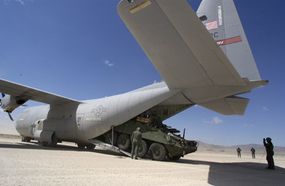
![]() Photo courtesy U.S. Army, by Sgt. 1st Class Gary Ogilvie A Stryker Mortar Carrier exits the tail of an Air Force C-130 Hercules aircraft after landing at Bicycle Lake Army Airfield at the National Training Center, Fort Irwin, CA. |
Today's conflicts are often too short in duration and small in scale for the older strategies of moving large convoys of equipment slowly along supply lines. Further, today's opponents are often small but determined independent forces rather than large national armies. This puts pressure on the Army's ability to respond to threats all over the world in a timely and powerful fashion. In response to speed-of-deployment problems he faced in the Kosovo conflict in 1999, General Eric Shinseki drafted the "Army Transformational Plan," which called for sweeping changes in the Army's organizational structure to adapt to the new challenges it faced.
General Shinseki's plan ordered the development of a new set of combat brigades to be known as an "interim force." Each of these brigades would be self-sufficient, as powerful as a tank battalion, and able to be deployed by air anywhere in the world within 96 hours. This is no easy task considering that current heavy brigades must be moved by ship and often require weeks to deploy. An interim-force brigade or platoon of brigades would be used in one of two ways:
- as a first-responder, establishing and maintaining a presence until the heavier mechanized units arrived
- as the main combat element
The Stryker project, a light vehicle designed to maximize speed, firepower, adaptability and interoperability, is the platform that was chosen to enable these new brigades to meet their objectives. If the interim-force brigades are as successful in the field as is hoped, Shinseki's plan then calls for the eventual transformation of the entire Army into an "objective force" where every brigade is capable of meeting similar goals of maximized firepower in a highly portable package.
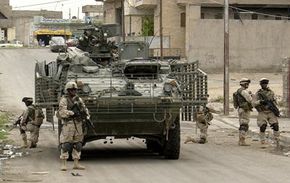
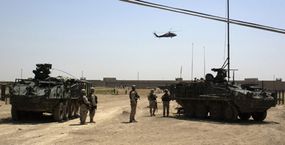
![]() Photo courtesy U.S. Army, by Sgt. Jeremiah Johnson Soldiers maintain security for a helicopter landing zone just outside the city of Mosul, Iraq. |
In order to meet that last requirement, an interim-force brigade's Stryker vehicle must be transportable on a C-130 aircraft, since that is the U.S. Air Force's most common cargo aircraft. The C-130 weight restrictions require a cargo load of no greater than 22 tons, so a Stryker vehicle itself can't weigh more than about 19 tons. Throughout the process of testing and modifying the Stryker for the unique characteristics of live combat missions, meeting this weight requirement has been one of the project's toughest challenges.
If the interim-force brigades and their Strykers meet with success on the battlefield, one day we may see the end of the distinction between light and heavy brigades, and a vast sea of Strykers will head into battle.
For more information on the Stryker project and other military vehicles, check out the links on the next page.