Key Takeaways
- Without a spacesuit in space, you would become unconscious within 15 seconds due to lack of oxygen.
- Your blood and body fluids would boil and then freeze because of the extremely low air pressure, and your tissues would expand from the boiling fluids.
- You would face extreme temperatures and radiation exposure, and you could be hit by high-speed micrometeoroids or orbiting debris.
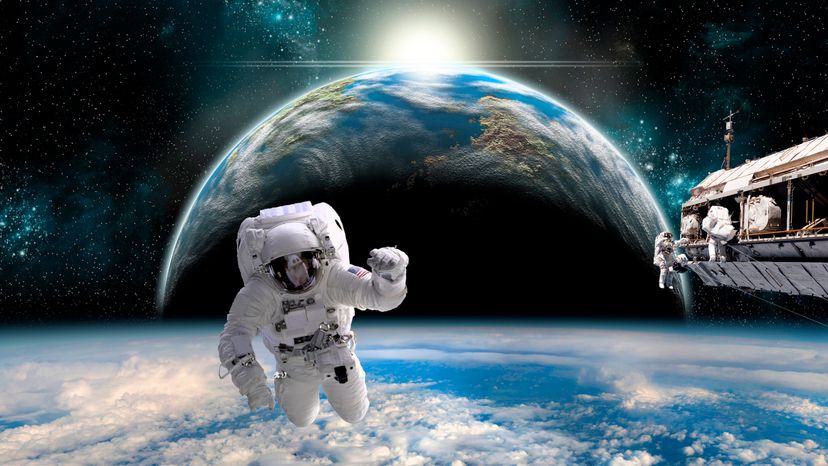
The current space suit that's used for spacewalking from the shuttle and International Space Station is called the Extravehicular Mobility Unit or EMU. Because an Earth-like environment is created within the suit itself, a space suit allows you to walk around in space in relative safety. Space suits provide:
- Pressurized atmosphere - The space suit provides air pressure to keep the fluids in your body in a liquid state -- in other words, to prevent your bodily fluids from boiling. The pressure in the suit is much lower than normal air pressure on Earth (4.3 versus 14.7 PSI) so that the suit doesn't balloon and so that it's as flexible as possible.
- Oxygen - Space suits must supply pure oxygen, because of the low pressure. Normal air -- 78 percent nitrogen, 21 percent oxygen and 1 percent other gases -- would cause dangerously low oxygen concentrations in the lungs and blood at this low pressure.
- Regulated temperature -- To cope with the extremes of temperature, most space suits are heavily insulated with layers of fabric (Neoprene, Gore-Tex, Dacron) and covered with reflective outer layers (Mylar or white fabric) to reflect sunlight.
- Protection from micrometeroids -- Space suits have multiple layers of durable fabrics such as Dacron or Kevlar. These layers prevent the suit from tearing on exposed surfaces of the spacecraft.
Advertisement