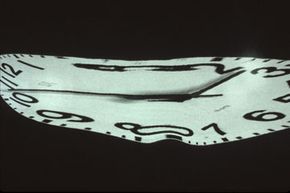
From millennium-skipping Victorians to phone booth-hopping time traveler teenagers, the term time travel often summons our most fantastic visions of what it means to move through the fourth dimension. But of course you don't need a time machine or a fancy wormhole to jaunt through the years.
As you've probably noticed, we're all constantly engaged in the act of time travel. At its most basic level, time is the rate of change in the universe -- and like it or not, we are constantly undergoing change. We age, the planets move around the sun, and things fall apart.
Advertisement
We measure the passage of time in seconds, minutes, hours and years, but this doesn't mean time flows at a constant rate. In fact Einstein's theory of relativity determines that time is not universal. Just as the water in a river rushes or slows depending on the size of the channel, time flows at different rates in different places. In other words, time is relative.
But what causes this fluctuation along our one-way trek from the cradle to the grave? It all comes down to the relationship between time and space. Human beings frolic about in the three spatial dimensions of length, width and depth. Time joins the party as that most crucial fourth dimension. Time can't exist without space, and space can't exist without time. The two exist as one: the space time continuum. Any event that occurs in the universe has to involve both space and time.
In this article, we'll look at the real-life, everyday methods of time travel in our universe, as well as some of the more far-fetched methods of dancing through the fourth dimension.
Advertisement