
Classifying Waves
The word "tsunami" comes from the Japanese words tsu (harbor) and nami (waves). A tsunami is a wave or series of waves in the ocean that can span hundreds of miles across and reach heights of 100 feet (30 meters) and more once they near land. These "walls of water" can even outrun a commercial jet. The massive Dec. 26, 2004, tsunami traveled 375 miles (600 kilometers) in a mere 75 minutes. That's 300 miles (480 kilometers) per hour. When these walls of water hit coastal lands, massive damage often occurs.
In order to understand tsunamis, let's first look at waves in general. Most of us are familiar with waves from days at the beach or at local wave pools. Waves consist of a crest (the highest point of the wave) and a trough (the lowest point of the wave). We measure waves in two ways:
Advertisement
- The wave height is the distance between the crest and trough.
- The wavelength is the horizontal distance between two consecutive wave crests.
We measure the frequency of waves by noting the time it takes for two consecutive waves to cross the same point. This is called the wave period.
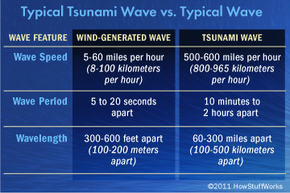
So as far as structure goes, tsunamis and normal waves are the same. The differences boil down to sheer magnitude and speed, as the accompanying table describes.
Now let's look at what creates a normal wave. Waves in the ocean stem from several different factors such as gravitational pull, underwater activity and atmospheric pressure. The most common source for waves, however, is wind.
When the wind blows across a smooth water surface, the air molecules grab water molecules as they speed along. The friction between the air and water stretches the water's surface, creating ripples in the water known as capillary waves. The capillary waves move in circles. This circular motion of water continues vertically underwater, though the power of this motion decreases in deeper water. As the wave travels, more water molecules amass, increasing the size and momentum of the wave. The most important thing to know about waves is that they do not represent the movement of water, but instead show the movement of energy through water.
In normal waves, the wind is the source of that energy. The size and speed of wind waves depends on the strength of what's blowing.