Introduction to How Zombies Work
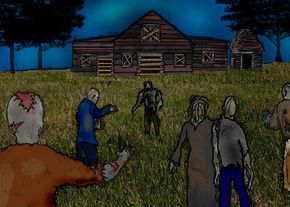
It happens in just about every zombie movie -- a throng of reanimated corpses lumbers toward the farmhouse, shopping mall, pub or army base where the heroes have barricaded themselves. The zombies aren't dead, but they should be. They're relentless and oblivious to pain, and they continue to attack even after losing limbs. Usually, anyone the zombies kill returns as a zombie, so they quickly evolve from a nuisance to a plague.
![]() |
| The concept of zombies are thought to have originated in Haiti. See more zombie pictures. |
Like a lot of monsters, zombies have their roots in folklore and -- according to some researchers -- in real events in Haiti. In this article, we'll discuss Haitian zombies, explore depictions of zombies in films and video games and review the best course of action for surviving an attack.
|
|
Haitian Zombies
![]() Zora Neale Hurston is one of many ethnographers who have documented the traditions and beliefs of Haitian voodoo. |
Even after documenting numerous stories and rumors, researchers found little solid evidence to explain or prove the phenomenon. Often, the alleged zombies had received little or no medical care before their apparent deaths. Researchers also had trouble ruling out mistaken identity and fraud.
In 1980, a man appeared in a rural Haitian village. He claimed to be Clairvius Narcisse, who had died in Albert Schweitzer Hospital in Deschapelles, Haiti on May 2, 1962. Narcisse described being conscious but paralyzed during his presumed death -- he had even seen the doctor cover his face with a sheet. Narcisse claimed that a bokor had resurrected him and made him a zombie.
|
|
Since the hospital had documented Narcisse's illness and death, scientists viewed him as a potential proof for Haitian zombies. Narcisse answered questions about his family and childhood that not even a close friend could have known. Eventually, his family and many outside observers agreed that he was a zombie returned to life.
![]() |
![]() |
in "The Serpent and the Rainbow" and "The Passage of Darkness."
Narcisse was the impetus for the Zombie Project -- a study into the origins of zombies conducted in Haiti between 1982 and 1984. During that time, ethnobotanist and anthropologist Dr. Wade Davis traveled through Haiti in the hopes of discovering what causes Haitian zombies.
Next, we'll look at what Davis discovered.

|
|
Haitian Zombie Powder
|
|
Davis learned that Haitians who believed in zombies believed that a bokor's sorcery -- not a poison or a drug -- created them. According to local lore, a bokor captures a victim's ti bon ange, or the part of the soul directly connected to an individual, to create a zombie. But during his research, Davis discovered that the bokor used complex powders, made from dried and ground plants and animals, in their rituals.
Davis collected eight samples of this zombie powder in four regions of Haiti. Their ingredients were not identical, but seven of the eight samples had four ingredients in common:
![]() Photo courtesy MBL Marine Biology Laboratory A puffer fish, an ingredient in zombie powder. |
- One or more species of puffer fish, which often contain a deadly neurotoxin called tetrodotoxin
- A marine toad (Bufo marinus), which produces numerous toxic substances
- A hyla tree frog (Osteopilus dominicensis), which secretes an irritating (but not deadly) substance
- Human remains
The use of puffer fish intrigued Davis. Tetrodotoxin causes paralysis and death, and victims of tetrodotoxin poisoning often remain conscious until just before death. The paralysis prevents them from reacting to stimuli -- much like what Clairvius Narcisse described about his own death. Doctors have also documented cases in which people ingested tetrodotoxin and appeared dead but eventually made a complete recovery.
![]() Photo courtesy USGS Bufo marinus, an ingredient in zombie powder. |
Davis theorized that the powder, applied topically, created irritation and breaks in the victim's skin. The tetrodotoxin could then pass into the bloodstream, paralyzing the victim and causing him to appear dead. The family would bury the victim, and the bokor would remove the body from the grave. If all had gone well, the poison would wear off and the victim would believe himself to be a zombie.
While Davis's theory is promising, it does have some holes. Next, we'll look at the controversy surrounding Davis's research.
But when people eat toxic servings of fugu and recover, they are poisoning victims -- not zombies. Davis's theory is that culture and belief cause some Haitians to believe that they are zombies after recovering from the powder's effects. Some bokor also describe feeding zombies a paste that includes Datura stramonium, locally known as "zombie's cucumber." Called jimson weed in the U.S., this plant causes fever, hallucinations and amnesia, potentially strengthening a victim's belief that a real transformation has taken place. |
The Zombie Controversy
|
|
Other researchers, however, have raised questions about the legitimacy of Davis's research and the actual components of the samples he brought back from Haiti. Scientists have:
- Questioned Davis's ethics, since he observed the desecration of graves when gathering ingredients for the powder
- Questioned whether the initial experiments with the powder were scientific or controlled and whether other substances had been added to the powder being tested
- Alleged that samples of powder contained little to no tetrodotoxin. Davis counters that putting the powder into solution for testing may have destroyed the active ingredients
- Revealed that Davis repeated his topical applications of the powder using rats and saw absolutely no effect
- Studied several alleged zombies and discovered clear cases of mental illness and mistaken identity
A lot of people view Davis's work as the only possible explanation for the Haitian zombie phenomenon. Others dismiss it as unscientific or even fraudulent. You can learn more about the controversies regarding Haitian zombies and Davis's research in the April 15, 1988 issue of the journal Science or the October 11, 1997 issue of The Lancet.
![]() A lone (but deadly) child zombie from the original "Night of the Living Dead." |
Haitian zombies have been the inspiration for movies, books and video games. Next, we'll look at portrayals of zombies in popular culture.
Zombies in Popular Culture
![]() |
Many movies and video games have used Romero's concept of zombies. For the most part, zombies are:
- Newly dead corpses reanimated by radiation, chemicals, viruses, sorcery or acts of God
- Human, although some depictions include zombie animals
- Very strong, but not very fast or agile
- Impervious to pain and able to function after sustaining extreme physical damage
- Invulnerable to injury, except for decapitation or destruction of the brain
- Relentlessly driven to kill and eat
- Afraid of fire and bright lights
![]() Many movies follow the example of "Night of the Living Dead" and portray zombies as far more dangerous in large groups. |
In some portrayals, zombism is contagious, and people bitten by zombies become zombies themselves. In others, people die from the bite and are reanimated by the same force that created the other zombies. In general, this continual spread of zombies leads to a zombie plague in which the undead vastly outnumber living humans.
Some recent zombie movies, like "Shaun of the Dead," adhere faithfully to the Romero zombie conventions and make frequent references to his work. Others depict faster, more intelligent zombies. Films like "28 Days Later" keep the basic structure of a zombie film but do not portray actual zombies. (In "28 Days Later," people are infected with a virus that takes effect in seconds -- they don't actually die until they eventually starve.) A few recent movies and games throw all these conventions aside, presenting zombies that move quickly and can think for themselves, much to the chagrin of zombie purists.
Next, we'll review how to defend yourself from a zombie attack.
|
|
Zombie Self-Defense
|
|
- Don't panic.
- Get away from the zombies. Most of the time, you can move faster than they can.
- Gather food, water, an emergency radio, flashlights and weapons, and retreat to a secure location.
- If possible, retreat to a shopping mall, general retail store or other location where you'll have easy access to food and supplies.
- Stay away from densely populated areas, where the infestation is likely to be heaviest.
- Barricade all entrances and stay put at all costs.
- Don't get surrounded or backed into a corner or other enclosed space.
- Remember that anyone bitten or killed by a zombie will become a threat to you and your party.
- Wait patiently for rescue and make long-term preparations for your survival.
![]() An important rule of zombie survival: Don't get surrounded. From "Night of the Living Dead." |
Also, avoid common mistakes like:
- Sheltering in a vehicle to which you do not have the keys
- Leaving blades, cudgels or other basic weapons out for zombies to find
- Teaching zombies how to use firearms
- Giving your only weapon to anyone who is hysterical
- Retreating to a basement or cellar without taking supplies with you
- Getting into an elevator in a building infested with zombies
- Letting personal feelings and arguments get in the way of survival
![]() |
![]() |
there are better hiding places than farmhouses and pubs.
Follow the links on the next page for lots more information about Haiti, voodoo, zombies and related topics.
|
|
Lots More Information
Related HowStuffWorks Articles
- How Voodoo Works
- How Vampires Work
- How Halloween Works
- How Mummies Work
- How Bigfoot Works
- How Urban Legends Work
- How Chupacabras Work
- How Your Brain Works
- How Cells Work
More Great Links
- The Zombie Guide
- Homepage of the Dead
- National Center for Reanimation Prevention and Control
- Embassy of the Republic of Haiti
- Sacred Arts of Haitian Voodoo
Sources
Books
Films
Web Sites
http://ase.tufts.edu/cogstud/papers/unzombie.htm
http://www.mumblage.com/wadedavis.html
http://www.fvza.org/index.html
vol. 2, no. 4., 1995.
http://homepages.uc.edu/~polgertw/Polger-ZombiesJCS.pdf
http://www.zombiejuice.com/
http://members.aol.com/racine125/index.html
http://www.mamiwata.com/
http://www.straightdope.com/mailbag/mzombiepower.html
http://www.kuro5hin.org/story/2005/4/18/153047/155
http://p.ookee.com/
http://www.geocities.com/zombiewarning2000/
http://zombies.monstrous.com/
http://www.pslgroup.com/dg/3D806.htm