On your next trip to the local shopping mall, stop by one of the jewelry stores. Notice the diamond jewelry that takes up the majority of the showcase and the number of people hovering over the counters trying to pick out diamonds for their loved ones. There will surely be a salesperson explaining the "4 Cs" -- cut, clarity, carat and color -- to a young shopper, and explaining why one diamond is better than the one right next to it. Why all the fuss over diamonds?


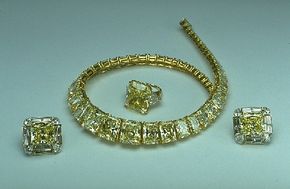
Photo courtesy Smithsonian Institution/Chip Clark
The Hooker Diamond necklace, earrings and ring on display at the National Museum of Natural History

A diamond is just carbon in its most concentrated form. That's it -- carbon, the element that makes up 18 percent of the weight of your body. In many countries, including the United States and Japan, there is no other gemstone as cherished as the diamond, but in truth, diamonds are no rarer than many other precious gems. They continue to demand higher market prices because the majority of the diamond market is controlled by a single entity.

Video Gallery: Expensive Taste
Bruster's diamond-encrusted ice cream cone is a special treat, weighing in at 152.16 carats and retailing for $1 million. The cone was designed by Lazare Kaplan in the likeness of Bruster's cherry vanilla ice cream waffle cone. In this video from MultiVu, see how the creation was designed around diamonds of different shapes and sizes, including a rare 5.63 Fancy Intense Yellow Radiant cut diamond.

In this article, we will track a diamond from the time it is formed to when it reaches the Earth's surface. We will also examine the artificial rarity created by the diamond cartel, De Beers, and briefly discuss the properties of these gems.

Space Diamonds
Diamonds are not exclusive to Earth. Scientists believe that diamonds may one day be found on the moon. Samples of rock brought back from the moon indicate that carbon is 10 times more abundant in the Earth's crust than the moon's, according to the Artemis Project, a group whose goal is to establish a permanent moon community. But this group believes that there may be diamonds under the moon's surface that Apollo astronauts were unable to detect. There is also some scientific evidence that diamonds may be found in larger abundance on Neptune and Uranus. Neptune and Uranus contain a lot of the hydrocarbon gas methane. Researchers at the University of California, Berkeley have shown that focusing a laser beam on pressurized liquid methane can produce diamond dust. Neptune and Uranus contain about 10 percent to 15 percent methane under an outer atmosphere of hydrogen and helium. Scientists think that this methane could possibly turn to diamond at fairly shallow depths.

First, we'll discuss carbon, the element behind the sparkle.
­