But as compelling as these stories might be to believers, they're of limited use to scientists because they occur in an uncontrolled environment. To effectively demonstrate something with hard evidence, scientists need to conduct structured laboratory experiments with closely controlled conditions.
The Zener Cards Experiments
Since the 1930s, scientists around the world have conducted parapsychological research. J.B. Rhine, often dubbed the father of parapsychology, was behind one of the earliest and most famous efforts, the Zener cards experiments.
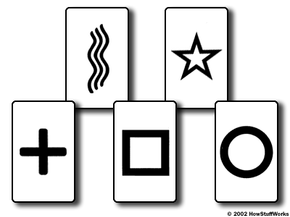
The original Zener cards (named after their designer, Karl Zener) were a deck of 25 plain white cards, each printed with one of five simple, distinct patterns. Each deck contained five cards of each pattern, so anybody had a one-in-five chance of correctly guessing the pattern on any particular card.
The experiment was simple: Rhine would ask his subject to guess the pattern on each card and record the result. On average, random guessing would yield five "hits" (correct guesses) per deck of 25. Rhine reasoned that consistent accuracy above that level, barring any cheating, indicated ESP ability.
The scientific community remained largely incredulous when Rhine claimed in his treatise, "Extra-Sensory Perception," that some of his subjects consistently guessed correctly above chance levels. Many disputed Rhine's methods and his credibility, but in general, others regarded him as a legitimate, sincere scientist.
In the years since Rhine's pioneering work, hundreds of parapsychologists have conducted similar experiments, sometimes with the same positive results. Most of these researchers have moved away from the rigid five symbols of Zener cards to more open-ended images, such as paintings or photographs.
In a typical experiment, a "sender" will concentrate on a particular image (a target) and try to communicate it telepathically to an isolated subject. The "receiver" subject describes what he sees in his mind, and the research team records his impressions. At the end of the session, the receiver attempts to pick the correct target out of a collection of images created from his impressions during the session.
The Ganzfeld Experiments
In ganzfeld (German for "whole field") target experiments, developed in the 1970s, the receiver has no sensory information to make it easier to focus on ESP messages. The subject of a Ganzfeld experiment lies in a room filled with dim red light, listening to white noise, with his or her eyes covered (by halved ping-pong balls in the conventional experiment).
Most of the time, receivers in such procedures do not guess correctly, but some subjects do describe the target images in striking detail. In similar experiments, designed to test clairvoyance alone and not telepathy, there is no sender, only a receiver.
In another popular experiment, subjects attempt to influence a machine, such as a random number generator, with their minds. Over the course of hundreds of runs, researchers have found that subjects do appear to have some influence over machine behavior, though it is very slight.
Intercessory Prayer
Many people categorize forms of religious prayer with ESP and other similar phenomena. The notion of intercessory prayer holds that focusing mental energy in the form of prayer can actually have an effect on reality, whether through a divine force or by virtue of the energy itself.
As it turns out, there is some scientific data supporting this belief. In a number of double-blind experiments, scientists monitored a control group of patients who were not being prayed for and an experimental group of patients who were being prayed for.
The results have been mixed, but some studies do indicate a correlation between prayer and recovery. For more information, see Wired's "A Prayer Before Dying."