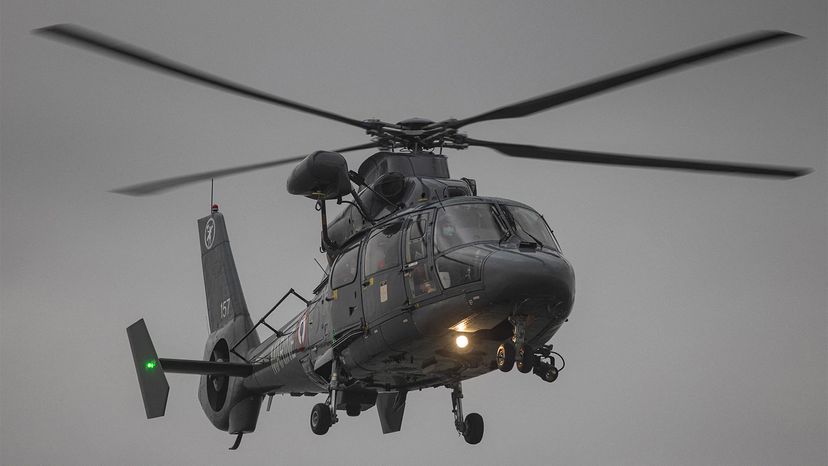
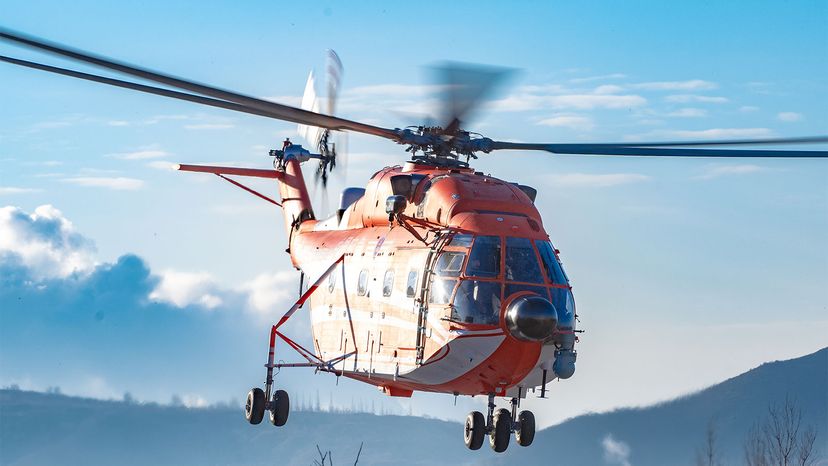
A helicopter stays in the air due to a variety of forces working in opposition to each other. Here, a helicopter lands at the Regional Operational Center for Surveillance and Rescue in Cap Gris-Nez, France, March 16, 2022. SAMEER AL-DOUMY/AFP/Getty Images
Ever since Daedalus fashioned wings of feathers and wax for himself and his son Icarus, humans have yearned to master powered, heavier-than-air flight. In the early 20th century, a few daring inventors turned the dream into reality by designing and building flying machines that actually lived up to their names. Everyone knows the story of the Wright brothers and their famed flight across the dunes of Kitty Hawk, North Carolina, so we won't dwell here on their accomplishments or how airplanes work. Instead, we want to focus on a lesser-known personality — Igor Sikorsky — and his vision of the modern helicopter: an aircraft without wings that achieves vertical flight from the rotation of overhead blades.
One thing that has characterized the helicopter since its invention in the 1930s has been the absurdity of the machine. The contraption simply looks unable to deliver on its promise, which is to fly up and down, backward and forward, right and left. The famous U.S. broadcast journalist Harry Reasoner discussed this apparent paradox in a 1971 commentary he delivered about the use of helicopters in the Vietnam conflict:
Advertisement
An airplane by its nature wants to fly. A helicopter does not want to fly. It is maintained in the air by a variety of forces and controls working in opposition to each other, and if there is any disturbance in this delicate balance, the helicopter stops flying, immediately and disastrously. There is no such thing as a gliding helicopter.
Reasoner laid bare the fundamental reality of helicopters — that the machines have complex designs and that flying them is extraordinarily complicated. The pilot has to think in three dimensions and must use both arms and both legs constantly to keep a helicopter in the air. Piloting a helicopter requires a great deal of training and skill, as well as continuous attention to the machine.
To fully appreciate this complexity, it helps to study the evolution of helicopters through the ages. How exactly did we get from floating, feathered Chinese tops to Black Hawks buzzing in the air?
History of the Helicopter: From Feathers to Hoppers
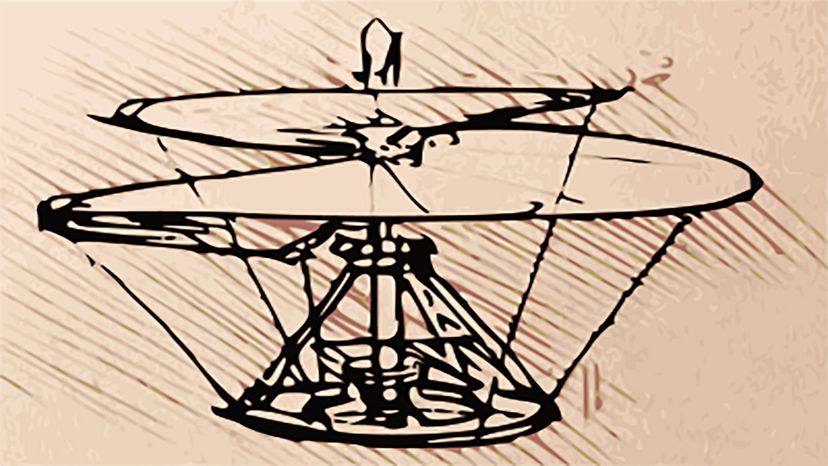
Leonardo da Vinci's 15th-century sketch of an "aerial screw" is seen as the first-ever design of a vertical take-off and landing machine, or basic helicopter. Wikimedia Commons (CC By SA 3.0)
The modern mechanical marvel we know as the helicopter began as a Chinese top consisting of a bamboo shaft — a stick — adorned with feathers on one end. Really. When a person placed the stick between his hands and spun it rapidly, the top would rise vertically into the air. Try it for yourself if you're feeling experimental.
Eventually, a few inventors decided to give the Chinese top a power boost. In 1754, a Russian by the name of Mikhail Lomonosov modeled a small rotor on the design of a Chinese top, then used a windup spring to power the device. (A helicopter rotor, by the way, just refers to a rotating part with airfoils, or blades.) Approximately 30 years later, the French naturalist Christian de Launoy built a similar rotor using turkey feathers mounted to both ends of an axle. A string, wound round the axle and tensioned by a crossbow, generated the power. When the tension was released, the counter-rotating blades generated lift and carried the device vertically.
Advertisement
These early designs were more toy than transport, but some of the greatest minds in the history of science and engineering were working hard to make vertical-lift flight something humans could enjoy as passengers. Leonardo da Vinci created elaborate sketches for several flying machines, including one he dubbed the aerial screw. The contraption consisted of a linen wing wrapped around an axis, or screw. Four pilots aboard the machine would turn the axis using a pumping action. As the screw turned, so da Vinci theorized, the machine would lift from the ground. And perhaps if the design were lighter, it would have. Sir George Cayley came up with another fanciful machine — the aerial carriage — that had two counter-rotating rotors mounted on each side of the craft. He attempted to power the device using a gunpowder-based engine, but the results were far from satisfactory.
Eventually, engines evolved enough to move helicopters from the theoretical to the practical. Thomas Edison, who experimented with several helicopter designs in the early 1900s, demonstrated that both high aerodynamic efficiency of the rotor and serious power from an engine were required for successful vertical flight. Other innovations and design refinements quickly followed. The first generation of engine-powered helicopters emerged between about 1904 and the 1920s, with military interest leading aircraft innovations around World War I. The engineers who built these machines hailed from France, Great Britain, Russia and the Netherlands, and their inventions could make short, tethered flights of just a few seconds. Some of the machines carried pilots, while some were unmanned. Almost all of them were unreliable and difficult to control.
And then along came a man named Igor, who was about to change the fate of these flying machines.
Advertisement
Helicopter History: Along Came Igor
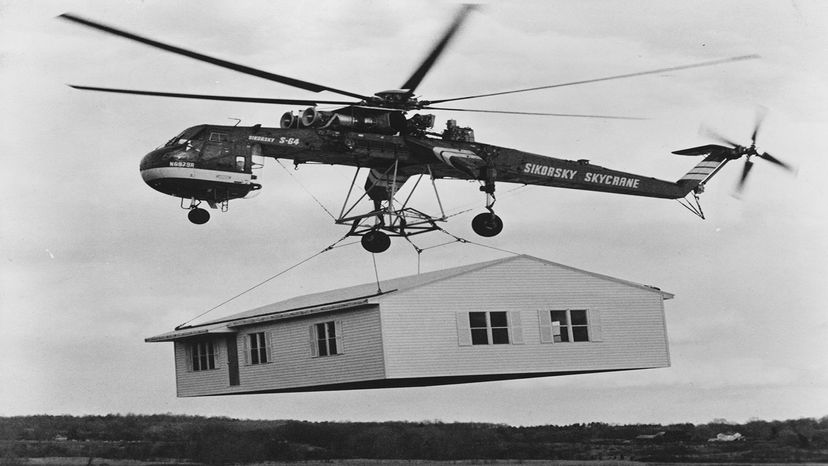
When it comes to helicopters, hoisting complete prefabricated houses, enacting death-defying rescues and generally venturing where no other machines can go is all in a day's work. Here, a Sikorsky Skycrane helicopter lifts a prefab house. Avalon/Getty Images
It was Igor Sikorsky, a Russian-born aeronautical engineer, who developed the first machine with all of the qualities we associate with modern helicopters. Interestingly, Sikorsky's early helicopters — circa 1910 — were failures, and he abandoned his efforts so he could focus on fixed-wing airplanes.
After emigrating to the United States and starting Sikorsky Aviation Corporation in Bridgeport, Connecticut, he once again turned his attention to vertical flight. In 1931, Sikorsky submitted a patent for a modern-looking helicopter design featuring a single main rotor and tail rotor. Eight years later, the first incarnation of this design — the VS-300 — lifted Sikorsky into the air. The VS-300 featured a 75-horsepower Lycoming engine connected to a main rotor with three blades and a two-bladed tail rotor. It also provided mechanisms to control the machine's flight. Two inputs, known as the collective and cyclic-pitch sticks, enabled a pilot to change the orientation of the blades to produce lift and enable lateral movement.
Advertisement
This was the first practical helicopter, but it still needed some refinement so it didn't ride like a bucking bronco. Sikorsky continued to make improvements, and May 1940, the VS-300 broke the world helicopter endurance record by staying aloft for one hour, 32 minutes and 26.1 seconds. Other engineers and innovations quickly followed. Notable among the early helicopter pioneers were Arthur Young, Frank Piasecki and Stanley Hiller. Young, backed by Bell Aircraft Corp., developed the Bell 30 helicopter and then the Bell 47, the first commercially certified helicopter. Piasecki designed the single-seater PV2 in 1943, but became better known for large cargo helicopters powered by two main rotors. And Hiller produced several helicopter models including the UH-12, which saw action in Korea and Vietnam.
Anatomy of a Helicopter: The Blade Are Spinning and the Engine Is Running
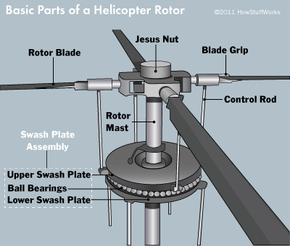
This diagram details the basic parts of a helicopter.
Sikorsky and a few of his contemporaries brought a technical rigor to the field that finally made vertical flight safe, practical and reliable. As the flight-crazy Russian continued to refine his helicopter designs, he worked out the fundamental requirements that any such machine needed to have to be successful, including:
a suitable engine with a high power-to-weight ratio,
a mechanism to counteract rotor torque action,
proper controls so the aircraft could be steered confidently and without catastrophic failures,
a lightweight structural frame, and
a means to reduce vibrations.
Many of the basic parts seen on a modern helicopter grew out of the need to address one or more of these basic requirements. Let's look at these components in greater detail:
Advertisement
Main rotor blade — The main rotor blade performs the same function as an airplane's wings, providing lift as the blades rotate — lift being one of the critical aerodynamic forces that keeps aircraft aloft. A pilot can affect lift by changing the rotor's revolutions per minute (rpm) or its angle of attack, which refers to the angle of the rotary wing in relation to the oncoming wind.
Stabilizer — The stabilizer bar sits above and across the main rotor blade. Its weight and rotation dampen unwanted vibrations in the main rotor, helping to stabilize the craft in all flight conditions. Arthur Young, the gent who designed the Bell 47 helicopter, is credited with inventing the stabilizer bar.
Rotor mast — Also known as the rotor shaft, the mast connects the transmission to the rotor assembly. The mast rotates the upper swash plate and the blades.
Transmission — Just as it does in a motor vehicle, a helicopter's transmission transmits power from the engine to the main and tail rotors. The transmission's main gearbox steps down the speed of the main rotor so it doesn't rotate as rapidly as the engine shaft. A second gearbox does the same for the tail rotor, although the tail rotor, being much smaller, can rotate faster than the main rotor.
Engine — The engine generates power for the aircraft. Early helicopters relied on reciprocating gasoline engines, but modern helicopters use gas turbine engines like those found in commercial airliners.
Stay with us. We'll learn to steer this baby next.
Advertisement
Anatomy of a Helicopter: Working the Controls
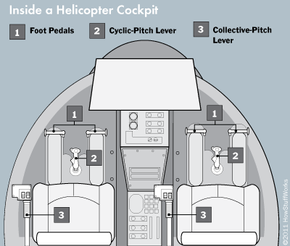
This diagram takes us inside a helicopter cockpit.
Fuselage — The main body of the helicopter is known as the fuselage. In many models, a frameless plastic canopy surrounds the pilot and connects in the rear to a flush-riveted aluminum frame. Aluminum wasn't widely used in aeronautical applications until the early 1920s, but its appearance helped engineers make their helicopters lighter and, as a result, easier to fly.
Cyclic Control — A helicopter pilot controls the pitch, or angle, of the rotor blades with two inputs: the cyclic- and collective-pitch levers, often just shortened to the cyclic and the collective. The cyclic, or "stick," comes out of the floor of the cockpit and sits between the pilot's legs, enabling a person to tilt the craft to either side or forward and backward.
Advertisement
Collective Control — The collective-pitch lever is responsible for up-and-down movements. For example, during takeoff, the pilot uses the collective-pitch lever to increase the pitch of all the rotor blades by the same amount.
Foot pedals — A pair of foot pedals controls the tail rotor. Working the pedals affects which way the helicopter points, so pushing the right pedal deflects the tail of the helicopter to the left and the nose to the right; the left pedal turns the nose to the left.
Tail boom — The tail boom extends out from the rear of the fuselage and holds the tail rotor assemblies. In some models, the tail boom is nothing more than an aluminum frame. In others, it's a hollow carbon-fiber or aluminum tube.
Anti-torque tail rotor — Without a tail rotor, the main rotor of a helicopter simply spins the fuselage in the opposite direction. It's enough to make your stomach heave just thinking about all that endless circling. Thankfully, Igor Sikorsky had the idea to install a tail rotor to counter this torque reaction and provide directional control. In twin-rotor helicopters, the torque produced by the rotation of the front rotor is offset by the torque produced by a counter-rotating rear rotor.
Landing skids — Some helicopters have wheels, but most have skids, which are hollow tubes with no wheels or brakes. A few models have skids with two ground-handling wheels.
The main rotor, of course, is the most important part of a helicopter. It's also one of the most complex in terms of its construction and operation. In the next section, we'll peer at the rotor assembly of a typical helicopter.
A helicopter's main rotor is the most important part of the vehicle. It provides the lift that allows the helicopter to fly, as well as the control that allows the helicopter to move laterally, make turns and change altitude. To handle all of these tasks, the rotor must first be incredibly strong. It must also be able to adjust the angle of the rotor blades with each revolution they make. The pilot communicates these adjustments through a device known as the swash plate assembly.
The swash plate assembly consists of two parts — the upper and lower swash plates. The upper swash plate connects to the mast, or rotor shaft, through special linkages. As the engine turns the rotor shaft, it also turns the upper swash plate and the rotor blade system. This system includes blade grips, which connect the blades to a hub. Control rods from the upper swash plate have a connection point on the blades, making it possible to transfer movements of the upper swash plate to the blades. And the hub mounts to the mast via the Jesus nut, so named because its failure is said to bring a pilot face-to-face with Jesus.
Advertisement
The lower swash plate is fixed and doesn't rotate. Ball bearings lie between the upper and lower swash plates, allowing the upper plate to spin freely on top of the lower plate. Control rods attached to the lower swash plate connect to the cyclic- and collective-pitch levers. When the pilot operates either of those two levers, his or her inputs are transmitted, via the control rods, to the lower swash plate and then, ultimately, to the upper swash plate.
Using this rotor design, a pilot can manipulate the swash plate assembly and control the helicopter's motion. With the cyclic, the swash plate assembly can change the angle of the blades individually as they revolve. This allows the helicopter to move in any direction around a 360-degree circle, including forward, backward, left and right. The collective allows the swash plate assembly to change the angle of all blades simultaneously. Doing this increases or decreases the lift that the main rotor supplies to the vehicle, allowing the helicopter to gain or lose altitude.
Now it's time to see how all these parts work together to get the helicopter airborne.
Advertisement
How Helicopters Fly
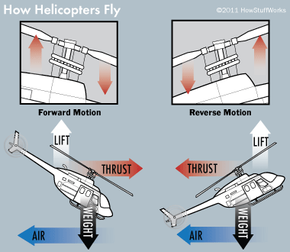
This diagram depicts some of the forces involved in helicopter flight.
Imagine that we would like to create a machine that can simply fly straight upward. Let's not even worry about getting back down for the moment — up is all that matters. If you are going to provide the upward force with a wing, then the wing has to be in motion in order to create lift. Wings create lift by deflecting air downward and benefiting from the equal and opposite reaction that results (see How Airplanes Work for details — the article contains a complete explanation of how wings produce lift).
A rotary motion is the easiest way to keep a wing continuously moving. You can mount two or more wings on a central shaft and spin the shaft, much like the blades on a ceiling fan. The rotating wings of a helicopter function just like the airfoils of an airplane wing, but generally helicopter airfoils are symmetrical, not asymmetrical as they are on fixed-wing aircraft. The helicopter's rotating wing assembly is normally called the main rotor. If you give the main rotor wings a slight angle of attack on the shaft and spin the shaft, the wings start to develop lift.
Advertisement
In order to spin the shaft with enough force to lift a human being and the vehicle, you need an engine, typically a gas turbine engine these days. The engine's driveshaft can connect through a transmission to the main rotor shaft. This arrangement works really well until the moment the vehicle leaves the ground. At that moment, there is nothing to keep the engine (and therefore the body of the vehicle) from spinning just as the main rotor does. In the absence of anything to stop it, the body of the helicopter will spin in an opposite direction to the main rotor. To keep the body from spinning, you need to apply a force to it.
Enter the tail rotor. The tail rotor produces thrust like an airplane's propeller does. By producing thrust in a sideways direction, this critical part counteracts the engine's desire to spin the body. Normally, the tail rotor is driven by a long driveshaft that runs from the main rotor's transmission back through the tail boom to a small transmission at the tail rotor.
In order to actually control the machine and, say, guide it into a canyon to complete the ultimate rescue, both the main rotor and the tail rotor need to be adjustable. The next three sections explain how a pilot guides the helicopter into taking off, hovering or buzzing off in a particular direction.
Advertisement
Flying a Helicopter: Taking Off
A Z-8 helicopter takes off above the 2022 Beijing Winter Olympics venues during a rehearsal of patrol and rescue missions. Yue Shuhua/VCG/Getty Images
The ability of helicopters to move laterally in any direction or rotate 360 degrees makes them exciting to fly, but piloting one of these machines requires great skill and dexterity. To control a helicopter, the pilot grips the cyclic in one hand, the collective in the other. At the same time, his feet must operate the foot pedals that control the tail rotor, which allows the helicopter to rotate in either direction on its horizontal axis. It takes both hands and both feet to fly a helicopter!
During takeoff, the pilot works the collective and the foot pedals simultaneously. Before we discuss how to take off, you should know that the collective typically looks like a handbrake whose grip functions as the throttle. Twisting the grip controls the power output of the engine, increasing or decreasing the speed of the main rotor. With that in mind, we're ready to begin a typical helicopter takeoff:
Advertisement
First, the pilot opens the throttle completely to increase the speed of the rotor.
Next, he or she pulls up slowly on the collective. The collective control raises the entire swash plate assembly as a unit. This has the effect of changing the pitch of all rotor blades by the same amount simultaneously.
As the pilot increases collective pitch, he or she depresses the left foot pedal to counteract the torque produced by the main rotor.
The pilot keeps pulling up slowly on the collective while depressing the left foot pedal.
When the amount of lift being produced by the rotor exceeds the weight of the helicopter, the aircraft will get light on its skids and slowly leave the ground.
At this point, the pilot feels the cyclic become sensitive. He or she grips the cyclic and, in most cases, nudges the helicopter forward. Directional flight is the topic of the next section.
Military Helicopters
Military helicopters have the same basic parts as other choppers, but they do have some features that set them apart. The most common use of military helicopters is troop or cargo transport. Attack helicopters also play important roles in combat operations. One of the most famous military helicopters was the UH-1, manufactured by Bell Helicopter in the 1960s. Its official nickname was Iroquois, but it was commonly known as "Huey" based on the Army's original HU-1 designation. Hueys gained their fame in Vietnam serving in a medevac role. They could be outfitted with sophisticated weapons, however. Hueys equipped with machine guns were known as Cobras. When they carried rocket pods, they were dubbed Hogs.
Advertisement
Flying a Helicopter: Directional Flight
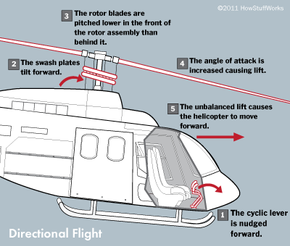
This diagram shows the steps involved in directional flight for a helicopter.
In addition to moving up and down, helicopters can fly forward, backward and sideways. This kind of directional flight is achieved by tilting the swash plate assembly with the cyclic, which alters the pitch of each blade as it rotates. As a result, every blade produces maximum lift at a particular point. The rotor still generates lift, but it also creates thrust in the direction that the swash plate assembly is tilted. This causes the helicopter to lean — and fly — in a certain direction. The pilot can impart additional directional control by depressing or easing up on the foot pedals, which increases or decreases the counteracting thrust of the tail rotor.
Let's assume for a moment that the helicopter we discussed in the last section needs to fly forward. This is the pilot's procedure:
Advertisement
First, he or she nudges the cyclic lever forward.
That input is transmitted to the lower swash plate and then to the upper swash plate.
The swash plates tilt forward at an amount equal to the input.
The rotor blades are pitched lower in the front of the rotor assembly than behind it.
This increases the angle of attack — and creates lift — at the back of the helicopter.
The unbalanced lift causes the helicopter to tip forward and move in that direction.
When the aircraft reaches about 15 to 20 knots of forward airspeed, it begins to transition from hovering flight to full forward flight. At this point, known as effective translational lift, or ETL, the pilot eases up on the left foot pedal and moves closer to a neutral setting. He or she also feels a shudder in the rotor system as the helicopter begins to fly out of rotor wash (the turbulence created by a helicopter's rotor) and into clean air. In response, the rotor will try to lift up and slow the aircraft automatically. To compensate, the pilot will continue to push the cyclic forward to keep the helicopter flying in that direction with increasing airspeed.
A helicopter that is flying forward can stop in midair and begin hovering very quickly. We'll cover this signature maneuver next.
Advertisement
Flying a Helicopter: Hovering
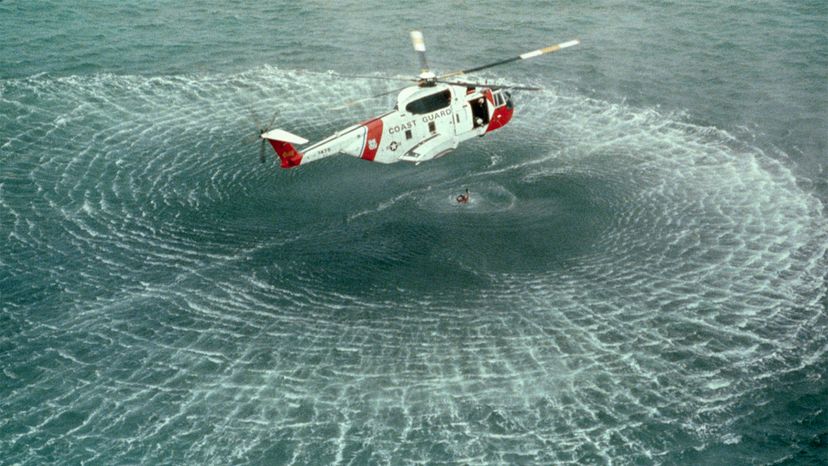
The ability to hover is critical to the daring maneuvers helicopters must perform. Here, a brave crewperson dangles from a U.S. Coast Guard rescue helicopter. Corbis/Getty Images
The defining characteristic of a helicopter is its ability to hover at any point during a flight. To achieve hovering, a pilot must maintain the aircraft in nearly motionless flight over a reference point at a constant altitude and on a heading (the direction that the front of the helicopter is pointing). This may sound easy, but it requires tremendous experience and skill.
Before we tackle the technique of hovering, let's take a moment to discuss nap-of-the-earth (NOE) flight, another unique characteristic of helicopters. NOE flight describes a helicopter located just above the ground or any obstacles on the ground. Military pilots perfected the technique during Vietnam as a means to become more elusive to ground-based weapons. In fact, film footage from the era often shows helicopters rapidly skimming the Earth's surface, machine-gunners firing from open rear doors or hovering with their skids just a few feet off the ground as troops disembark at a target location.
Advertisement
Of course, any helicopter taking off or landing must undertake NOE flight, if only for a few moments. It's a particularly critical time for a helicopter because a wild attitude adjustment could tip the craft too far and bring the rotor blades in contact with an obstacle. Attitude, for our purposes, refers to the helicopter's orientation in relation to the helicopter's direction of motion. You'll also hear flight-minded folks talk about attitude in reference to an axis, such as the horizon.
With that said, here's the basic technique to bring a helicopter into a hovering position:
First, the pilot must cease any directional flying. For example, if flying the helicopter forward, the pilot must ease back on the cyclic until the helicopter's forward motion stops and the aircraft remains motionless over a point on the ground.
Next, it's important that the pilot can detect small changes in the aircraft's altitude or attitude. He or she accomplishes this by locating a fixed point outside the cockpit and tracking how the helicopter moves relative to that point.
Finally, the pilot adjusts the collective to maintain a fixed altitude and adjusts the foot pedals to maintain the direction that the helicopter is pointing.
To maintain a stabilized hover, the pilot must make small, smooth, coordinated corrections on all of the controls. In fact, one of the most common errors of novice pilots is to overcompensate while trying to hover. For example, if the helicopter begins to move rearward, the pilot must be careful not to apply too much forward pressure on the cyclic because the aircraft will not just come to a stop but will start drifting forward.
Over the years, innovations in helicopter design have made the machines safer, more reliable and easier to control. Next, we'll look at a few of these innovations to provide a glimpse of how far helicopters have come and where they might go in the future.
Advertisement
Helicopter Innovations
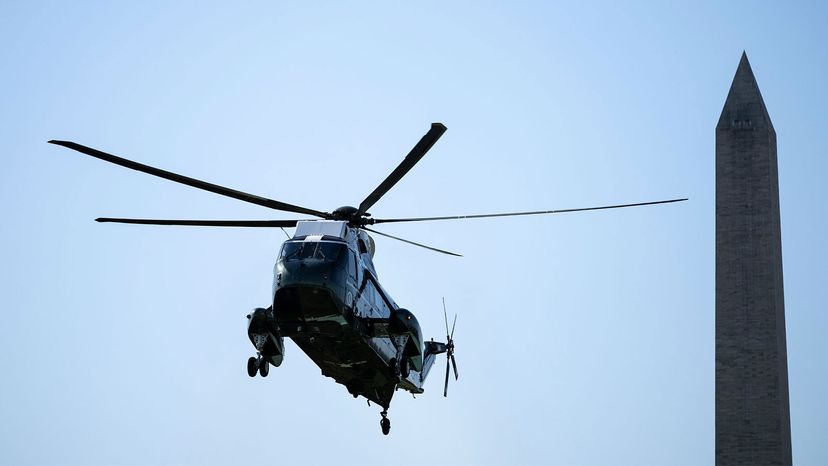
Marine One, with U.S. President Joe Biden onboard, prepares to land on the South Lawn of the White House April 11, 2022 in Washington, D.C. Drew Angerer/Getty Images
The modern helicopter, like any complex machine, is an accumulation of innovations from numerous inventors and engineers. Some of these modifications improve performance significantly without changing the overall appearance of the aircraft. For example, Arthur Young's stabilizer bar looks small and insignificant when compared to the gross anatomy of a chopper, but it revolutionized vertical-lift flight. Other innovations are less subtle and seem to give the helicopter a complete makeover. Let's check out a few changes.
One significant advancement has been the no-tail rotor, or NOTAR, helicopter. As you now know, vertical-lift flight is impossible without a tail rotor to counteract the torque produced by the main rotor. Unfortunately, the much-smaller tail rotor makes a lot of noise and is often easily damaged. The NOTAR helicopter solves both of these problems. Here's how it works: A large fan at the rear of the fuselage blows spent air from the main rotor down the tail boom. Slots along the side of the tail boom and at the end of the boom allow this air to escape. This creates a sideways force that counteracts the main rotor's torque. Varying the amount of air expelled from the rear slot provides additional directional control.
Some helicopters started receiving a second engine, which can operate the main rotor if the main engine fails. For example, the UH-60 Black Hawk helicopter, the workhorse of the U.S. Army, features this design improvement. Either engine can keep the aircraft aloft on its own, enabling the pilot to land safely in the event of an emergency.
Scientists have also fiddled with the main rotor assembly in an attempt to simplify one of the most complex parts of a helicopter. In the late 1990s, researchers developed a solid-state adaptive rotor system incorporating piezoelectric sheets. A piezoelectric material is one in which its molecules bend and twist in response to an electric field. In a rotor assembly, piezoelectric sheets — not mechanical linkages — twist sections of the blade root, thereby changing the pitch of the blades as they rotate. This eliminates parts in the rotor hub and decreases the chance of a mechanical failure.
Smaller unmanned quadcopters, commonly known as drones, have also seen a surge in popularity. Instead of the typical two-rotor design, quadcopters use four or more electric rotors of equal size, providing both thrust and stability. Operation of the aircraft is done via remote control on the ground, and some advanced systems will also have a degree of automated control. Thanks to their compact size, drones can be flown more cheaply and safely than full-size aircraft, especially in tight spaces. Quadcopters have seen extensive use in surveillance, search and rescue, as well as cinema. Chances are, a movie you've seen this year has had at least one aerial shot capture via drone.
Finally, it's worth mentioning those strange machines, known as tiltrotors, that bring together the best features of helicopters and airplanes. A tiltrotor aircraft takes off like a helicopter, with its two main rotors upright. But when it's airborne, the pilot can tip the rotors forward 90 degrees, enabling the machine to fly like a conventional turboprop airplane. The V-22 Osprey operates in this fashion. Winged aircraft which can hover and take off similarly to a helicopter are collectively known as Vertical Takeoff and Landing (VTOL) aircraft.
None of these innovations has made helicopters less absurd-looking. Some, like the tiltrotor, only increase the aircraft's awkward visual appearance. All of which brings us back to Harry Reasoner's 1971 commentary about helicopters:
Mark Twain once noted that he lost belief in conventional pictures of angels of his boyhood when a scientist calculated for a 150-pound man to fly like a bird, he would have to have a breast bone 15 feet wide supporting wings in proportion. Well, that's sort of the way a helicopter looks.
Mr. Reasoner may be right, but a helicopter's peculiar design and configuration haven't diminished its impact. It's become one of the most versatile and widely used aircraft in the world today.
British Heritage Travel. "Sir George Cayley, the Father of Aviation." Feb. 23, 2022. (March 29, 2022) https://britishheritage.com/history/sir-george-cayley-aviation
Heli Archive. “Hiller UH-12B” (March 28, 2022)
https://www.heli-archive.ch/en/helicopters/in-depth-articles/hiller-uh-12b
Helimer. “Helicopter Pilots are Different” (March 29, 2022)
http://www.helimer.es/content/helicopter-pilots-are-different
Joiner, Stephen. “Birth of the Cobra” Smithsonian. (March 28, 2022)
https://www.smithsonianmag.com/air-space-magazine/13_aug2017-birth-of-the-cobra-180963930/
Klimek, Chris. “More Than Just a Helicopter, the ‘Huey’ Became a Symbol of the Vietnam War” Smithsonian. (March 28, 2022)
https://www.smithsonianmag.com/air-space-magazine/bell-uh-1h-iroquois-180976722/
Leishman, J. Gordon. "A History of Helicopter Flight." University of Maryland via Aviators Database. 2000. (March 28, 2022) https://www.aviatorsdatabase.com/wp-content/uploads/2013/07/A-History-of-Helicopter-Flight-.pdf
Lemos, Robert. "The Helicopter: A Hundred Years of Hovering." Wired. Nov. 12, 2007. (Oct. 12, 2011) http://www.wired.com/science/discoveries/multimedia/2007/11/gallery_helicopter?currentPage=1&slideView=7
Mendelovich, Yossy. “Ambulance FPV Drone Featurette With the Komodo Bayhem” Y.M. Cinema (March 29, 2022) https://ymcinema.com/2022/03/28/ambulance-fpv-drone-featurette-with-the-komodo-bayhem
NASA. “Simulation of Nap-of-the-Earth Flight in Helicopters” (March 29, 2022)
https://ntrs.nasa.gov/api/citations/19910011818/downloads/19910011818.pdf
NASA. “Tiltrotor Aeroacoustic Model Summary” (March 29, 2022)
https://rotorcraft.arc.nasa.gov/Research/Programs/tramprogram.html
Shiltsev, Vladimir. “Mikhail Lomonosov and the Dawn of Russian Science” Physics Today. (March 28, 2022) https://physicstoday.scitation.org/doi/10.1063/PT.3.1438
Skydio. “Autonomous Drones for Defense” (March 29, 2022)
https://www.skydio.com/defense?
Smithsonian. “Bell Model 30” (March 29, 2022)
https://airandspace.si.edu/collection-objects/bell-model-30-ship-1a-genevieve/nasm_A19650240000
Technology.org. “This is a Jesus Nut” (March 29, 2022)
https://www.technology.org/2018/03/27/this-is-a-jesus-nut-what-kind-of-part-is-that-why-does-it-have-such-a-bizarre-name/
Tzianetopoulou, Theodora “Design of an Improved Piezoelectric Actuator for Helicopter Rotor Control” MIT. (March 29, 2022) https://dspace.mit.edu/bitstream/handle/1721.1/82197/49674217-MIT.pdf?sequence=2&isAllowed=y
U.S. Patent Office. “A.M. Young Helicopter Aircraft, 1943.” (March 28, 2022)
https://pdfpiw.uspto.gov/.piw?docid=02368698&SectionNum=2&IDKey=924A41633A84&HomeUrl=http://patft.uspto.gov/netahtml/PTO/patimg.htm
Wright, Michael and Mukul Patel. "Helicopters." How Things Work Today. Crown Publishers. 2000.
Cite This!
Please copy/paste the following text to properly cite this HowStuffWorks.com article: