How will landing on Mars work?

­The last time man set foot on the moon was nearly 40 years ago, and plans are in the works for a reunion tour of sorts. A big part of this focus will be setting up shop on the moon and using those efforts to prepare for robotic and manned expeditions to Mars. Just returning to the moon's surface (scheduled to take place no later than 2020) is a large undertaking; but the planning and sheer ingenuity required to send humans to another planet is -- to put it simply -- astronomical.

Mars Image Gallery

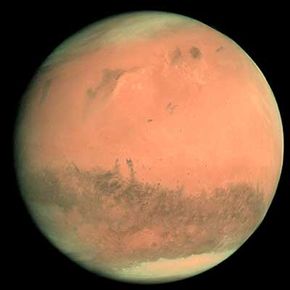
The planet Mars
European Space Agency/Getty Images
Rosetta, the European Space Agency's comet chaser, cruised by Mars and photographed the planet in 2007.
See more Mars pictures.


To help attempt such a feat­, scientists and engineers must solve hundreds of questions and issues. Researchers are formulating answers about the surface of Mars based on the observations made by their circling satellites and roving robots

Quiz Corner
Think you know all there is to know about the red planet? Test your knowledge with our Mars Quiz.

­Let's do a quick refresher on the Red Planet. ­Mars is the fourth planet from the sun and is about the same age as Earth, roughly 4.6 billion years old. Mars has a r­adius of about 2,107 miles (3,390 kilometers), which is about half the size of our planet. On the whole it's much chillier (though summers can get warmer). Don't think about running around the surface of Mars without your space suit just yet though. If the atmosphere's low pressure doesn't kill you, the carbon dioxide that makes up 95 percent of it will. The Martian atmosphere contains only 0.13 percent oxygen versus Earth's 21 percent. Mars lacks a strong magnetic field, though scientists suspect a stronger magnetic field (a byproduct of a hot, fiery core) existed at one time. Large dust storms frequently occur on Mars, and two, small moons named Phobos and Deimos orbit the planet [source: NASA].

­So what do gymnasts and Mars-bound astronauts have in common? Besides wearing quirky uniforms, both must stick their landings in order to succeed. This article will specifically focus on one aspect of a manned mission to Mars -- the landing. Let's read about some of the challenges researchers must overcome in order to safely arrive on Mars.

Challenges of a Mars Landing

The challenges of a Mars landing are numerous, although researchers are planning and working hard to figure out exactly how we'll pull it off. Assuming people are able to arrive in the vicinity of Mars, there are a few elements to consider when it comes to landing. Scientists and engineers are already throwing around different processes and design ideas. Considerations are being given to the shape of the vehicle, the type of fuel it will use, the location of its engines and the size of its payload. Another question is whether propulsive maneuvers, performed in the form of short thruster burns, will be accompanied by parachutes during landing. There is also the issue of how best to accommodate astronauts during interplanetary missions ... the list goes on.

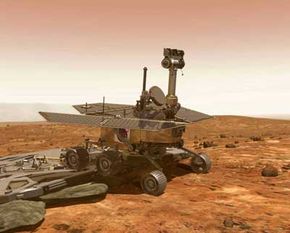
Mars Exploration Rover
Image courtesy NASA/JPL
An artist's rendering of one of the two Mars Exploration Rovers, Spirit and Opportunity. Both were easier to land than human-accessible landing vehicles because they're
so lightweight.


One of the main issues with landing humans on Mars is figuring out how to slow down so the vehicle landing doesn't smash into the ground. The problem is Mars' thin atmosphere. This issue doesn't affect the Mars rovers' landings because those machines are lightweight. If humans land on Mars, they'll need to bring quite a bit of luggage and, without a dense atmosphere to provide friction, it'll be very difficult to slow this heavier payload.

The way friction helps slow moving objects can be seen in your everyday life. For example, think of a time when you saw a driver slam on his brakes to come to a stop quickly. Also, airplanes -- much like spacecraft -- use the air's friction to decrease speeds and land safely.

The landing situation is further complicated by other factors affecting the density of Mars' atmosphere. The season, weather, latitude and even the time of day can change the atmosphere's density. For example, almost 8 million metric tons of carbon dioxide leaves and re-enters Mars' atmosphere seasonally. That's comparable to nine inches (23 centimeters) of dry ice (solid carbon dioxide) [source: Encyclopaedia Brittanica]. Researchers are working on modeling Mars' atmospheric changes so the astronauts can land within a sufficiently dense portion that still provides enough visibility. Planners are considering whether the arriving spacecraft should immediately proceed to the surface (possibly easier from an operational standpoint), or park in orbit before landing. Parking in orbit gives the astronauts more flexibility in case a dust storm strikes, similar to when airplanes circle the airport in bad weather.

Now that we've had a look at some of the challenges that mission planners face, let's look at some of the possible solutions that are being tossed around on the next page.

Prospective Mission Plan to Mars

Landing on Mars isn't going to be a walk in the park, but it also might not be as tricky as first thought. Although ideas are still being hammered out, here are some details of what a prospective mission plan to Mars could entail.

Planners must decide if the landing should be done in stages, by sending payloads down separately, or all at once. Landing a large mass could probably be achieved, but astronauts might be restricted to landing on portions of the planet with low elevations, and they might be able to carry only a small amount of supplies for a short visit of limited scope.

One idea put forth by aerospace expert Robert Zubrin in his book, "The Case for Mars" involves sending a cargo-carrying spacecraft prior to the habitat spacecraft that contains the human crew. This cargo vehicle could provide enough supplies to increase the length of the astronauts' stay and already be fueled and ready for the return trip (discussed below). The astronauts can leave the habitat spacecraft they originally arrived in behind, in order to begin the development of an infrastructure on Mars.

The key to Zubrin's plan is that the fuel for the return voyage is manufactured on Mars. The atmosphere of Mars (unlike the moon's) has an abundance of carbon dioxide that may come in handy to future astronauts. For example, by mixing about six metric tons of hydrogen (a surplus of hydrogen could be taken aboard for this reason) with carbon dioxide, a chemical processor could create enough methane and oxygen to propel the vehicle during liftoff and the trip back to Earth. From these same basic building blocks, the processor could also generate the oxygen, water and fuel our astronauts would require during an extended stay on Mars, as well as the flight home, saving outbound cargo space.

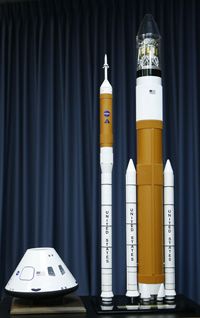
spacecraft models
Matt Stroshane/Getty Images
These models of the Orion crew exploration vehicle (left) and Ares I and Ares V (right) represent the spacecraft that'll soon travel to the moon. These spacecraft, or similar ones, could later be heading to Mars.

Planners are also studying whether to leave a portion of the spacecraft in orbit, or bring it all down to the surface. But knowing the spacecraft (what remains of the original that blasted off from Earth) is able to land on Mars is an important factor in the mission plan's design. That remaining portion is sometimes referred to as the Earth return vehicle (ERV), and it's what astronauts would use to eventually travel back to Earth. Being able to land the entire ERV -- as opposed to just a lander -- could allow for longer visits and avoid complications related to complex orbital maneuvers [source: Zubrin]. But these sorts of technical decisions are still being debated.

It looks like we're ready to descend to the surface, so let's take a closer look at what we're riding in. Currently, a spacecraft heading toward Mars is slated to resemble the old Apollo program -- along the lines of the new Constellation program, which is planned to take humans back to the moon.

The ERV (or whatever portion of the spacecraft will be landing) will likely end up looking a bit like a gumdrop. A large, dish-shaped aeroshell (or heat shield) will help increase the amount of friction created when the craft cuts into the atmosphere, thus slowing it down [source: Zubrin].

A likely scenario is that after the craft makes an initial pass through the atmosphere to reduce its speed, it returns to an orbital position. At the selected time, the aeroshell is again employed -- possibly with a parachute -- to make the final pass through the atmosphere toward Mars' surface. Small thrusters can then be fired to ensure a smooth landing. To learn more about landing maneuvers, read How Space Shuttles Work.

­Now that we've examined some of the unknown aspects surrounding a Mars landing, let's discuss the other questions about the mission.

The Details of Landing on Mars

Manned missions are still a long way off as many of the details of landing on Mars must be addressed. The U.S. plan is to return to the moon by 2020 and eventually build a permanent base there. Estimates on when we'll take that next step and journey to Mars are tentative. According to the British National Space Centre, the goal is for an international cooperative effort to launch astronauts to Mars by 2030.

The price tag for sending humans to Mars will vary greatly depending on the final spacecraft and mission plan design. Utilizing technology similar to what's already been developed helps keep costs more manageable. For example, the Constellation rockets are based on the Saturn Vs, making use of some design elements of the Space Shuttle program. Another money-saver that might be employed is making use of the Martian atmosphere to generate fuel, oxygen and water (like we read about on the previous page).

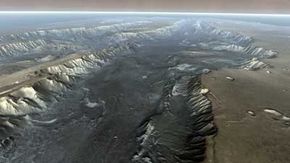
Valles Marineris
Stocktrek Images/Subjects/Getty Images
The vast Valles Marineris is a giant system of canyons on Mars and one of the many surface features scientists want to study first-hand.


There is the possibility that preliminary voyages could send people into Mars' orbit without actually setting down on the surface, although many in the field argue it's pointless to explore if you're not going to get up close and personal with the surface of the planet. It's like driving to the beach and spending the whole afternoon watching the ocean from your car. This could, however, help fix some of the kinks of long-distance space travel and enable explorers to receive real-time reports from robots on the surface of the planet, without the risk and cost of a landing. Robotic vehicles that can return from Mars with samples are also in the works.

Preventing Contamination
Another consideration of landing on Mars is the possibility of cross-contamination between that planet and Earth. The United Nations Office for Outer Space Affairs (UNOOSA) has a treaty to this effect, which has been ratified by 98 countries and 27 more signing on. The treaty states that nations should, as much as possible, avoid contaminating the Earth with extraterrestrial material, especially if such contamination would cause lasting damage or alteration of conditions on Earth. We must reciprocate this sentiment with our own impact on other celestial bodies. Critics argue both ways: Some say cross-contamination could be harmful; others say the chance of Martian life causing trouble on Earth is a complete nonissue. A more moderate argument is that, while highly unlikely, there is a chance Mar­tian microbes could have a harmful impact on Earth, by competing with existing organisms for example.
­


Alas, once the dust has settled around the landed spacecraft and astronauts can take those first incredible steps onto Mars' surface, they also open a whole new can of worms for scientists to solve -- mainly, how will the astronauts survive the harsh and uncompromising Martian climate, and how will they spend their time while they're there? We'll save those questions for another day.

For more information about Mars and the future of space exploration, visit the links on the next page. ­

Lots More Information

Rel­ated HowStuffWorks Articles


More Great Links

Sources

  • Aldridge, E.C. et al. "A Journey to Inspire, Innovate, and Discover." Report of the President's Commission on Implementation of United States Space Exploration Policy. 6/2004. (5/13/2008)
    http://govinfo.library.unt.edu/moontomars/docs/M2MReportScreenFinal.pdf
  • Bell, Jim. "Space For Both? Human vs. Robotic Space Missions." Scientific American Science Talk Podcast. 7/18/2007. (5/13/2008)
    http://www.sciam.com/podcast/episode.cfm?id=D9A7341D-E7F2-
    99DF-3D14CB5FAD1A7A66
  • British National Space Centre. "Aurora: Exploring the Moon, Mars and beyond." (5/13/2008)
    http://www.bnsc.gov.uk/content.aspx?nid=5616
  • Christian, John et al. "Sizing of an Entry, Decent, and Landing System for Human Mars Exploration." Space 2006 Proceedings. 2006. (5/13/2008)
  • Connolly, John. "Constellation Program Overview." Constellation Program Overview. 10/2006. (5/13/2008)
    http://www.nasa.gov/pdf/163092main_constellation_program_overview.pdf
  • "Constellation: NASA's New Space Craft: Ares and Orion." (7/7/2008)
    http://www.nasa.gov/mission_pages/constellation/ares/index.html
  • "Constellation Program: America's Spacecraft for a New Generation of Explorers." (7/7/2008)
    http://www.nasa.gov/pdf/166914main_FS_Orion508c.pdf
  • Landis, Geoffrey. "Teleoperation from Mars orbit: A proposal for human exploration." Acta Astronautica. 1/2008. (5/13/2008)
  • "Mars: Extreme Planet." NASA's Jet Propulsion Laboratory. 3/22/2006. (5/13/2008)
    http://marsprogram.jpl.nasa.gov/facts/
  • "Mars (planet)." Encyclopaedia Brittanica. (5/22/2008)
    http://www.britannica.com/EBchecked/topic/366330/Mars
  • "Mars Sample Return: The Next Step In Exploring the Red Planet." Mars Daily. 7/3/2008.
    http://www.marsdaily.com/reports/Mars_Sample_Return_The_Next_Step_In_
    Exploring_The_Red_Planet_999.html
  • McCulloch, Marie. "Human life on Mars?" FirstScience.com. 8/7/2007. (5/13/2008)
    http://www.firstscience.com/home/articles/space/human-life-on-mars_
    34740.html
  • Moomaw, Bruce. "Mars Invades Earth." Terra Daily. 6/4/2001. (7/7/2008)
    http://www.spacedaily.com/news/life-01p1.html
  • Squyres, Steven W. "Mars." World Book Online Reference Center. 2004. (5/13/2008)
    http://www.worldbookonline.com/wb/Article?id=ar346000
  • United Nations Office for Outer Space Affairs. "Treaty on Principles Governing the Activities of States in the Exploration and Use of Outer Space, including the Moon and Other Celestial Bodies." 1/2008. (5/13/2008)
    http://www.unoosa.org/oosa/SpaceLaw/outerspt.html
  • Wells, Grant et al. "Entry, Descent, and Landing Challenges of Human Mars Exploration." American Astronautical Society. 2/2006. (5/13/2008)
    http://smartech.gatech.edu/bitstream/1853/14772/1/AAS_20GN%26C_
    2006-072.pdf
  • York, Stephen. "Engine Placement for Manned Descent at Mars Considering Single Engine Failures." Massachusetts Institute of Technology. 8/25/2006. (3/13/2008)
    http://dspace.mit.edu/handle/1721.1/37949
  • ­­Zubrin, Robert. "The Case for Mars." Touchstone. 1996. (7/7/2008)