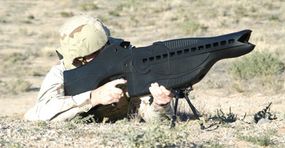
Could this young man use his laser gun to stun an opponent?
Lambert/Hulton Archive/Getty Images
You may have seen them in "Star Wars," "Star Trek," and other science fiction films and shows. The X-wing fighters, the Death Star, the Millennium Falcon, and the Enterprise used laser weapons in great fictional battles to conquer and/or defend the universe. And starships aren't the only ones packing laser heat. Han Solo carried the blaster, a laser weapon, in "Star Wars", while Captain Kirk used a phaser in "Star Trek". All of these weapons used directed energy, in the form of a laser beam, to disable or kill an opponent.
But what are the advantages of using a laser as a weapon? Is it even possible? Could you use such a weapon to stun an opponent? These questions are being addressed by the Air Force Research Laboratory's Directed Energy Directorate. This program is developing high-energy lasers, microwave technologies and other futuristic weapons systems.
Advertisement
By tapping into concentrated electromagnetic energy, laser weapons can heat, disrupt, or burn targets. But how does that high energy laser get used? Read on for a variety of lethal and non-lethal applications.
Lasers and other directed-energy weapons have many advantages over traditional kinetic weapons that use projectiles like bullets and missiles:
The weapons' light outputs can travel at the velocity of light.
High energy laser weapons can be precisely targeted.
The output of laser weapon systems can be controlled -- high-power for lethal outcomes or cutting and low-power for nonlethal outcomes.
The Air Force has already developed three weapons systems that we can discuss. These systems include the Airborne Laser (Advanced Tactical Laser), the PHaSR and the Active Denial System. Let's learn more about these laser systems.
Advertisement
The Difference Between Light and Laser Weapons
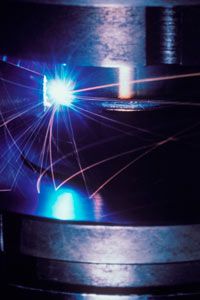
This industrial cutter uses lasers to get the job done.
Dick Luria/Photodisc/Getty Images
At its most basic, a laser is a light source. To understand how it can become a weapon, consider an ordinary incandescent light bulb. The bulb sends light waves out in every direction. These waves, just like waves in water, have peaks and troughs, or high points and low points. There are also lots of frequencies, or colors, of light coming from a light bulb, and they all combine to create what looks like white light.
Now, think of a flashlight. A flashlight's beam is more focused than what comes from a naked light bulb. Most of its light travels in one direction, depending on where you point the flashlight. There are still lots of frequencies of light that combine to create white light, and the peaks and troughs of the different light waves pass by at different times.
Advertisement
A laser is even more focused than a flashlight. It creates only one wavelength, or color, of light. The peaks and troughs from the light waves are also synchronized peak to peak and trough to trough. This means that the different waves don't interfere with each other. This light travels only in one direction.
The light beam can be tightly focused and remain so over great distances. Lasers can produce light of tremendous powers (1,000 to 1 million times stronger than a typical light bulb). Various types of lasers can produce various wavelengths of light, from the infrared range through the visible wavelengths to the ultraviolet range.
Advertisement
Basic Components of a Laser System
Light is basically moving energy. A laser produces very intense energy that can travel over very long distances. That's why a laser system can become a weapon while the light from an incandescent bulb typically can't.
To do this, a laser has to produce light in a nonconventional way. "Laser" stands for light amplification by stimulated emission of radiation. In other words, a laser produces light by stimulating the release of photons, or light particles. A laser needs four basic parts to do this:
Advertisement
Lasing medium: a source of atoms that get excited and emit light of a specific wavelength. The medium can be a gas, liquid or solid.
Energy source: primes or pumps the atoms in the lasing medium to an excited state
Mirrors: a full mirror and a half-silvered mirror. The mirrors allow the emitted light to bounce back and forth within the lasing medium cavity and ultimately to escape to the outside
Lens: most lasers have some type of lens to focus the beam.
The lasing process is all about storing and releasing electromagnetic energy. An energy source injects energy into the lasing medium. The energy excites electrons, which move up to higher energy levels. When the electrons relax, they emit photons. The photons move back and forth between the mirrors, exciting other electrons as they go. This produces a powerful, efficient laser -- something the military has been very interested in!
Advertisement
Military Lasers
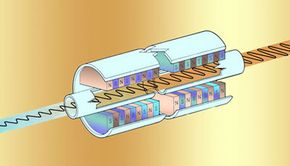
Illustration of a free electron laser. A beam of electrons is sent through an undulator -- an array of magnets with alternating north and south poles. The magnetic field in the undulator forces each bunch of electrons to oscillate back and forth, causing them to emit a laserlike beam of light.
Image courtesy Flavio Robles/Creative Services Office, Lawrence Berkeley National Lab
Types of High Energy Lasers
There are many different types of lasers, including:
Solid state lasers have a lasing medium that is solid crystal, like the ruby laser or the neodinium YAG laser, which emits a 1.06 micrometer wavelength.
Gas lasers have a lasing medium that is a gas or combination of gases, such as helium-neon laser or carbon dioxide laser, which emits 10.6 micrometer wavelengths (infrared).
Excimer lasers have a lasing medium that is a combination of reactive gases, like chlorine or fluorine, and inert gases, like argon or krypton. The argon fluoride laser emits ultraviolet light of 193 nanometer wavelengths.
Dye lasers have a lasing medium that is a fluorescent dye, such as rhodamine. They can be tuned to a variety of wavelengths within a certain range. The rhodamine 6G dye laser can be tuned from 570- to 650-nanometer wavelengths.
Carbon dioxide lasers are being explored by the military because they're powerful infrared lasers that can be used for cutting metal.
The FEL Laser Weapon
There are several lasers currently being used for military purposes. One that's being researched and developed is the free electron laser (FEL). In the 1970s, Stanford physicist John Madey invented and patented the FEL, which consists of an electron injector, a particle accelerator and a magnetic undulator or wiggler. It works like this:
Advertisement
The electron injector injects a pulse of free electrons into the particle accelerator.
The particle accelerator accelerates the electrons to near the speed of light (300,000 km/s)
The electrons move through the undulator or wiggler, which is a series of magnets with alternating north-south directions.
Inside the wiggler, the electrons oscillate back and forth. With each bend, they emit light of a specific wavelength.
The spacing of the magnets within the wiggler controls the wavelength of emitted light. So, the FEL laser can be tuned by changing the magnet spacing.
In theory, the FEL can be tuned from the infrared region to the X-ray region of the electromagnetic spectrum.
FELs have been used to produce high-energy infrared light and synchrotron X-rays for research purposes. The FEL was also a laser of interest for the Defense Department's Strategic Defense Initiative (President Reagan's "Star Wars" program). Recently, the U.S. Naval Postgraduate School acquired Madey's original FEL developed at Stanford University, to use for military research.
The COIL
In 1977, the U.S. Air Force developed a chemical oxygen-iodine laser (COIL). The energy source for the COIL is a chemical reaction, and the lasing medium is molecular iodine. Here's how it works: atoms, heat and byproducts, including water vapor and potassium chloride.
A chemical reaction occurs between chlorine gas and liquid mixture of hydrogen peroxide and potassium hydroxide.
The chemical reaction produces single oxygen
Molecular iodine gets injected into the laser. The singlet oxygen provides the energy to get the iodine atoms to lase and emit infrared light at a wavelength of 1.3 micrometers.
The laser can emit light continuously or the light can be pulsed, which increases the efficiency of the laser.
The COIL laser is used aboard the Air Force's Airborne Laser, which we'll talk about next.
Advertisement
The Airborne Laser
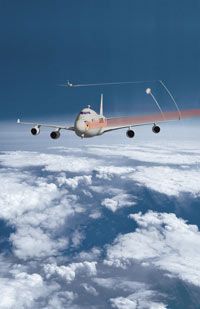
Air Force's Airborne Laser is an aircraft equipped with a chemical laser. It's designed to shoot down missiles in early flight.
Photo courtesy Kirtland AFB/ U.S. Air Force
In the Gulf War, Saddam Hussein's forces fired SCUD missiles at Israel and U.S. bases in the Middle East. The Patriot missile defense system was deployed to protect American interests. Patriot missiles can destroy incoming missiles on their downward path, but what if you could catch it earlier and destroy the missile during its boost phase (the upward path near its origin)? That's what Boeing, Northrup Grumman, and Lockheed Martin contractors designed the U.S. Air Force's Airborne Laser (ABL) to do.
This missle defense system was mounted in a modified Boeing 747 jumbo jet. It consisted of four lasers, advanced adaptive optics, sensors, and computers to locate, track, and destroy missiles. It worked as follows:
Advertisement
Infrared sensors detect the heat signature of a boosting missile and report information to an Active Tracking Laser.
The Active Tracking Laser tracks the missile and reports relevant tracking information (distance, speed, altitude).
The Tracker Illuminator Laser scans the target and figures out where best to aim the high-energy laser.
The Beacon Illuminator Laser shines on the target, determines the amount of atmospheric turbulence between the ABL and the target, and relays this information to the adaptive optics system in the aiming mechanism of the high-energy laser.
The Adaptive Optics system is made of deformable mirrors that compensate for atmospheric turbulence. The turret mounted in the nose houses a 1.5-meter telescope as part of the optics system.
The COIL laser fires a megawatt beam at the target. The beam exits the ABL through the nose-mounted turret.
The high-energy laser beam penetrates the skin of the target missile and disables or explodes it, depending upon where the beam strikes.
The ABL required a crew of six, who wore special safety goggles to protect their eyes from possible reflections of the beams by water droplets in the air. While the ABL program was scrapped in late 2011, such high-energy lasers are being designed and developed for use on land and at sea. These lasers are truck- or ship-mounted and capable of shooting down incoming missiles, artillery shells, and possibly enemy aircraft.
Advertisement
Nonlethal and Personal Laser Weapons
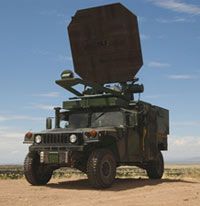
The Active Denial System directs millimeter radio frequencies at a target and causes an intense burning sensation.
Photo courtesy U.S. Department of Defense
The Active Denial System
Now we know that high-energy lasers are used to shoot down missiles, but do they have nonlethal uses, too? Yes. In fact, one such system is called the Active Denial System (ADS). The ADS isn't a laser, but a truck-mounted high-energy radio frequency generator and directional antenna. A generator inside creates a 95 GHz millimeter wave. (Millimeter waves have wavelengths of 1 to 10 millimeters and frequencies of 30 to 300 GHz.) The directional antenna focuses the millimeter waves and allows the operator to point the beam.
The millimeter beam penetrates the skin of anyone in its path to a depth of 1/64th of an inch, about the thickness of three sheets of paper. Like a microwave oven, the energy of the beam heats water molecules in the skin tissue and causes an intense burning sensation. The beam doesn't permanently injure because it doesn't penetrate very far, and when a person moves out of the beam, the sensation goes away (see How Military Pain Beams Will Work).
Advertisement
The PHaSR Device
Suppose you could momentarily stun or distract an opponent. The Air Force has developed a device that will do just that -- the Personnel Halting and Stimulation Response (PHaSR).
The PHaSR incorporates two low-power diode lasers, one visible and one infrared. It's about the size of a rifle and can be fired by an individual. The laser light temporarily distracts or "dazzles" the target person without blinding him.
Via the Department of Defense, the army's rapid capabilities are busy developing other optical distracter devices that could temporarily impair a target's vision.
Want Your Own Directed Energy Weapon?
You don't have to be a sci-fi fan to be wondering if there are any personal laser weapons on the market for civilians. Can the average person purchase or build one? Well, back in 2005, a company called Information Unlimited advertised a laser ray gun. After signing a hazardous equipment affidavit and purchasing the plans, you could purchase the hardware and assemble your very own laser gun.
The Personnel Halting and Stimulation Response (PHaSR) is a rifle-size laser weapon system that uses two nonlethal laser wavelengths to deter an adversary.
Photo courtesy Kirtland AFB/U.S. Air Force
Information Unlimited's laser ray gun was a solid state laser that used a flash lamp as an energy primer and a neodinium glass rod as the lasing medium. It required 12 volts of DC power, which came from AA batteries. It emitted infrared light of 1.06 micrometer wavelength in short 3 joule pulses for a total of 500 joules of energy. The beam is focused with a collimating lens, which straightened the beams and made them parallel.
The device was classified as a hazardous class IV laser, and the company claimed that it was capable of burning holes in most materials (infrared lasers can do these things). But don't try to pick one up for your 9-year-old's birthday, as the company no longer exists. What a surprise!
To learn more about laser weapons, take a look at the links on the next page.
National Defense Magazine, Directed Energy Weapons Promise "Low Cost Per Kill", 2001. http://www.nationaldefensemagazine.org/issues/2001/Sep/Directed-Energy.htm
U.S. Air Force Kirtland Air Force Base, Directed Energy Directorate. http://www.kirtland.af.mil/afrl_de/
U.S. Air Force, Brief History of the Airborne Laser. http://www.kirtland.af.mil/shared/media/document/AFD-070404-025.pdf
U.S. Air Force, Personal Halting and Stimulation Response (PHaSR). http://www.kirtland.af.mil/shared/media/document/AFD-070404-043.pdf
New Scientist online, "U.S. military sets laser PhaSRs to stun." November 2005. http://www.newscientist.com/article.ns?id=dn8275
New Scientist online, Sweeping stun guns to target crowds, June 2004.
Joint Non-Lethal Weapons Program, Active Denial System Fact Sheet. https://www.jnlwp.com/misc/fact_sheets/ADS%20Fact%20Sheet%20-%2015%20Oct%2007%20-%20FINAL.pdf
POPSCI.com. Attack at the Speed of Light. http://www.popsci.com/military-aviation-space/article/2006-05/attack-speed-light
POPSCI.com, How it Works: The Flying Laser Cannon. http://www.popsci.com/military-aviation-space/article/2008-03/how-it-works-airborne-laser-cannon
Lawrence Berkeley Laboratory, Into the Future at the Speed of Light: The Advanced Photon Science Intitiative. http://www.lbl.gov/Science-Articles/Archive/sabl/2007/Nov/APSI.html
Cite This!
Please copy/paste the following text to properly cite this HowStuffWorks.com article: