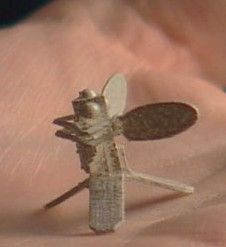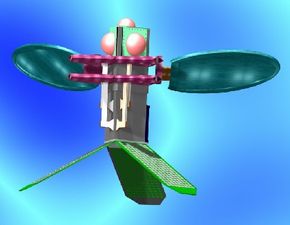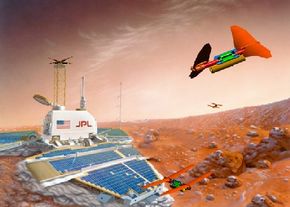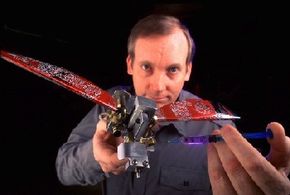
Our country is at war in an unfamiliar territory, and a battle is about to begin. Enemy ground troops are positioning themselves to form an attack on our army, located just 2 miles (3.2 km) away. However, the enemy doesn't know that its every move is being monitored by robotic insects equipped with tiny cameras, flying overhead. These tiny robotic flyers, called micro air vehicles (MAVs), will be able to buzz over enemy territory nearly unnoticed by the enemy troops below. Few would even look twice at these dime-sized flying robots.
The U.S. Department of Defense is spending millions of dollars to develop these MAVs. They are the perfect way to keep soldiers out of harm's way during reconnaissance missions. Today, gathering reconnaissance during battle typically involves putting either small teams of soldiers or large aircraft in harm's way. At the same time, satellite imagery is not immediately accessible by a ground soldier.
Advertisement
The Defense Advance Research Projects Agency (DARPA) is funding several research teams to develop MAVs no larger than 6 inches (15 cm) in length, width and height. These tiny aircraft will be an order of magnitude smaller than any unmanned aerial vehicle (UAV) developed to date. One class of these MAVs is being designed to mimic the flying motions of certain insects, including flies, bees and dragonflies. In this article, we will focus on these bug-like MAVs. You will learn how flies fly, how machines can be built to mimic their movements and where these tiny aerial devices will be deployed.
Advertisement