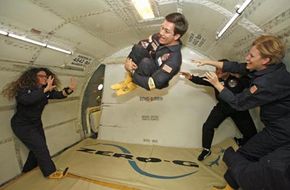
Playing catch with a fellow passenger in a low-gravity environment
Photo courtesy of Zero Gravity Corporation
Training to become an astronaut requires an applicant to endure physically demanding and stressful tests -- various machines and simulators measure each trainee's response to the rigors of space travel. Today, an entirely unrelated industry uses many of these simulators and other devices for a different purpose -- entertainment.
Few of these simulators appeal to the general public more than the zero-gravity flight. Almost everyone dreams of floating effortlessly like astronauts in space. Currently, NASA uses a modified C-9plane to create simulations of a weightless environment, both for training purposes and to conduct weightlessness experiments (without the enormous costs of space travel). Until recently, only a select few had the privilege of experiencing these flights. Today, a company called Zero Gravity Corporation (ZERO-G) offers this experience to the general public.
Advertisement
In this article, we'll learn about gravity, free-falling and what it's like to board the so-called "vomit comet." We'll start with what it's like to experience weightlessness.
So exactly how can we simulate weightlessness without escaping the gravitational pull of the Earth? The simplest answer is that we observe an object in free fall. Free fall is when an object falls solely under the influence of gravity. Because of air resistance, an object can't truly be in a free fall without being in a vacuum.
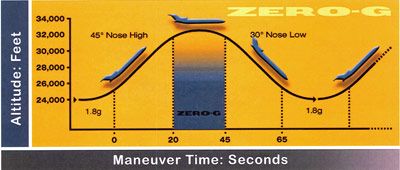
In order for passengers in a plane to experience a free fall safely, the aircraft must climb at a steep angle, level off, and then dive, creating a path called a parabolic arc, also called a Keplerian Trajectory or free-fall path. In a true parabolic arc, the only accelerative force is gravity pulling in a vertical direction -- horizontal velocity remains constant. Because of air resistance, objects in Earth's atmosphere only travel in arcs that approximate a true parabola.
Advertisement
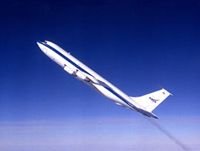
Typically, ZERO-G's plane, called G-FORCE-ONE, flies between 24,000 and 32,000 feet altitude. This gives the pilot enough room to maneuver the plane safely through its flight path. The plane's descent must start at a high altitude to provide enough distance for the pilot to safely pull out of a dive. As the plane climbs to the peak of its arc, the pilot orients it at a 45-degree angle. During the climb, the plane's acceleration and the force of gravity create a pull 1.8 times the strength of gravity alone -- passengers temporarily weigh nearly twice as much as normal.
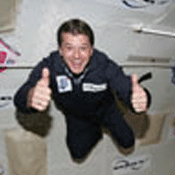
A passenger aboard the G-FORCE-ONE
Photo courtesy of Zero Gravity Corporation
As the plane goes over the top of the arc, the centrifugal force exerted on the plane and everything in it cancels out the gravitational force pulling downwards. At this point, passengers experience microgravity -- it feels as if you are weightless because only negligible gravitational forces are present. The sense of weightlessness lasts for about 30 seconds. Because the plane shields the passengers from the rush of air, they can experience a free fall without the interference of air resistance.
The pilot pulls the plane out of the dive so that the dip between one arc and the next is at about 24,000 feet altitude. As the plane pulls out of the dive and begins to climb again, passengers again experience the force of 1.8 times that of gravity. The typical ZERO-G flight includes 15 of these parabolic arcs, while NASA flights may include up to 100.
In the next section, we'll find out how passengers prepare for zero gravity -- and motion sickness.
Advertisement
Largest LMT on Earth
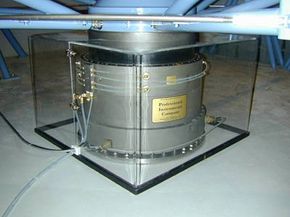
The air bearing spindle at the bottom of a liquid mirror telescope
Photo courtesy of Professional Instrument Company
The largest LMT on Earth is the Large Zenith Telescope in British Columbia. Its spinning liquid mirror is almost 20 feet across and weighs three tons, making it the third-largest telescope in North America. The dish that holds the mercury is fabricated from hexagonal segments glued together to form a shell. Each piece has a high-density foam core covered with fiberglass. To give the shell a concave shape, it is heated in a large oven. A wall at the rim of the mirror prevents mercury from spilling.
The biggest advantage of an LMT is its relative low cost. Liquid telescopes cost much less to build than polished aluminum mirrors of similar size. For example, the Large Zenith Telescope carried a price tag of $1 million. A comparable glass mirror telescope would cost 100 times that much to build. And LMTs cost less to maintain, mainly because the liquid mirror doesn’t need to be cleaned, adjusted or aluminized.
Advertisement
Of course, there are some drawbacks. Mercury is extremely toxic, so working with it poses some long-term health risks. Not only that, the dish holding the mercury can only be tilted so far before the liquid spills out. This limits the view of an LMT, which can only look straight up.
Supporting the dish is a steel truss and 19 adjustable pads. The truss, in turn, is supported by a stainless-steel air bearing designed just for the Large Zenith Telescope. An air bearing is a special type of bearing that uses a thin film of pressurized air to act as the lubricant around the shaft that turns the mirror. Normal bearings that use oil lubricants are less effective because they produce vibrations and unstable rotations that degrade image quality. As a zero-friction solution, an air bearing eliminates these problems, leading to a perfectly smooth, vibration-free rotation. A built-in brushless DC motor turns the air bearing spindle and can rotate a load up to 10 tons at approximately 10 revolutions per minute.
Six support legs attach the primary mirror to a ring at the top of the telescope. The ring supports a smaller refracting lens that helps focus the image, as well as the detector. The detector includes a charge-coupled device (CCD), which gathers photons of light and converts them into picture elements, or pixels. These pixels are transferred to a computer screen and pieced together to form an image that can be manipulated and enhanced to improve the image detail. The computer is not housed in the telescope's observatory structure, but in a building located nearby
The one problem with the Large Zenith Telescope -- a problem it shares with all Earth-bound telescopes -- is its location. Even at an altitude of 1,295 feet, its view of the heavens is still shielded by the atmosphere. If a liquid mirror telescope mirror could be placed on the moon, where there is no atmosphere to block ultraviolet, infrared and other forms of energy, it could provide even more spectacular results. But, as we'll see in the next section, building an LMT on the moon presents its own challenges.
Advertisement
Suiting Up
Photo courtesy of NASANASA’s KC-135A in a45-degree ascent.
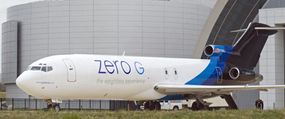
If you want to experience a zero-gravity flight, you can book a trip on G-FORCE-ONE -- a modified Boeing 727-200 -- through the ZERO-G Web site or at your local Sharper Image store for $3,500. The package includes your flight, unique merchandise and a post-flight celebration (or, depending on your point of view, a wake for your temporary dramatic weight loss). Passengers must be at least 15 years old if unaccompanied, or 12 if flying with a parent or guardian.
ZERO-G has a stigma to shake off -- that of the Vomit Comet, the name passengers gave to NASA’s zero-gravity flight programs. Many people who have taken a trip on NASA’s zero-gravity flights experienced severe motion sickness. ZERO-G’s focus is more on entertainment than research, and so they strive to reduce passenger discomfort.
Advertisement
According to the company, most people begin to experience motion sickness after the plane has traveled through 25 or more parabolic arcs -- the company limits G-FORCE-ONE to 15 arcs per trip [Source: Zero Gravity Corporation]. The company also provides Dramamine for passengers prone to motion sickness.
After you book your flight, the company will mail you a packet of information and forms to fill out. Forms include a waiver and statement that you are not suffering from any conditions or illnesses that could become worse during the flight. Some passengers may need to obtain a doctor"s permission before the company allows them to go on the experience.
On the day of your flight, you"ll travel to the appropriate location -- normally either McCarren International Airport in Las Vegas or the Kennedy Space Center in Florida. Once you"re at the airport, you"ll have to check in with the flight center where you"ll receive your own flight suit.
You"ll then enjoy a light meal (you wouldn"t want to fill up before throwing your sense of equilibrium out of whack) provided by the company before watching an orientation and safety video. The video is a mandatory part of the experience, and the company is serious about showing it to every passenger. If you leave during the video for any reason, you will have to watch the entire video again uninterrupted before the company allows you on the flight. After the video, passengers participate in a question-and-answer session with the flight crew.
In the next section, we"ll find out what it"s like to do a somersault in zero gravity.
Advertisement
Taking the Plunge
Each flight includes 15 parabolas-- a total of seven to eightminutes of reduced gravity.
Photo courtesy of Zero Gravity Corporation
Once the question-and-answer session is over, it's time to board the plane. Passengers sit in the rear of the plane, which looks like a normal 727, apart from the lack of windows. You'll fasten your seat belt, and the pilot will taxi the plane to the runway and take off just like any other flight. Once you reach cruising altitude, it's time to unbuckle your seat belt and move to the play area of the plane, where you'll lie down as you prepare for the first steep climb, during which the g-forces increase.
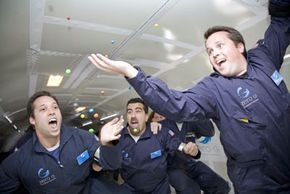
When the plane goes over the top of the highest point, a crew member will yell "Martian gravity," "Lunar gravity" or "zero gravity." At that point you can move about the play area, experiencing a reduced-gravity environment. The crew offer assistance and take pictures and video footage of your experience as you float, somersault, fly and bounce through the play area. When the plane begins to pull out of its dive, a crew member will yell, "feet down." This is your cue to orient yourself so that you may safely land on the floor as gravity gradually increases. You'll have to lie down again to prepare for the next climb.
Advertisement
Each flight includes 15 parabolas, which means you'll experience seven to eight minutes of reduced gravity. Once the plane completes the final parabolic arc, you'll return to the seating area and strap in for landing. Upon your return to the airport, you'll leave the plane to go to a post-flight party, complete with complimentary champagne and souvenirs.
By adjusting the curve of the flight path, the plane can simulate the gravity of Mars or the moon. The shape of the parabola is elongated and not as steep as the free-fall path. The resulting centrifugal force is weaker and only partially offsets the force of gravity.
Earth’s gravity is about three times stronger than Mars’ and about six times stronger than Lunar gravity.
In the next section, we'll find out how the Boeing 727-200 was retrofitted to withstand the force of 15 parabolic arcs.
Advertisement
Inside the G-FORCE-ONE
Passengers can eat candy in a weightless environment andnot gain weight ... at least until they land.
Photo courtesy of Zero Gravity Corporation
Doctors Peter Diamandis and Byron Lichtenberg founded ZERO-G in 1993 with the intention of creating a space entertainment and tourism company. NASA used to conduct zero-gravity flights using a Boeing KC-135A Stratotanker, originally designed as an in-flight aircraft refueling vehicle. Diamandis and Lichtenberg needed an aircraft that met FAA (Federal Aviation Administration) regulations (NASA is exempt from FAA certification, but commercial travel is not), yet could withstand the stresses involved in simulating weightlessness. The aircraft also needed to be less expensive to purchase and maintain than the KC-135A. They focused their attention on the Boeing 727-200.
The 727 has many qualities that appealed to Diamandis and Lichtenberg. Most large airports in the United States can accommodate the aircraft. Also, because the 727 is still a major part of the fleets of many airlines, parts and servicing are readily available. And although ZERO-G made some minor modifications to the aircraft, the 727 met FAA regulations, including standards on noise abatement.
Advertisement
In 2004, the FAA granted ZERO-G the permission to conduct flights in a 727-200 using parabolic paths. The company flies over uninhabited areas that are out of the way of most commercial flight routes. Each flight takes place within an FAA-designated corridor about 100 miles long and 10 miles wide.
ZERO-G’s Boeing 727-200, G-FORCE-ONE
Photo courtesy of Zero Gravity Corporation
ZERO-G modified the 727-200 to better suit the company's needs. Crews removed most of the seating and created a padded, 90-foot-long corridor where flyers -- the company's term for passengers -- would experience weightlessness. The rear of the plane can hold up to 35 flyers and six crew members. Engineers designed a new system that prevented air and hydraulic fluid from mixing in a weightless environment -- such a mixture could result in a loss of hydraulic pressure, making it very difficult to control the plane. The new hydraulic system is a closed system, meaning a series of valves prevents air and hydraulic fluid from mixing.
Engineers also designed a special accelerometer for the cockpit. The accelerometer measures the plane's speed and path through a parabolic arc. Because of ZERO-G's focus on providing entertainment to customers, the company felt that comfort of customers was an important concern (NASA relies on its pilots to follow the parabolic path on their own and is less concerned about the smoothness of the flight). Pilots can receive data on their flight path, making minor adjustments when necessary to make ensure each arc is smooth as possible.
Boeing designed the 727 to withstand forces from -0.1 G to 2.5 G. The g-load stresses during parabolic flight on G-FORCE-ONE range from 0 G to 1.8 G, well within the range of safety. ZERO-G regularly inspects the aircraft for signs of equipment fatigue and maintenance needs.
Thanks to Dr. Peter Diamandis of the Zero Gravity Corporation for his input on this article.
The company's headquarters is in Las Vegas, Nev. Most flights originate from Las Vegas or the Kennedy Space Center in Florida, but because many airports can accommodate a 727, the company invites customers to charter flights based out of their nearest major airport, making it that much easier to achieve a lifelong dream of defying gravity.
To find out more about zero-gravity flights, check out the links on the next page.