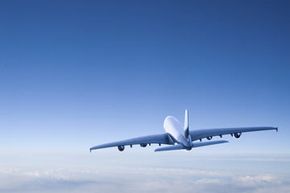
Human flight has become a tired fact of modern life. At any given moment, roughly 5,000 airplanes crisscross the skies above the United States alone, amounting to an estimated 64 million commercial and private takeoffs every year [source: NATCA]. Consider the rest of the world's flight activity, and the grand total is incalculable.
It is easy to take the physics of flight for granted, as well as the ways in which we exploit them to achieve flight. We often glimpse a plane in the sky with no greater understanding of the principles involved than a caveman.
Advertisement
How do these heavy machines take to the air? To answer that question, we have to enter the world of fluid mechanics.
Physicists classify both liquids and gases as fluids, based on how they flow. Even though air, water and pancake syrup may seem like very different substances, they all conform to the same set of mathematical relationships. In fact, basic aerodynamic tests are sometimes performed underwater. To put it simply, a salmon essentially flies through the sea, and a pelican swims through the air.
The core of the matter is this: Even a clear sky isn't empty. Our atmosphere is a massive fluid layer, and the right application of physics makes it possible for humans to traverse it.
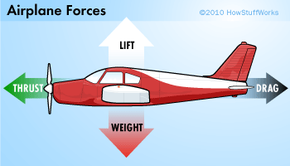
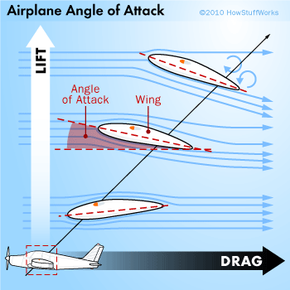
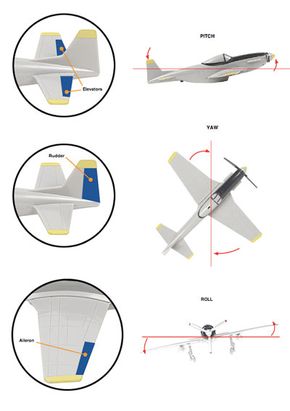
In this article, we'll walk through the basic principles of aviation and the various forces at work in any given flight.
Advertisement