Can China control the weather?
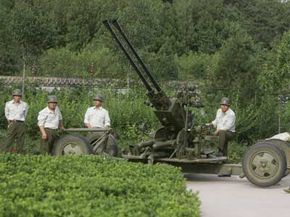
Every year, China launches thousands of rockets and artillery shells into the sky. They're not part of a set of war games or preparation for a battle with Taiwan, but rather a battle with the weather. Through its Weather Modification Program, the Chinese government hopes to control the fickle forces behind rain. Run by the Weather Modification Department, a division of the Chinese Academy of Meteorological Science, the program employs and trains 32,000 to 35,000 people across China, some of them farmers, who are paid $100 a month to handle anti-aircraft guns and rocket launchers.The heavy weapons are used to launch pellets containing silver iodide into clouds. Silver iodide is thought to concentrate moisture and cause rain. The process is known as cloud seeding and China has invested heavily in it, using more than 12,000 anti-aircraft guns and rocket launchers in addition to about 30 planes [Source: Asia Times Online].
Chinese research into weather control began in 1958, when the practice was still in its early stages. With a population of more than 1.3 billion, China requires vast amounts of water. Cities like Beijing suffer from terrible smog, and rain can help clear away air pollution. The government is using cloud seeding to try to produce rain for farmers, stave off drought and fill water basins.

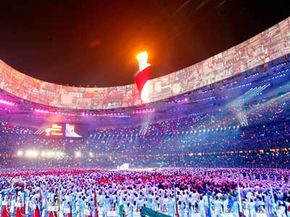
Image courtesy Jurie Maree/Dreamstime.com
The Chinese government believes launching shells containing
silver iodide pellets into clouds will curb rainfall and smog,
ensuring clear skies for the 2008 Summer Olympics
opening ceremonies in Beijing.
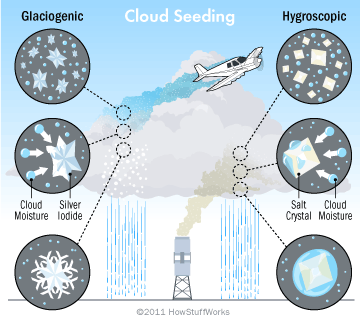
So how does it work? Even in areas with very low humidity, water is present in the sky and in clouds. A rainstorm happens after moisture collects around particles in the air, causing it to reach a level of saturation at which point it can no longer hold in that moisture. Cloud seeding essentially helps that process along, providing "nuclei" around which water condenses. These nuclei can be salts, calcium chloride, dry ice or silver iodide, which the Chinese use. Silver iodide is used because its form is similar to ice crystals. Calcium chloride is often used in warm or tropical areas.
Cloud seeding is heavily used in northern China, an area that does not receive much rain -- its rainfall levels are 35 percent below the world average, and some of its water supplies are significantly polluted. Zhiang Qiang, who runs the Beijing Weather Modification Office, told the Asia Times that water levels in Beijing's water basins have increased up to 13 percent due to cloud seeding [Source: Asia Times Online]. Cloud seeding has also been used to cool down Beijing on hot days.
The Beijing Weather Modification Office is researching how to prevent rain in the city on Aug. 8, 2008, during the opening ceremonies of the 2008 Summer Olympics. The government has even guaranteed clear skies for the event. They plan to do it by tracking cloud formations and causing rain in the days leading up to the ceremonies. However, one official admits that although cloud seeding could be effective in preventing light rain on Aug. 8, it could not curb the onset of a moderate to heavy storm.
Video Gallery: Predicting Weather Watch this video from NASA to learn how scientists predict weather in space using sophisticated technology. Georgia Tech’s Severe Weather Research Center is on the cutting edge of weather research. Learn about the technology it uses and how it can predict when a thunderstorm turns into something deadly. GIFT (Geostationary Imaging Fourier Transform Spectrometer) is the future of weather satellite technology and could bring new understanding in predicting and even controlling weather. Learn how GIFT works in this video courtesy of NASA. Ever wonder how scientists predict hurricanes? This video explains how hurricanes work and how meteorologists track them. |
Scientists aren't sure if cloud seeding actually works, but despite the skepticism, China is moving forward, spending $60 to $90 million a year on weather modification, in addition to the $266 million spent from 1995 to 2003 [Source:Things Asian]. The government plans to produce 50 billion cubic meters of rain a year through the practice [Source: Asia Times Online].
China has a reputation for launching ambitious projects, from the Great Wall in ancient times to the highest railroad in the world, connecting Qinghai to Tibet. But is the investment in cloud seeding worth it, and can the government really make it rain whenever it sees the need? On the next page, we'll look at some of the methods and criticism of cloud seeding.
Cloud Seeding Methods and Criticism
There are three modes of cloud seeding: static, dynamic and hygroscopic. Static cloud seeding involves spreading a chemical like silver iodide into clouds. The silver iodide provides a crystal around which moisture can condense. The moisture is already present in the clouds, but silver iodide essentially makes rain clouds more effective at dispensing their water.
Dynamic cloud seeding aims to boost vertical air currents, which encourages more water to pass through the clouds, translating into more rain [Source: Department of Academic Science, Colorado State University]. Up to 100 times more ice crystals are used in dynamic cloud seeding. The process is considered more complex than static clouding seeding because it depends on a sequence of events working properly. Dr. William R. Cotton, a professor of atmospheric science at Colorado State University, breaks down dynamic cloud seeding into 11 separate stages. An unexpected outcome in one stage could ruin the entire process, making the technique less dependable than static cloud seeding.
Hygroscopic cloud seeding disperses salts through flares or explosives in the lower portions of clouds. The salts grow in size as water joins with them. On his Web site, Dr. Cotton claims that hygroscopic cloud seeding holds much promise, but requires further research.
![]() Image courtesy Mustafa Quraishi/Associated Press A modified Cessna 340 aircraft demonstrates its flares used to seed clouds. The government of India’s Andhra Pradesh state used these planes to try to stave off a drought in the summer of 2004. |
Cloud-seeding research has been performed in Russia, Israel, Thailand, the Caribbean and South Africa. In addition, Australian scientists conducted numerous experiments, discovering that static seeding was not effective over Australia's plains but appeared to be very effective over Tasmania.
Despite some successful tests, cloud seeding still has many problems. The fundamental concern is: Does it work? It may be a chicken-and-the egg type problem -- would it have rained in a given area without the use of cloud seeding, and would it have rained less? Cloud seeding is also very dependent on environmental conditions like temperature and cloud composition.
In 2003, the United States National Academy of Sciences declared that 30 years of studies had not produced "convincing" evidence that weather modification works [Source: Things Asian]. On the other hand, the American Meteorological Society claims that some studies on cloud seeding show a 10 percent increase in rain volume [Source:The Edwards Aquifer Website].
Cloud seeding is quite expensive, though potentially cheaper than other projects, like diverting rivers, building new canals or improving irrigation systems. Then again, the allure of cloud seeding may redirect attention and funding from other projects that could be more promising. Then there are questions about altering weather. Are some areas taking moisture out of the air that would have fallen as rain in another region?
Despite reassurances from cloud-seeding companies, concerns remain about exposure to silver iodide toxicity and soil contamination. Other safety issues are more transparent. In China, wayward munitions have damaged property, and they even killed one person in May 2006. The Chinese government contends that it has improved training, licensing and safety practices.
In the end, cloud seeding has strong supporters, but it remains controversial. And although the practice has lost momentum in the U.S., China is counting on its legion of farmers-turned-weather-gods to clear the skies for the opening ceremonies of the 2008 Summer Olympics.
For more information about cloud seeding, weather control and other related topics, please check out the links on the next page.
Lots More Information
Related HowStuffWorks Articles
- How Floods Work
- How Hurricanes Work
- How Rainbows Work
- What causes the smell after rain?
- How could it rain for 45 straight days?
- How Lightning Works
- How Windshield Wipers Work
More Great Links
- North American Interstate Weather Modification Council
- Project Stormfury attempted to weaken hurricanes in the 1960s and '70s
- Utah Cloud Seeding Home Page
- Weather Modification Association
Sources
- "AI Weather Modification Page." Atmospherics Inc. 1996. http://www.atmos-inc.com/weamod.html
- "China." CIA World Factbook. https://www.cia.gov/library/publications/the-world-factbook/print/ch.html
- "China to force rain ahead of Olympics." The Associated Press. Boston Globe. April 25, 2007.http://www.boston.com/news/science/articles/2007/04/25/
china_to_force_rain_ahead_of_olympics/ - "China to zap rain clouds with rockets." Reuters. July 17, 2007. http://www.reuters.com/article/scienceNews/idUSPEK9012220070717
- "Faculty." CSU Department of Atmospheric Sciences. Colorado State University. May 30, 2007. http://www.atmos.colostate.edu/dept/faculty/cotton.php
- "North American Interstate Weather Modification Council." http://www.naiwmc.org/
- "Rainmaking in China." Things Asian. June 21, 2004. http://www.thingsasian.com/stories-photos/2987
- Aiyar, Pallavi. "Ready, aim, fire and rain." Asia Times. July 13, 2007. http://www.atimes.com/atimes/China/IG13Ad01.html
- Cotton, William R. "Weather Modification by Cloud Seeding - A Status Report 1989 - 1997." Department of Atmospheric Sciences. Colorado State University. April 21, 1997. http://rams.atmos.colostate.edu/gkss.html
- de Blas, Alexandra. "Every Cloud Has a Silver Lining." Earthbeat. July 17, 2004. http://www.abc.net.au/rn/science/earth/stories/s1157040.htm
- Eckhardt, Gregg. "Cloud Seeding." The Edwards Aquifer Website. http://www.edwardsaquifer.net/cloudseeding.html
- Lim, Louisa. "China warns of water pollution." BBC News. March 23, 2005. http://news.bbc.co.uk/2/hi/asia-pacific/4374383.stm