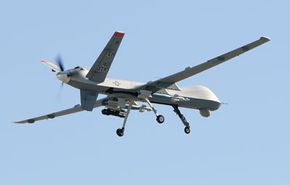
Reaper Capabilities: What Can It Do?
One important thing to remember about the Reaper (and the Predator as well) is that the Reaper is a weapons system and not just an individual drone. Each Reaper system consists of four individual Reaper drones operated by four different flight teams (we'll talk about these flight teams a little more in the next section). The whole system costs about $54 million to build [source: USAF].
The Reaper is powered by a single 900-horsepower turboprop engine developed by Honeywell. The drone is 66 feet (20 m) wide, from wingtip to wingtip. (By comparison, the Predator has a 49-foot (14 m) wingspan). A Reaper weighs 4,900 pounds (2,223 kilograms) without any added firearms and can carry 3,750 pounds (1,701 kilograms) of equipment or weaponry. What's more, it can store up to 4,000 pounds (1,814 kilograms or 602 gallons) of fuel [source: USAF]. One of the reasons it's so much more lightweight than other aircrafts is because its design eliminates the need for cockpit and pilot-support functions.
But the Reaper wouldn't be called a hunter/killer without the hardware to back up such a title. It can carry 14 Hellfire missiles -- that's 12 more than the Predator. The Reaper is equipped with laser range finders to locate and transmit images of targets. Its arsenal is a mix of laser-guided bombs and missiles (typically Hellfire missiles). The Reaper can also carry two bombs, as many as most standard fighter jets.
The Reaper normally carries GBU-12s, which are 500-pound (226-kilogram) laser-guided precision bombs. It can also be fitted with GBU-49s, which are similar to GBU-12s except that they're also equipped with an onboard GPS. The navigation guide enables the bomb to strike its target in any type of weather without the need of a laser designator.
While the Reaper takes off and lands on normal military base runways, it can be pretty easily transported, too. If a Reaper needs to be moved from a location in California, for instance, to a base in Iraq, it's designed so that Air Force crews can take it apart, pack it up in a crate and ship it to its destination in a C-130. The crew on the receiving end simply unpacks the crate and reassembles the Reaper, which is ready for operation once it is fueled.
Undoubtedly, the Reaper's full potential hasn't been realized yet, since its combat debut in Afghanistan in October 2007 is still relatively recent. There are great possibilities for the Reaper system. Imagine four heavily armed unmanned drones soaring high above the Earth for hours and hours at a time, then racing to their target, able to engage and destroy vehicles, personnel, buildings or anti-aircraft batteries.