Introduction to How Solar Sail Technology Works
| Special thanks to Dr. Louis Friedman, Executive Director of The Planetary Society, for his technical assistance. |
In June 2005, The Planetary Society, in collaboration with several Russian space organizations, will launch the Cosmos-1 spacecraft into Earth orbit.
![]() Photo courtesy The Planetary Society Solar sails will use the sun's energy to propel spacecraft across the cosmos. See more solar sail pictures. |
What is a solar sail? How can you use sunlight to move a spacecraft in outer space? In this article, HowStuffWorks will show you how solar sail technology works, take an in-depth look at the Cosmos-1 mission and find out what solar-sails mean for future space travel.
Solar Sails
Solar sails may evoke images of large sailing vessels of old, such as clipper ships, or modern America's Cup racing yachts. However, the principles, construction and operation of solar sails are quite different from sailboats.
What is a Solar Sail?
A solar sail is a very large mirror that reflects sunlight. As the photons of sunlight strike the sail and bounce off, they gently push the sail along by transferring momentum to the sail. Because there are so many photons from sunlight, and because they are constantly hitting the sail, there is a constant pressure (force per unit area) exerted on the sail that produces a constant acceleration of the spacecraft. Although the force on a solar-sail spacecraft is less than a conventional chemical rocket, such as the space shuttle, the solar-sail spacecraft constantly accelerates over time and achieves a greater velocity. It's like comparing the effects of a gust of wind versus a steady, gentle breeze on a dandelion seed floating in the air. Although the gust of wind (rocket engine) initially pushes the seed with greater force, it dies quickly and the seed coasts only so far. In contrast, the breeze weakly pushes the seed during a longer period of time, and the seed travels farther. Solar sails enable spacecraft to move within the solar system and between stars without bulky rocket engines and enormous amounts of fuel.
What is a Solar Sail Made of?
For a solar sail to be a practical way of propelling a spacecraft, it must have the following characteristics:
- Large area - It must collect as much sunlight as possible, because the larger the area, the greater the force of sunlight.
- Light weight - The sail must be thin and have a minimal mass, because the more mass, the less acceleration that sunlight imparts to the sail.
- Durable and temperature resistant - It must withstand the temperature changes, charged particles and micrometeoroid hazards of outer space.
Solar sails come in three major designs:
- Square sail - requires booms to support the sail material
- Heliogyro sail - bladed like a helicopter, the sail must be rotated for stability
- Disc sail - circular sail that must be controlled by moving the center of mass relative to the center of pressure
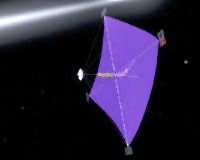
![]() Photo courtesy NASA Square solar sail |
Cruising by Sunlight
Maneuvering a solar-sail spacecraft requires balancing two factors: the direction of the solar sail relative to the sun and the orbital speed of the spacecraft. By changing the angle of the sail with respect to the sun, you change the direction of the force exerted by sunlight.
Maneuvering a solar sail to change orbits (For purposes of illustration, the change in orbit shown here occurs faster than in reality.)
|
The pressure of sunlight decreases with the square of the distance from the sun. Therefore, sunlight exerts greater pressure closer to the sun than farther away. Future solar-sail spacecraft may take advantage of this fact by first dropping to an orbit close to the sun -- a solar fly-by -- and using the greater sunlight pressure to get a bigger boost of acceleration at the start of the mission. This is called a powered perihelion maneuver.
Cosmos-1 Spacecraft Design
The first solar-sail spacecraft, called Cosmos-1, has been developed, built and tested by The Planetary Society, a private, non-profit organization whose goal is to encourage the exploration of our solar system. The Planetary Society contracted a Russian space organization, the Babakin Space Center, to build, launch and operate the spacecraft. The cost of the project is about $4-million and is funded by Cosmos Studios, a new science-based media company.
Cosmos-1 spacecraft
The spacecraft itself weighs 88 lb (40 kg) and can sit on a tabletop. After a first-phase test launch, the spacecraft will be launched into Earth orbit -- 522 mi (840 km) perigee and 528 mi (850 km) apogee. The spacecraft systems include:
- Solar sail
- made of aluminized Mylar
- thickness of 0.0002 inches (5 microns)
- area of 6,415 square feet (600 square meters)
- arranged in eight triangular blades:
- each about 49 ft (15 m) long
- consist of inflatable plastic tubes that support the sail (a foam may be used inside the tubes to hold them rigid once inflated)
- can be pivoted (like a helicopter blade) by electric motors to change its angle relative to the sun
- Solar-sail deployment - A pressurized gas-filling system inflates the plastic tubes.
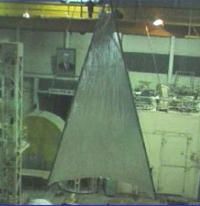
![]() Photo courtesy The Planetary Society One solar-sail blade |
Solar-sail deployment
- Power - A small array of solar cells supplies all of the electrical power.
- Navigation - It is essential for the spacecraft to know where it is and where the sun is at all times.
- A sensor detects the position of the sun.
- A global positioning system (GPS) receiver detects the spacecraft's position. (From the ground, the spacecraft orbit will be determined from Doppler tracking data with the aid of on-board accelerometers, which we'll discuss later.)
- The information from the sun sensor and the GPS receiver are continuously relayed to the spacecraft's on-board computer.
- The on-board computer operate the motors that turn the sail blades to maintain the proper orientation of the sail blades with respect to the sun.
- The on-board computer can accept corrections or override commands from the ground.
- Communications - Redundant radio systems are used to communicate with flight controllers on the ground.
- one UHF band, 400 megahertz
- one S-band, 2210 MHz
- On-board computer
- Two 386EX series microprocessors
- old, but reliable in the harsh environment of outer space
- can be run in low-power modes, similar to laptop computers
- programmed to operate the on-board systems, relay information to the ground and receive commands from the ground
- A software program assigns tasks to each microprocessor based on workload and performance (speed, delay).
- Each processor has its own small amount of read-only memory (ROM) -- enough to boot the computer and load the operating system into random-access memory (RAM).
- Three re-writable ROMs contain the operating systems and programs. The copies of ROM are checked before use for errors caused by radiation in outer space.
- Three RAMs are present to receive the operating system. Again, the integrity of each RAM is checked for errors before loading.
- The ROM architecture allows programmers on the ground to update and re-boot the spacecraft's software at any time. It also allows the spacecraft to function in the case of severe radiation damage.
- Data are stored in two separate databases connected by serial and parallel systems.
- Two 386EX series microprocessors
- Instruments
- Two on-board imaging cameras (Russian and American) to document the mission
- On-board accelerometers to measure the acceleration of the spacecraft due to sunlight pressure (non-gravitational acceleration)
|
|
In the next section, we'll discuss the details of the Cosmos-1 mission.
Cosmos-1 Mission
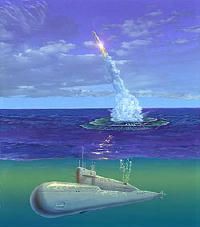
![]() Photo courtesy The Planetary Society Cosmos-1 will be launched from a submarine. |
Launch Vehicle
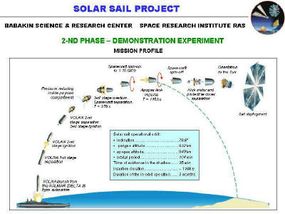
To get Cosmos-1 into Earth orbit, the spacecraft will be loaded into a modified intercontinental ballistic missile (ICBM) of Russian design, called the Volna. The ICBM will be launched from a Russian submarine in the Barents Sea. Typically, the Volna ICBM does not have enough thrust to reach orbit, but the missile used for Cosmos-1 will have an added rocket engine (kick stage) that is used to de-orbit satellites. The kick-stage engine will provide the additional thrust required to get Cosmos-1 into orbit.
Once in orbit, the solar sails will be deployed. The mission could last anywhere from a few days to a few months. The mission will be deemed a success if the spacecraft can move to a higher orbit using the solar sails. If the goal of the mission is achieved, and if the mission lasts longer than a few days, there may be an additional test to determine if Earth-based lasers can supply sufficient light to push the spacecraft in orbit.
![]() Photo courtesy The Planetary Society Launch (larger version of the image) |
Other Solar Sail Missions
Groups other than The Planetary Society have proposed and are developing solar-sail missions. In August of 2004, two large solar sails were launched and deployed into space by the Japanese Aerospace Exploration Agency. NASA is developing a solar-sail spacecraft for launch. The German Space Agency (DLR) and European Space Agency (ESA) also have a solar-sail spacecraft in development, and Carnegie Mellon University is working on a heliogyro solar sail.
Future of Solar Sails
|
|
Lots More Information
Related HowStuffWorks Links
- How Light Works
- How Rocket Engines Work
- How Satellites Work
- How Space Shuttles Work
- How the Sun Works
- How Space Elevators Will Work
- How Light Propulsion Will Work
- How Inflatable Spacecraft Will Work
- How Antimatter Spacecraft Will Work
- How Fusion Propulsion Will Work
- How Space Elevators Will Work
Other Great Links
The Planetary Society
Solar Sail information- NASA's Advanced Propulsion Concepts: Solar Sails
- NASA's Advanced Propulsion Concepts: Interstellar Light Sail
- German Space Agency (DLR) Solar Sail Home Page
- Solar Sails
- The Microlight Solar Sail
- Carnegie Mellon University: Solar Blade Solar Sail Project
- JPL Basics of Space Flight
- "Starsailing: Solar Sails and Interstellar Travel" by Louis Friedman
- "Space Sailing" by Jerome L. Wright
- "The Starflight Handbook: A Pioneer's Guide to Interstellar Travel" by Eugene F. Mallove, Gregory L. Matloff (Contributor)
- "Solar Sailing: Technology, Dynamics and Mission Applications" by Colin Robert McInnes
- "To Rise from Earth: An Easy-To-Understand Guide to Space Flight" by Wayne Lee