Sustaining a Permanent Environment in Space
To sustain a permanent environment in outer space where people can live and work, the ISS must be able to provide the following things:
- life support
- atmosphere control, supply and recycling
- water recycling
- temperature control
- food supply
- waste removal
- fire protection
- propulsion - move the station in orbit
- communications and tracking - talk with ground-based flight controllers
- navigation - find its way around
- electrical power
- computers - coordinate and handle information
- resupply - methods of getting new supplies and removing waste
- emergency escape route
Life Support
We take for granted all of the things that the Earth and our society provides to keep us alive. We have a constant supply of fresh air. The carbon dioxide that we exhale gets recycled by plants. We have a large supply of fresh water from rivers, lakes and streams that we use for drinking, showers, cooking and laundry. We are warmed by heaters or the sun and cooled by air conditioning. We have fire protection from local fire stations. All of these things must be designed into the ISS.
Atmosphere Control, Supply and Recycling
Astronauts on board the ISS need to have the following:
- Atmosphere similar to Earth's
- Carbon dioxide that they exhale removed
- Contaminating or trace gases removed
- Normal humid environment
Our atmosphere is a mixture of gases -- 78 percent nitrogen, 21 percent oxygen, 1 percent other gases -- at a pressure of 14 lbs/in
2 (1 atm). The ISS astronauts will need a similar atmosphere. To achieve this, oxygen and nitrogen will have to be supplied:
- The Russian Elektron generator will make oxygen by splitting water into hydrogen and oxygen (electrolysis).
- Solid fuel oxygen generators or oxygen candles will be burned to make additional oxygen, if required.
- The space shuttle or Progress supply ships will bring nitrogen from Earth, and store it in external tanks on the station.
- In later phases of construction, external tanks will supply oxygen; these tanks can be refilled by the space shuttle. In the final stage, an additional electrolysis oxygen generator will be added to the station.
- The pressure control assembly (a system of pumps and valves) will mix the nitrogen and oxygen in the right percentages, monitor the atmospheric pressure and depressurize the station when necessary to prevent overpressure or to extinguish a fire during an emergency.
A
carbon dioxide removal assembly (a series of beds of special material) will absorb carbon dioxide and release it into outer space. In addition, backup
chemical carbon dioxide canisters can remove carbon dioxide by reacting it with lithium hydroxide.
The trace contaminant control system will filter cabin air to remove trace odors and volatile chemicals from leaks, spills and outgassing. As a backup, the harmful impurities filter will also be used.
The station's heating system will control the humidity and circulate the atmosphere throughout the station.
Finally, the major constituent analyzer will constantly monitor the amount and type of gases in the cabin air, and control the atmosphere supply and recycling systems.
Water Recycling
Besides air, water is the most important element aboard the ISS. Initially, the space shuttle and Progress supply vehicles will bring water from Earth. On the ISS, water will be highly conserved. There will be no long, luxurious showers. In fact, most astronauts get by with sponge baths. The water recovery and management subsystem will collect, recycle and distribute water from various sources including:
- Sink
- Shower
- Urine - from the astronauts and from laboratory animals onboard
- Spacesuit wastewater
- Heating and cooling systems
- Cabin air - moisture exhaled by astronauts and laboratory animals
- The space shuttle's fuel cells
The water recovery and management subsystem consists of various condensers, filters and water purifiers. The water will be used for drinking and cooling electrical systems. This system is not 100 percent efficient, and water will be lost through the Elektron oxygen generator, airlocks and carbon dioxide removal systems. Water will be periodically replenished from Earth. However, this system will greatly reduce the amount of water needed from Earth.
Temperature Control
Outer space is an extremely cold environment, and temperatures will vary drastically in different parts of the ISS. You might think that heating the ISS would be a problem. However, the electronic equipment generates more than enough heat for the station. The problem is getting rid of the excess heat. So the temperature control system has to carry out two major functions -- distributing heat where it is needed on the station and getting rid of the excess. To do this, the ISS has two methods to handle temperature control:
- Passive methods - generally simple; handle small heat loads and require little maintenance
- insulating materials, surface coatings, paints - reduce heat loss through the walls of the various modules, just like your home insulation
- electrical heaters - use electrically-heated wires like a toaster to heat various areas
- heat pipes - use liquid ammonia in a pipe to transfer heat from a warm area to a cold area over short distances. The ammonia evaporates at the warm end of the pipe, travels to the cold end and condenses, giving up heat; then the liquid travels back to the warm end along the walls of the pipe (capillary action).
- Active methods - more complex; use fluid to handle large heat loads; require maintenance
- cold plates - metal plates that collect heat by direct contact with equipment or conduction
- heat exchangers - collect heat from equipment using fluid. The equipment radiates heat to a fluid (ammonia), which in turn passes heat on to water. Both fluids are pumped and recirculated to remove heat.
- pumps, lines, valves - transport the collected heat from one area to another
- heat rejection units - large, winged structures, similar to solar panels, that radiate the collected heat to outer space
For cabin air, the
temperature and humidity control system circulates and filters air, removes water (humidity) and maintains a constant temperature range. Any collected water goes to the water recovery and management system.
Food Supply
The space shuttle and Progress supply ships will bring food to the ISS. Food comes in several forms (dehydrated, low moisture, heat-stabilized, irradiated, natural, fresh). The ISS has a galley (kitchen) equipped with the following:
- Food storage compartments
- Food warmers
- A food preparation area
- Table with restraints (straps, footholds) so the astronauts do not float away
- Metal trays that stop the food packages and utensils from floating away
The United States and Russia have each agreed to supply half of the food for the crew.
Waste Removal
Like any home, the ISS must be kept clean. This is especially important in space, where floating dirt and debris could present a hazard. Wastes are made from cleaning, eating, work and personal hygiene. For general housecleaning, astronauts will use various wipes (wet, dry, fabric, detergent, disinfectant), detergents and wet/dry vacuum cleaners to clean surfaces, filters and themselves. Trash will be collected in bags, stowed in a Progress supply ship and returned to Earth for disposal. Solid waste from the toilet is compacted, dried and stored in bags, where it is returned to Earth for disposal (burning). Water reclaimed from solid waste is processed and purified for drinking purposes.
Fire Protection
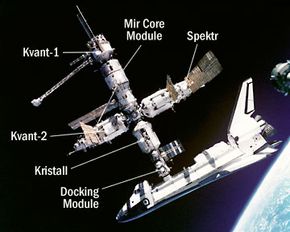
Fire is one of the most dangerous hazards in space. During astronaut Jerry Linenger's stay on Mir, a fire broke out. The Mir crew extinguished the fire, but not before the station was damaged. The ISS has a fire detection and suppression subsystem that consists of the following:
- Area smoke detectors in each module
- Smoke detectors in each rack of electrical equipment
- Alarms and warning lights in each module
- Nontoxic portable fire extinguishers - foam or liquid extinguishers that are either carbon dioxide (from the United States) or nitrogen-compound-based (from Russia)
- Personal breathing apparatus - mask and oxygen bottle for each crew member
After a fire is extinguished, the atmosphere control system will filter the air to remove particulates and toxic substances.