Living and Working Aboard the ISS

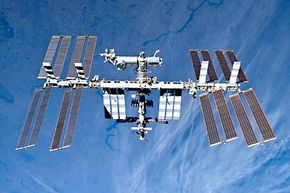
The first space station crew members will spend a lot of their time setting up the station, building its components and conducting various scientific experiments and Earth observations. The crew will live in the service module at first. This module has spartan living quarters, but provides everything the crew needs -- personal sleeping quarters, a toilet, hygiene facilities, a kitchen with a table, a treadmill and a stationary bicycle. Astronauts will have to exercise frequently to keep from losing bone and muscle mass, which happens with prolonged weightlessness.

  • Sleeping in space is quite different from sleeping on Earth. Instead of a bed, you have a wall-mounted sleeping bag that you slip into and zip up. The bag is also equipped with arm restraints to prevent your arms from floating above your head while you sleep.

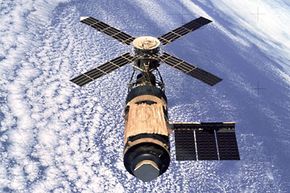
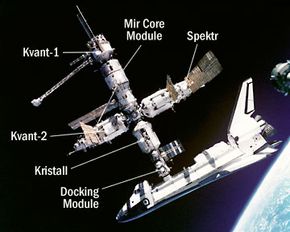
  • While stations such as Skylab and Mir have been equipped with a shower, most astronauts take sponge baths using washcloths or moistened towelettes. This reduces the amount of water consumed. Each astronaut will also have a personal hygiene kit with a toothbrush, toothpaste, shampoo, razor and other basic toiletries.

  • The food on the ISS will be mainly frozen, dehydrated or heat-stabilized, and drinks will be dehydrated. Astronauts will collect food trays and utensils, locate their individually-packaged meal from a storage compartment, prepare the items (rehydrate if necessary), heat the items (microwave, forced-air convection oven), place them in the tray and eat. After the meal, they will place the used items in a trash compactor, and clean and stow the utensils and trays. Interestingly, astronauts get to select their menus approximately five months before their flight.

  • In weightless conditions, the body loses bone and muscle mass. To counter these losses, astronauts will have to exercise daily. The service module is equipped with a treadmill and a stationary bicycle. Astronauts must strap themselves onto these devices so that they do not float away while exercising.

  • Once the ISS is completed, work will involve maintaining the station (fixing broken equipment, repairing structures, etc.) and conducting scientific experiments and observations. The station will have six scientific laboratories. Closet-sized racks along the walls of the laboratory module will hold the equipment, and the astronauts will use footholds and restraints so they won't float away while working. The experiment racks will also have remote video and data links so that scientists on the ground will be able to monitor the experiments on-board the ISS continuously. The Japanese laboratory module will have a platform open to space, for determining the effects of the space environment on materials.

  • Working in weightlessness, or microgravity, is very different from what we are used to. For example, as I write this article at my computer, I do not have to worry about floating off of my chair, or having the papers on my desk float away. This is not the case in the ISS. As we have mentioned above, many places (experiment racks, kitchen area, crew quarters) will have restraints to keep the astronauts and equipment from floating away. And while I can walk the corridor in my office with no trouble, astronauts on the ISS will have to use handholds mounted on the walls of the station to keep themselves stable as they move around.
  • The crew will have to perform spacewalks during construction and maintenance of the ISS. Initially, the crew will perform spacewalks from the Russian service module using Russian space suits. Because space suits operate at lower pressures than the station, the astronauts will have to reduce the air pressure of the entire station prior to the spacewalk, so that the spacewalker's body can adjust; otherwise, the spacewalker might get the bends.

Once the Joint Airlock Module (JAM) arrives at the ISS, the crew will be able to use both Russian and American space suits, and the entire station will no longer have to be depressurized prior to a spacewalk. To prepare for a spacewalk, the spacewalkers will have to do the following:

  • Enter the JAM with their space suits and equipment
  • Reduce the pressure in the airlock from 14.7 lb/in2 (1 atm) to 10.2 lbs/in2 (0.7 atm)
  • "Camp-out" overnight in order to:
    • adjust to the low pressure used in space suits -- 4.3 lbs/in2 (0.3 atm)
    • eliminate nitrogen from the space walker's body, thereby reducing the chance of decompression sickness
  • Put the space suit on
  • Pre-breathe pure oxygen (space suits use pure oxygen) for a few minutes prior to the space walk
  • Open the airlock doors
  • Conduct the spacewalk
The space suits used on the ISS will be enhanced versions of those used on the shuttle. They will have the following modifications:
  • Internal parts that are more easily replaced
  • Carbon-dioxide absorption cartridges that are reusable and removable
  • Metal sizing rings that adjust the fit for individual users
  • New gloves with increased flexibility and dexterity
  • Enhanced radio with more channels, so more people can talk at once
  • New heaters, and a cooling system shut-off (ISS spacewalkers will have to work in shadows, where it is colder; shuttle spacewalkers were able to work in the sun, because the shuttle could be turned easily toward sunlight)
  • Helmet-mounted flood lights and spot lights
  • Jet-pack that allows an untethered astronaut to fly back to the station in an emergency (if he should slip away from the ISS)
The space suits will have to be returned to the ground for maintenance after every 25 spacewalks.

Astronauts training for space walks
Photo courtesy NASA
Astronauts training for the many space walks that will be involved in ISS construction and maintenance.

The ISS will have robotic arms to assist spacewalkers and move large items such as construction modules and some supply ships.

All work and no play makes for cranky astronauts. This has been observed on space shuttle, Skylab and Mir missions. Crews do need to have leisure time. What can you do with free time on the ISS? You can read, play games or e-mail your friends. However, most astronauts say that what they like to do most is look out the window at the Earth below.

Habitation Module
The United States will provide an additional habitation module, the trans-hab module, for extra crew quarters.

proposed U.S. trans-hab module
Photo courtesy NASA
The proposed U.S. trans-hab module.

This habitation module will be able to sleep four astronauts. Each cabin will have a sleeping bag (note that it is upright on the wall), a desk with a computer, and footholds.

crew quarters of trans-hab module
Photo courtesy NASA
Crew quarters of trans-hab module.

The module will also have a wardroom with a galley, table and storage area. This will be a place for the astronauts to eat and gather for meetings.

wardroom of the trans-hab module
Photo courtesy NASA
The wardroom of the trans-hab module.

The module will also contain a level for crew health care, which includes exercise and medical equipment as well as storage space.

exercise area of trans-hab module
Photo courtesy NASA
The exercise area of the trans-hab module.