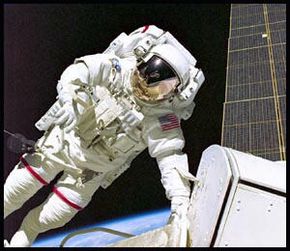
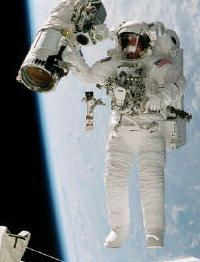
Space suits provide oxygen, temperature control and some protection from radiation.
Photo courtesy NASA
Think about how you suit up when you go outside on a cold winter's day. You have your shirt, pants, sweater, perhaps long underwear, jacket, gloves, hat or hood, scarf and boots. You put on quite a bit of clothing to protect you from the cold.
Now, imagine what you would have to put on to protect you from outer space. Space suits must provide all of the comfort and support that the Earth or a spacecraft does, addressing issues like atmosphere, water and protection from radiation.
Advertisement
Outer space is an extremely hostile place. If you were to step outside a spacecraft and you weren't wearing a space suit, the following things could happen:
You could become unconscious within 15 seconds because there's no oxygen.
Your blood and body fluids could "boil" and then freeze because there is little or no air pressure.
Your tissues (skin, heart, other internal organs) could expand because of the boiling fluids.
You could face extreme changes in temperature. For example, in the sunlight temperatures might reach 248 degrees F (120 degrees C) and plummet to -148 F ( -100 C) in the shade.
You would be exposed to various types of radiation, such as cosmic rays, and charged particles emitted from the sun (solar wind).
You could be hit by small particles of dust or rock that move at high speeds (micrometeoroids) or orbiting debris from satellites or spacecraft.
So, to protect you from these dangers, a space suit must:
Have a pressurized atmosphere
Give you oxygen and remove carbon dioxide
Maintain a comfortable temperature despite strenuous work and movement into and out of sunlit areas
Protect you from micrometeoroids and from radiation to some degree
Allow you to see clearly, move easily inside the space suit and outside of the spacecraft, and communicate with others (ground controllers, fellow astronauts)
That's a big job. In this article, we will examine the problems of walking in outer space and how space suits are made to cope with them.
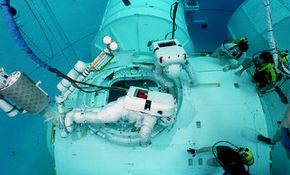
Astronauts training in water for a spacewalk to build the International Space Station
Photo courtesy NASA
By creating an Earth-like environment within the suit itself, space suits allow humans to walk around in space in relative safety. Space suits provide:
Pressurized Atmosphere
The space suit provides air pressure to keep the fluids in your body in a liquid state -- in other words, to prevent your bodily fluids from boiling. Like a tire, a space suit is essentially an inflated balloon that is restricted by some rubberized fabric, in this case, Neoprene-coated fibers. The restriction placed on the "balloon" portion of the suit supplies air pressure on the astronaut inside, like blowing up a balloon inside a cardboard tube.
Advertisement
Most space suits operate at pressures below normal atmospheric pressure (14.7 lb/in2, or 1 atm); the space shuttle cabin also operates at normal atmospheric pressure. The space suit used by shuttle astronauts operates at 4.3 lb/in2, or 0.29 atm. Therefore, the cabin pressure of either the shuttle itself or an airlock must be reduced before an astronaut gets suited up for a spacewalk. A spacewalking astronaut runs the risk of getting the bends because of the changes in pressure between the space suit and the shuttle cabin.
Oxygen
Space suits cannot use normal air -- 78 percent nitrogen, 21 percent oxygen and 1 percent other gases -- because the low pressure would cause dangerously low oxygen concentrations in the lungs and blood, much like climbing Mt. Everest does. So, most space suits provide a pure oxygen atmosphere for breathing. Space suits get the oxygen either from a spacecraft via an umbilical cord or from a backpack life support system that the astronaut wears.
Both the shuttle and the International Space Station have normal air mixtures that mimic our atmosphere. Therefore, to go into a pure oxygen space suit, a spacewalking astronaut must "pre-breathe" pure oxygen for some period of time before suiting up. This pre-breathing of pure oxygen eliminates the nitrogen from the astronaut's blood and tissues, thereby minimizing the risk of the bends.
Carbon Dioxide
The astronaut breathes out carbon dioxide. In the confined space of the suit, carbon dioxide concentrations would build up to deadly levels. Therefore, excess carbon dioxide must be removed from the space suit's atmosphere. Space suits use lithium hydroxide canisters to remove carbon dioxide. These canisters are located either in the space suit's life support backpack or in the spacecraft, in which case they are accessed through an umbilical cord.
Temperature
To cope with the extremes of temperature, most space suits are heavily insulated with layers of fabric (Neoprene, Gore-Tex, Dacron) and covered with reflective outer layers (Mylar or white fabric) to reflect sunlight. The astronaut produces heat from his/her body, especially when doing strenuous activities. If this heat is not removed, the sweat produced by the astronaut will fog up the helmet and cause the astronaut to become severely dehydrated; astronaut Eugene Cernan lost several pounds during his spacewalk on Gemini 9. To remove this excess heat, space suits have used either fans/heat exchangers to blow cool air, as in the Mercury and Gemini programs, or water-cooled garments, which have been used from the Apollo program to the present.
Micrometeroids
To protect the astronauts from collisions with micrometeroids, space suits have multiple layers of durable fabrics such as Dacron or Kevlar. These layers also prevent the suit from tearing on exposed surfaces of the spacecraft or a planet or moon.
Radiation
Space suits offer only limited protection from radiation. Some protection is offered by the reflective coatings of Mylar that are built into the suits, but a space suit would not offer much protection from a solar flare. So, spacewalks are planned during periods of low solar activity.
Clear Sight
Space suits have helmets that are made of clear plastic or durable polycarbonate. Most helmets have coverings to reflect sunlight, and tinted visors to reduce glare, much like sunglasses. Also, prior to a spacewalk, the inside faceplates of the helmet are sprayed with an anti-fog compound. Finally, modern space suit helmet coverings have mounted lights so that the astronauts can see into the shadows.
Mobility Within the Space suit
Moving within an inflated space suit is tough. Imagine trying to move your fingers in a rubber glove blown up with air; it doesn't give very much. To help this problem, space suits are equipped with special joints or tapers in the fabric to help the astronauts bend their hands, arms, legs, knees and ankles.
Communications
Space suits are equipped with radio transmitters/receivers so that spacewalking astronauts can talk with ground controllers and/or other astronauts. The astronauts wear headsets with microphones and earphones. The transmitters/receivers are located in the chestpacks/backpacks worn by the astronauts.
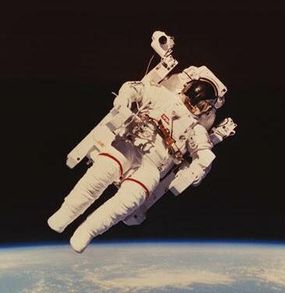
Astronaut Bruce McCandless II floated freely in space while testing the Manned Maneuvering Unit (MMU) during an early shuttle flight.
Photo courtesy NASA
Mobility in the Spacecraft
In weightlessness, it is difficult to move around. If you push on something, you fly off in the opposite direction (Newton's third law of motion -- for every action there is an equal and opposite reaction). Gemini spacewalking astronauts reported great problems with just maintaining their positions; when they tried to turn a wrench, they spun in the opposite direction. Therefore, spacecraft are equipped with footholds and hand restraints to help astronauts work in microgravity. In addition, before the mission, astronauts practice spacewalking in big water tanks on Earth. The buoyancy of an inflated space suit in water simulates microgravity.
NASA has also developed some gas-powered rocket maneuvering devices to allow astronauts to move freely in space without being tethered to the spacecraft. One such device, which was called the Manned Maneuvering Unit (MMU), was basically a gas-thruster powered chair with a joystick control. NASA has also developed a nitrogen-gas propelled unit that fits on the backpack, called the Simplified Aid for Extravehicular Activity Rescue (SAFER). The SAFER can help an astronaut return to the shuttle or station in the event that he/she gets separated from the spacecraft. The SAFER holds 3.1 lb (1.4 kg) of nitrogen propellant and can change an astronaut's velocity by a maximum of about 9 feet/second (3 meters/second).
Advertisement
Space Suit History
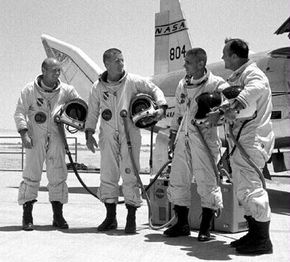
Test pilots of the H-10 series lifting body aircraft
Photo courtesy NASA
When jet aircraft were developed, pilots needed pressurized flight suits to cope with the low atmospheric pressure and lack of oxygen at high altitudes. Most of these suits were designed to be used only when the pressurized cabin failed. The suits consisted of neoprene rubber-coated fabric that could inflate like a balloon, and a more rigid fabric over the neoprene to restrain the suit and direct the pressure inward on the pilot. Hoses were attached from the plane to the suit to provide oxygen.
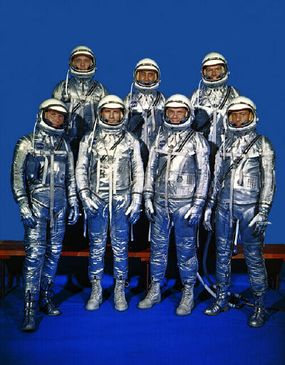
When NASA's Mercury program started, the space suits kept the designs of the early pressurized flight suits, but added layers of aluminized Mylar over the neoprene rubber.
Advertisement
Original Mercury astronauts in their space suits
Photo courtesy NASA
The Mercury space suit also had laced boots, a helmet that attached via a collar ring, and gloves. The suit was cooled with an external fan unit that the astronaut carried. The astronaut received oxygen from the spacecraft via hoses connected to the suit. Again, the suit was only pressurized in the event that the cabin pressure failed.
Astronauts found it difficult to move in the Mercury space suit when it was pressurized; the suit itself was not designed for spacewalking. However, when NASA's Gemini program began, space suits had to be designed not only for emergency use, but also for spacewalking, so some changes had to be made.
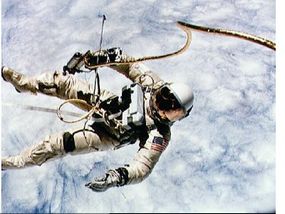
Gemini 4 astronaut Ed White II during America's first spacewalk
Photo courtesy NASA
To cope with the space environment, the Gemini space suit had a human-shaped neoprene rubber bladder that was constrained by netting. Over the bladder, the suit had layers of Teflon-coated nylon to protect the wearer from micrometeoroids. The spacecraft supplied the oxygen and air-cooling through an umbilical cord (shown in the photo above). After the Gemini program, astronauts learned that cooling with air did not work very well. Often, the astronauts were overheated and exhausted from spacewalking; and their helmets often fogged up on the inside from excessive moisture. In the following section, we'll talk about the changes that were made to the space suit design for the Apollo.
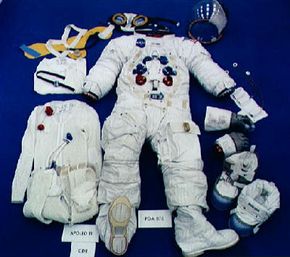
Because Apollo astronauts had to walk on the moon as well as fly in space, a single space suit was developed that had add-ons for moonwalking. The basic Apollo space suit, which was worn during liftoff, was the backup suit needed in case cabin pressure failed.
The Apollo suit consisted of the following:
Advertisement
A water-cooled nylon undergarment
A multi-layered pressure suit: inside layer - lightweight nylon with fabric vents; middle layer - neoprene-coated nylon to hold pressure; outer layer - nylon to restrain the pressurized layers beneath
Five layers of aluminized Mylar interwoven with four layers of Dacron for heat protection
Two layers of Kapton for additional heat protection
A layer of Teflon-coated cloth (nonflammable) for protection from scrapes
A layer of white Teflon cloth (nonflammable)
The suit had boots, gloves, a communications cap and a clear plastic helmet. During liftoff, the suit's oxygen and cooling water were supplied by the ship.
For walking on the moon, the space suit was supplemented with a pair of protective overboots, gloves with rubber fingertips, a set of filters/visors worn over the helmet for protection from sunlight, and a portable life support backpack that contained oxygen, carbon-dioxide removal equipment and cooling water. The space suit and backpack weighed 180 lb on Earth, but only 30 lb on the moon.
The basic Apollo space suit was also used for spacewalking during the Skylab missions.
During the early flights of the space shuttle, astronauts wore a brown flight suit. Like earlier missions, this flight suit was meant to protect the astronauts if the cabin pressure failed. Its design was similar to the earlier flight suits of Apollo.
As shuttle flights became more routine, the astronauts stopped wearing pressurized suits during liftoff. Instead, they wore light-blue coveralls with black boots and a white, plastic, impact-resistant, communications helmet. This practice was continued until the Challenger disaster.
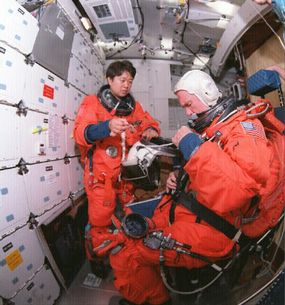
Latest shuttle flightsuit used during liftoff and re-entry
Photo courtesy NASA
After a review of the Challenger disaster, NASA started requiring all astronauts to wear pressurized suits during liftoff and re-entry. These orange flight suits are pressurized and equipped with a communications cap, helmet, boots, gloves, parachute, and inflatable life preserver. Again, these space suits are designed only for emergency use -- in case the cabin pressure fails or the astronauts have to eject from the spacecraft at high altitude during liftoff or re-entry. We will discuss the current space suit (Extravehicular Mobility Unit or EMU) that is used for spacewalking from the shuttle and International Space Station in the next section.
Advertisement
Modern Space Suit: EMU
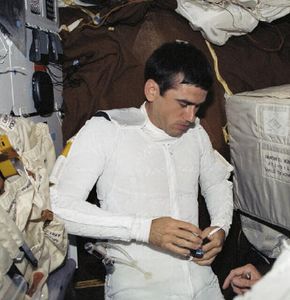
Astronaut in LCVG preparing for a spacewalk
Photo courtesy NASA
While early space suits were made entirely of soft fabrics, today's Extravehicular Mobility Unit (EMU) has a combination of soft and hard components to provide support, mobility and comfort. The suit itself has 13 layers of material, including an inner cooling garment (two layers), pressure garment (two layers), thermal micrometeoroid garment (eight layers) and outer cover (one layer). The materials used include:
Nylon tricot
Spandex
Urethane-coated Nylon
Dacron
Neoprene-coated Nylon
Mylar
Gortex
Kevlar (material in bullet-proof vests)
Nomex
All of the layers are sewn and cemented together to form the suit. In contrast to early space suits, which were individually tailored for each astronaut, the EMU has component pieces of varying sizes that can be put together to fit any given astronaut.
Advertisement
The EMU consists of the following parts:
Maximum Absorption Garment (MAG) - collects urine produced by the astronaut
Liquid Cooling and Ventilation Garment (LCVG) - removes excess body heat produced by the astronaut during spacewalks
EMU Electrical Harness (EEH) - provides connections for communications and bio-instruments
Communications Carrier Assembly (CCA) - contains microphones and earphones for communications
Lower Torso Assembly (LTA) - lower half of the EMU including pants, knee and ankle joints, boots and lower waist
Hard Upper Torso (HUT) - hard fiberglass shell that supports several structures including the arms, torso, helmet, life-support backpack and control module
Arms
Gloves - outer and inner gloves
Helmet
Extravehicular Visor Assembly (EVA) - protects the astronaut from bright sunlight
In-suit Drink Bag (IDB) - provides drinking water for the astronaut during the spacewalk
Primary Life Support Subsystem (PLSS) - provides oxygen, power, carbon dioxide removal, cooling water, radio equipment and warning system
Display and Control Module (DCM) - displays and controls to run the PLSS
Maximum Absorption Garment (MAG)
Spacewalking astronauts can spend up to seven hours spacewalking. During that time, their bodies produce urine. Because it takes too much time to pressurize and depressurize both the space suits and the airlocks/spacecraft, astronauts cannot simply go inside the spacecraft and use the toilet to relieve themselves. Therefore, each spacewalking astronaut wears a large, absorbant diaper to collect urine and feces while in the space suit. The astronaut disposes the MAG when the spacewalk is over.
Liquid Cooling and Ventilation Garment (LCVG)
LCVG is a set of Nylon tricot and spandex "long underwear" that is laced with thin plastic tubes. Cool water flows through these tubes to remove the heat produced by the astronaut. The cooling water comes from the space suit's backpack unit or from the spacecraft through an umbilical cord (used in the airlock while preparing for the spacewalk).
EMU Electrical Harness (EEH)
This is a set of communications wires and bioinstruments that is worn by the astronaut inside the suit. It provides connections to the radio and bioinstruments in the suit's backpack. It allows for communication and for monitoring of the astronaut's vital signs (respiration rate, heart rate, temperature, etc.).
Communications Carrier Assembly (CCA)
The CCA is a fabric cap worn by the astronaut. It contains microphones and speakers for use with the radio. It allows hands-free radio communications within the suit.
Lower Torso Assembly (LTA)
The LTA is a one-piece unit that contains the lower half of the EMU, including pants, knee and ankle joints, boots and lower waist. It is fitted to the upper half of the EMU by a metal connect ring. The LTA has loops to tether tools so that they do not float away in space.
EMU Facts
Weight = 280 lb (127 kg) on Earth
Thickness = 3/16 in (0.48 cm), 13 layers
Atmosphere = 4.3 lb/in2 (0.29 atm) of pure oxygen
Volume = 4.4 to 5.4 ft3 (.125 to .153 m3) without astronaut
Cost = $12 million each
Contractors - Hamilton Sundstrand, ILC Dover
Advertisement
Modern Space Suit: Upper Torso
Hard Upper Torso (HUT)
The HUT is a hard fiberglass shell in the shape of a vest. It supports several structures including the arms, lower torso, helmet, life-support backpack and control module. It can also hold a mini-tool carrier. Pieces click into the HUT through quick-connect rings.
Arms
Arm units contain shoulder, upper arm and elbow joint bearings so that the astronaut can move his or her arms in many directions. The arm units come in various sizes so that the EMU can be fitted to different astronauts. The arm units fit into the HUT by quick connect rings.
Advertisement
Gloves
Like the arm units, gloves have wrist bearings for easy movement. They fit into the arms by quick-connect rings. The gloves have rubberized fingertips to help astronauts grip things. Astronauts also wear fine-fabric gloves inside the outer glove units for comfort. The outer gloves have loops on them to tether tools.
Helmet
The helmet is made of clear, impact-resistant, polycarbonate plastic, and fits to the HUT by a quick-connect ring. The helmet is padded in the rear for comfort, because the helmet remains fixed rather than rotating with the astronaut's head. It has a purge valve to remove carbon dioxide if the backup oxygen supply must be used. In the helmet, oxygen flows from behind the astronaut's head, over the head and down his or her face. The inside of the helmet is treated with an anti-fog compound prior to the spacewalk.
Extravehicular Visor Assembly (EVA)
The EVA fits over the helmet. It has the following pieces:
A metallic-gold-covered visor to filter sunlight
A clear, impact resistant cover for thermal and impact protection
Adjustable blinders to block sunlight
Four head lamps
A TV camera
In-suit Drink Bag (IDB)
Astronauts working in a space suit for up to seven hours need water. So the space suit has the IDB, which is a plastic pouch mounted inside the HUT. The IDB can hold 32 ounces (1.9 liters) of water and has a small tube, a straw, that is positioned next to the astronaut's mouth.
There is also a slot in the helmet for a rice-paper-covered fruit and cereal bar that the astronaut can eat if he or she gets hungry during the spacewalk. The bar is designed so that the astronaut can take a bite and pull the remainder up. The entire bar must be eaten at once to prevent crumbs from floating within the helmet. However, most astronauts prefer to eat prior to the spacewalk and not use this bar.
Primary Life-Support Subsystem (PLSS)
The PLSS is the backpack worn by the astronaut. It contains the oxygen tanks (1.2 lb / 0.54 kg at 518 atm tank pressure), carbon dioxide scrubbers/filters, cooling water (10 lb / 4.6 kg total), radio, electrical power, ventilating fans and warning systems. Oxygen flows into the suit behind the astronauts's head and out of the suit at the feet and elbows. Once inside the PLSS, the air flow enters a charcoal cartridge, to remove odors, and then the carbon dioxide scrubber cartridge. The gas flow then goes through a fan, and then to a sublimator that removes water vapor and returns it to the cooling-water supply. The temperature of the air flow is maintained at 55 F (12.8 C). The astronaut can adjust the temperature, pressure and air flow through controls on the DCM. The PLSS provides up to seven hours of oxygen supply and carbon dioxide removal.
The EMU battery is made of 11 zinc cells connected in series. The battery provides about 27 amp-hours of electrical current, and can be recharged inside the shuttle.
Secondary Oxygen Pack (SOP)
The SOP is an emergency oxygen supply that fits below the PLSS on the backpack frame. It has two oxygen tanks that contain a total of 2.6 lb (1.2 kg) at 408 atm tank pressure. This is enough oxygen for 30 minutes, which is sufficient time to get a crewmember back inside the spacecraft. This oxygen supply automatically turns on when the oxygen pressure in the suit drops below 0.23 atm.
Display and Control Module (DCM)
The DCM is a chest-mounted unit. It contains all of the switches, gauges, valves and LCD displays necessary to operate the PLSS. The DCM can be seen by the astronaut, sometimes with the aid of a sleeve-mounted mirror.
In addition to these major parts, the EMU has some of the following accessories:
Servicing and Cooling Umbilical (SCU) - provides connections to the spacecraft's oxygen, power, communication and water lines
Airlock Adapter Plate (AAP) - holds the EMU pieces while the astronaut is suiting up
Helmet Lights and Camera - provide additional lighting and cameras for ground control monitoring
Sleeve-mounted Mirrors - help astronauts see gauges on the DCM
Sleeve-mounted Checklists - remind them of spacewalk procedures
Servicing and Cooling Umbilical (SCU)
The SCU is an umbilical cord containing tubes for cooling water, electrical wires for power and tubes for oxygen. The SCU is used to provide water, power and oxygen to the EMU while the astronaut is in the airlock preparing for the spacewalk. This helps conserve the EMU's expendable supplies until the astronaut actually leaves the spacecraft.
Airlock Adapter Plate (AAP)
The AAP is a frame mounted to the wall of the airlock that helps hold the EMU pieces while the astronaut is suiting up.
Helmet Lights and Camera
These devices are mounted on the EVA, which fits over the helmet. They are used to help the astronauts and ground controllers see into dark areas.
Sleeve-mounted Mirrors and Checklists
These devices fit over the sleeves of the EMU. The mirrors help the astronauts see the DCM displays and see behind them. The checklists help them remember procedures over the course of a seven-hour spacewalk.
In the next section, we'll find out how an astronaut gets into one of these things.
Advertisement
Putting on a Spacesuit
An astronaut on a space walk.
Photo courtesy NASA
To prepare for a spacewalk, crewmembers must do the following:
Reduce the pressure in the shuttle to 0.7 atm and increase the oxygen
Pre-breathe 100 percent oxygen for 30 minutes to remove nitrogen from their blood and tissues
Put on the MAG
Enter the airlock
Put on the LCVG
Attach the EEH to the HUT
Attach the DCM to the HUT (PLSS is pre-attached to the HUT)
Attach the arms to the HUT
Rub the helmet with anti-fog compound
Place a wrist mirror and checklist on the sleeves
Insert a food bar and water-filled IDB inside the HUT
Check the lights and TV cameras on the EVA
Place the EVA over the helmet
Connect the CCA to the EEH
Step into the LTA and pull it above their waist
Plug the SCU into the DCM and into the shuttle
Squirm into the upper torso portion of the suit
Attach the cooling tubes of the LVCG to the PLSS
Attach the EEH electrical connections to the PLSS
Lock the LTA to the HUT
Put on the CCA and eyeglasses (if the astronaut wears them)
Put on comfort gloves
Lock on the helmet and EVA
Lock on the outer gloves
Check the EMU for leaks by increasing the pressure to 0.20 atm above the airlock pressure
No leaks mean the airlock is depressurized. Once these steps are completed:
Advertisement
The EMU automatically depressurizes to its operating pressure.
The suits are tethered to the airlock.
The outer airlock door is opened.
The SCU is disconnected from the EMU.
The astronauts step out of the airlock into the shuttle's cargo bay.
And the spacewalk begins. At this point, the EMU is a spacecraft in and of itself, independent of the shuttle/space station. This is why each EMU has a $12 million price tag. After the spacewalk, these steps are reversed to get out of the suit and back into the spacecraft.
When working on the moon, Apollo astronauts had difficulties moving around in their space suits. The Apollo suits were not nearly as flexible as the EMU used today; however, the EMU weighs almost twice as much as the Apollo suit (not a problem because the EMU was designed for work in microgravity, not on a planet's surface). For future space missions to Mars, NASA is developing "hard suits" that are more flexible, more durable, lighter-weight and easier to don than current space suits.
For more information on space suits and related topics, check out the links on the next page.