Introduction to How Tsunamis Work
On December 26, 2004, a massive underwater earthquake off the coast of Indonesia's Sumatra Island rattled the Earth in its orbit. The quake, measuring 9.0 on the Richter scale, was the largest one since 1964. Dozens of aftershocks with magnitudes of 5.0 or higher occurred in the following days. But the most powerful and destructive aftermath of this devastating earthquake was the tsunami that it caused. The death toll reached higher than 220,000, and many communities suffered devastating property damage.
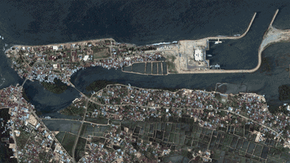
![]() Photo courtesy DigitalGlobe The shore of Banda Aceh, Sumatra, before and after the 2004 tsunami. See more flood pictures. |
![]() Photo courtesy DigitalGlobe Banda Aceh northern shore detail, 2004, before and after the tsunami |
Related Links |
The devastation of this tsunami overshadowed the devastation of any other tsunami we've seen in recent history, but scientifically, the course of events followed the same basic sequence of a typical tsunami. In this article, we'll look at what causes tsunamis, the physics that drives them and the effects of a tsunami strike. We will also examine scientists' worldwide efforts to monitor and predict tsunamis in order to avoid disasters like the one that occurred in the final days of 2004. Find out more about how to classify waves on the next page.
Classifying Waves
Anatomy of a Wave
The word "tsunami" comes from the Japanese words tsu (harbor) and nami
(waves). A tsunami is a wave or series of waves in the ocean that can
be hundreds of miles long and have been known to reach heights of up to
34 ft (10.5 m). These "walls of water" travel as fast or faster than a
commercial jet. The massive December 26, 2004 tsunami traveled 375
miles (600 km) in 75 minutes. That's 300 mph (480 kph). These walls of
water are capable of inflicting massive damage along coastal lands.
![]() Photo courtesy DigitalGlobe Tsunami strikes Sri Lanka, December 26, 2004 |
In order to understand tsunamis, let's first look at waves in general. Most of us are familiar with waves from days at the beach or local water park wave pools. Waves are made up of a crest (the highest point of the wave) and a trough (the lowest point of the wave). Waves are measured in two ways:
- The wave height is the distance between the crest and trough.
- The wave length is the horizontal distance between two consecutive wave crests.
![]() Photo courtesy U.S. Navy Anatomy of a normal wave |
The frequency of waves is measured by the time it takes for two consecutive waves to cross the same point. This is called the wave period.
Tsunamis and normal waves have all of the same parts and are measured in the same ways, but there are many differences between the two. The chart below shows some of the differences.
|
vs. Typical Wind-generated Wave | ||
| Wave Feature | Wind-generated Wave | Tsunami Wave |
| Wave Speed | 5-60 mph (8-100 kph) | 500-600 mph (800-1,000 kph) |
| Wave Period (time required for two waves to pass a single point in space) | 5 to 20 seconds apart | 10 minutes to 2 hours apart |
| Wave Length (horizontal distance between two waves) | 300-600 feet apart (100-200 meters apart) | 60-300 miles apart (100-500 km apart) |
The primary differences are size, speed and source. Let's look at what creates a normal wave.
Waves in the ocean are created by a number of things (gravitational pull, underwater activity, atmospheric pressure), but the most common source for waves is the wind.
![]() Photo courtesy DigitalGlobe Banda Aceh flooding, 2004 |
![]() Photo courtesy DigitalGlobe Banda Aceh Grand Mosque, before and after the 2004 tsunami |
When the wind blows across a smooth water surface, the air molecules grab water molecules as they are carried across the water by the wind. The friction between the air and water stretches the water's surface, creating ripples in the water known as capillary waves. The capillary waves move in circles. This circular motion of water continues vertically underwater, though the power of this motion decreases in deeper water. As the wave travels, more and more water molecules are collected, increasing the size and momentum of the wave. The most important thing to know about waves is that they do not represent the movement of water, but instead show the movement of energy through water.
In normal waves, the wind is the source of that energy. The size and speed of wind waves is dependant on the strength of the wind.
The Birth of a Tsunami
The most common causes of tsunamis are underwater earthquakes. To understand underwater earthquakes, you must first understand plate tectonics. The theory of plate tectonics suggests that the lithosphere, or top layer of the Earth, is made up of a series of huge plates. These plates make up the continents and seafloor. They rest on an underlying viscous layer called the asthenosphere.Think of a pie cut into eight slices. The pie crust would be the lithosphere and the hot, sticky pie filling underneath would be the asthenosphere. On the Earth, these plates are constantly in motion, moving along each other at a speed of 1 to 2 inches (2.5-5 cm) per year. The movement occurs most dramatically along fault lines (where the pie is cut). These motions are capable of producing earthquakes and volcanism, which, when they occur at the bottom of the ocean, are two possible sources of tsunamis.
![]() Formation of a tsunami |
When two plates come into contact at a region known as a plate boundary, a heavier plate can slip under a lighter one. This is called subduction. Underwater subduction often leaves enormous "handprints" in the form of deep ocean trenches along the seafloor.
In some cases of subduction, part of the seafloor connected to the lighter plate may "snap up" suddenly due to pressure from the sinking plate. This results in an earthquake. The focus of the earthquake is the point within the Earth where the rupture first occurs, rocks break and the first seismic waves are generated. The epicenter is the point on the seafloor directly above the focus.
When this piece of the plate snaps up and sends tons of rock shooting upward with tremendous force, the energy of that force is transferred to the water. The energy pushes the water upward above normal sea level. This is the birth of a tsunami. The earthquake that generated the December 26, 2004, tsunami in the Indian Ocean was a 9.0 on the Richter scale -- one of the biggest in recorded history.
Hitting the Water
Once the water has been pushed upward, gravity acts on it, forcing the energy out horizontally along the surface of the water. It's sort of the same ripple effect you get from throwing a pebble in the water, but in reverse: The energy is generated by a force moving out of rather than into the water. The energy then moves through the depths of the water and away from the initial disturbance.
The tremendous force created by the seismic disturbance generates the tsunami's incredible speed. The actual speed of the tsunami is calculated by measuring the water depth at a point in time when the tsunami passes by. The speed is the square root of the product of acceleration of gravity and the quantity of water depth, or:
- t = square root (g x d)
t = tsunami speed in meters per second
g = acceleration of gravity (32 feet/10 meters per second/per second)
d = quantity of water depth
Photo courtesy NOAA
An animation of the 2004 Indian Ocean tsunami
A tsunami's ability to maintain speed is directly influenced by the depth of the water. A tsunami moves faster in deeper water and slower in shallower water. So unlike a normal wave, the driving energy of a tsunami moves through the water as opposed to on top of it. As a result, as a tsunami moves though deep water at hundreds of miles an hour, it is barely noticeable above the waterline. A tsunami is typically no more than 3 feet (1 meter) high until it gets close to shore.
Once a tsunami gets close to shore, it takes its more recognizable and deadly form.
Photo courtesy USGS
Simulation of a theoretical tsunami in the Pacific
A distant tsunami travels more than 600 miles (1,000 km) from the source area before it reaches land. Distant tsunamis are more likely to occur in the Pacific Ocean and are capable of traveling across the entire ocean in less than one day. Since distant tsunamis make such long trips with a relatively constant speed, experts can predict their arrival with a fair degree of accuracy. This makes it easy to warn and evacuate people that could be affected by the wave. A local tsunami travels toward nearby coastal lands within 60 miles (100 km) of the source. Local tsunamis are usually the result of submarine landslides and typically occur in a bay or harbor. Local tsunamis are particularly dangerous because they can reach land within a matter of minutes. This type of "sneak attack" makes it hard to warn the public about the tsunami's approach. |
Landfall and Famous Tsunamis
When a tsunami reaches land, it hits shallower water. The shallow water and coastal land acts to compress the energy traveling through the water. This starts the transformation of the tsunami.
The topography of the seafloor and shape of the shore begins to affect the tsunami's appearance and behavior. Also, as the velocity of the wave diminishes, the wave height increases considerably -- the compressed energy forces the water upward. A typical tsunami approaching land will slow down to speeds around 30 miles per hour (50 kph), and the wave heights can reach up to 90 feet (30 meters) above sea level. As the wave heights increase during this process, the wave lengths shorten considerably. (Think of squeezing an accordion.)
A witness on the beach will see a noticeable rise and fall of beach water when a tsunami is imminent. Sometimes, the coastal water will disappear completely as it is drawn into the tsunami. This amazing event is followed by the actual trough of the tsunami reaching shore. Tsunamis most often arrive as a series of strong and fast floods of water, not one single, enormous wave. However, a bore, which is a large vertical wave that arrives with a churning front, may appear. Bores are often followed by rapid floods of water, which make them particularly destructive. Other waves can follow anywhere from five to 90 minutes after the initial strike -- the tsunami wave train, after traveling as a series of waves over a long distance, is releasing itself onto land.
Tsunamis typically result in staggering body counts. This is especially true when they strike without warning. Tsunamis can level development and strip away coastlines, pulling everything in their path out to sea.
![]() Photo courtesy National Geophysical Data Center Tsunami breaking over pier in Hilo, Hawaii |
![]() Photo courtesy National Geophysical Data Center Wreckage of a political party clubhouse from a tsunami that hit the Aleutian Islands in 1946 |
The areas of greatest risk during a tsunami strike are within 1 mile (1.6 km) of the shoreline, due to the flooding and scattered debris, and less than 50 feet (15 m) above sea level, due to the height of the striking waves.
A tsunami is even capable of reaching sheltered areas due to varying land features and the underlying seascape. For instance, a protected bay area with a narrow inlet can give a tsunami a "funnel" to travel through, amplifying the destructive power of the waves. Also, a river channel can provide room for a tsunami bore to rush through, allowing it to flood tremendous tracts of land.
Until a tsunami strikes, it's difficult to predict how it will interact with the features of the affected land. The wrap-around effect occurs along island coastlines when multiple wave strikes hit different areas of surrounding land, resulting in different degrees of flooding. Harbor resonance is a chaotic and highly destructive tsunami side effect created when waves continuously reflect and bounce off of the edges of a harbor or bay. Harbor resonance can cause the amplification of circulating wave heights and even increase the duration of the wave activity within the area.
|
2004 Tsunami
On December 26, 2004, the world's most powerful earthquake in more than 40 years struck deep under the Indian Ocean off the west coast of Sumatra, triggering a massive tsunami. One of the things that made this event particularly destructive is that the tsunamis struck relatively well-populated areas in the middle of the tourist-packed holiday season. Here is a timeline of the disaster:12:59 am - A massive 9.0 earthquake occurs in the Indian Ocean off Sumatra, Indonesia. The quake is so large it is felt in the neighboring countries of Thailand, Malaysia and Singapore. Huge buildings in the Thai capital of Bangkok shake under the force of the earthquake and its aftershocks. Bangkok is 1,242 miles (nearly 2,000 km) from where the earthquake took place.
1:07 am - After the quake, stations in Australia alert the NOAA Pacific Tsunami Warning Center of the earthquake and the potential tsunami threat. There are widely conflicting reports from different sources about the size of the quake. Different reports put the earthquake at magnitudes varying between 6.6 and 8.9. At the same time, an Indonesian radio station reports the death of nine villagers as the result of a tidal wave.
![]() Photo courtesy DigitalGlobe Kalutara, Sri Lanka - receding waters |
![]() Photo courtesy DigitalGlobe Kalutara flooding close-up - receding waters |
2:27 am - The massive waves hit Kalmunai, Sri Lanka.
2:30 am - Kattankudy is hit. By now, almost the entire east coast of Sri Lanka is under 9 feet (2.7 meters) of water.
2:40 am - Over the next 15 minutes, Batticaloa, Mullaitivu and Trincomalee, Sri Lanka, are hit. Yala, Thailand, is also struck by the tsunami. Though it has not yet been reported, more than 15,000 people have died.
2:57 am - News wire services release the first report: "Earthquake sets off big waves." Reports of heavy damage and fatalities began to come in from Thailand's Phukit resort area. The official death toll is still nine. All reports are unclear, and the numbers are unconfirmed.
![]() Photo courtesy DigitalGlobe Beach damage in Kalutara |
3:00 am - An AFP news correspondent in Colombo, Sri Lanka, gets a phone call from reporters in Trinco: "The sea is coming in." In the same moment, Valvettiturai and Hambantota are hit. Almost 7,000 people are washed out to sea.
3:15 am - A Washington Post correspondent reports a tsunami hitting Weligama, Sri Lanka. The Sri Lankan provinces of Matara, Galle and Panadura are also hit. Another 5,000 people die.
3:20 am - Loaded with European tourists, the Sri Lankan resort Rae of Kalutara is hit. Satellite imagery reveals the water reaching 500 yards (460 meters) in from the shore line.
3:30 am - The AFP news correspondent in Colombo gets a call from Matara indicating that a second round of waves is coming. Waves hit the Indian coast. PTWC begins getting wire reports from the Internet about Sri Lankan casualties. Negombo, Sri Lanka, is hit.
3:46 am - AFP news reports massive casualties and numbers of homeless in Sri Lanka.
4:11 am - Rapidly rising water levels in India damage the coastline. Some small tremors are felt.
5:00 am - PTWC advises the U.S. Pacific Command in Hawaii of the potential threat of more tsunamis in the western Indian Ocean.
5:13 am - Sri Lanka deploys the military and asks India for help.
5:41 am - The Prime Minister of Thailand orders the evacuation of three major provinces, including Phukit.
6:09 am - In a few hours, the tsunami has all but crossed the ocean, flooding Male, the capitol of Maldives.
7:15 am - The PTWC advises the U.S. State Department on the continuing threat of tsunamis in Madagascar and Africa. In the next few hours, organized relief efforts begin.
Predictions
Scientists are constantly trying to learn new ways to predict the behavior of tsunamis. At this point, most data is gathered after a tsunami has already done its damage.
In a post-tsunami survey, a number of things are measured. Scientists are particularly interested in the inundation and run-up features after the waves strike land. Inundation is the maximum horizontal distance penetrated inland. Run-up is the maximum vertical distance above the sea level that the waves reached. Inundation and run-up are often determined by measuring the distance of killed vegetation, scattered debris along the land and eyewitness accounts of the incident.
![]() Photo courtesy National Geophysical Data Center Tsunami generated by earthquake of April 1, 1946, Aleutian Islands, Alaska. On the left, a building before the tsunami. On the right, the same building after the tsunami. |
![]() Photo courtesy National Geophysical Data Center Damage from tsunami generated by earthquake of May 22, 1960, coast of Chile |
Scientists have made great strides in monitoring and predicting the ongoing threat of tsunamis. One center continuously monitoring seismic events and changes in the tide level is the Pacific Tsunami Warning Center (PTWC). The PTWC is located in Ewa Beach, HI, and services the Hawaiian Islands and surrounding U.S. territories by working in conjunction with other regional centers. The West Coast & Alaska Tsunami Warning Center (ATWC) in Palmer, AK, serves the Aleutian Islands area along with British Columbia, Washington state, Oregon and California. This center is of particular importance because submarine earthquakes in this region have created waves that moved throughout the Pacific Ocean before striking elsewhere.
Tsunamis are detected by open-ocean buoys and coastal tide gauges, which report information to stations within the region. Tide stations measure minute changes in sea level, and seismograph stations record earthquake activity. A tsunami watch goes into effect if a center detects an earthquake at 7.5 or higher on the Richter scale. Civil defense agencies are then notified, and data from tidal gauge stations are closely monitored. If a threatening tsunami passes through and is noted by the gauge stations, a tsunami warning is issued to all potentially affected areas. Evacuation procedures in these areas are then implemented.
The Deep-Ocean Assessment and Reporting of Tsunamis (DART) uses unique pressure recorders that sit on the ocean bottom. These recorders are used to detect slight changes in the overlying water pressure. The DART system is capable of detecting a tsunami as small as a centimeter high above the sea level.
![]() Photo courtesy NOAA DART recording device |
The most serious problem facing humans is the fact that tsunami waves, once in motion, cannot be stopped. Scientists and civil agencies can only devote resources to predicting tsunamis and creating effective plans for protecting coastal areas from their ravages.
For more information on tsunamis and related topics, check out the links on the next page.
Lots More Information
Related HowStuffWorks Articles
- How Rip Currents Work
- How Earthquakes Work
- How Volcanoes Work
- Harrowing Survival Stories
- How Wave Pools Work
More Great Links


