Introduction to How Vampires Work
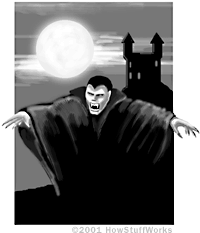
![]() The popular image of a vampire: a cloaked monster that hunts for victims at night. See more vampire pictures. |
People have been dreaming up horrible monsters and malicious spirits for centuries. The vampire, a seductive, "undead" predator, is one of the most inventive and alluring creatures of the bunch. It's also one of the most enduring: Vampire-like creatures date back thousands of years, and pop up in dozens of different cultures.
In this article, we'll see where the various elements of the vampire legend come from, and we'll examine some grounded scientific explanations for apparent vampirism. We'll also look at the psychological significance of these creatures and find out about some real-life counterparts to the supernatural vampire.
Vampire Basics
The vampires in contemporary books, movies and television shows are incredibly elaborate creatures. According to the predominant mythology, every vampire was once a human, who, after being bitten by a vampire, died and rose from the grave as a monster. Vampires crave the blood of the living, whom they hunt during the night. They use their protruding fangs to puncture their victims' necks.
|
|
Vampires are potentially immortal, but they do have a few weaknesses. They can be destroyed by a stake through the heart, fire, beheading and direct sunlight, and they are wary of crucifixes, holy water and garlic. Vampires don't cast a reflection, and they have superhuman strength.
This vampire figure, with its particular combination of characteristics and governing rules, is actually a fairly recent invention. Bram Stoker conceived it in his 1897 novel Dracula. Other authors reinterpreted Dracula in a number of plays, movies and books.
But while the specifics are new, most of the individual elements of the legend have deep roots, spanning many regions and cultures. In the next few sections, we'll look at some of the more notable vampire ancestors.
|
Vampiric shape-shifters go back thousands of years, but the particular connection to vampire bats is fairly recent. Vampire bats are only found in Central America and South America, so the Europeans and Asians who originally conceived of these monsters didn't know about them. When European explorers discovered the strange animals, they were soon incorporated into the vampire myth. |
Early Vampires: Lamastu and Lilith
|
|
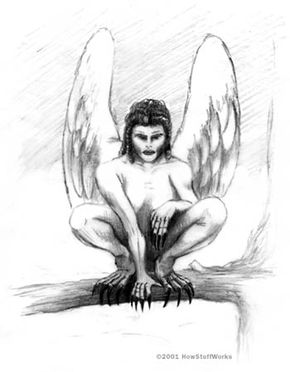
Lamastu, which translates to "she who erases," would also prey on adults, sucking blood from young men and bringing disease, sterility and nightmares. She is often depicted with wings and birdlike talons, and sometimes with the head of a lion. To protect themselves from Lamastu, pregnant women would wear amulets depicting Pazuzu, another evil god who once defeated the demoness.
![]() Lamastu and Lilith are often depicted with wings and sharp talons. |
Lamastu is closely associated with Lilith, a prominent figure in some Jewish texts. Accounts of Lilith vary considerably, but in the most notable versions of the story, she was the original woman. God created both Adam and Lilith from the Earth, but there was soon trouble between them. Lilith refused to take a subservient position to Adam, since she came from the same place he did.
In one ancient version of the legend, Lilith left Eden and began birthing her own children. God sent three angels to bring her back, and when she refused, they promised they would kill 100 of her children every day until she returned. Lilith in turn vowed to destroy human children.
Accounts of Lilith as a child-killer seem to be taken directly from the Lamastu legend. She is often described as a winged demoness with sharp talons, who came in the night, primarily to steal away infants and fetuses. Most likely, the Jews assimilated the figure of Lamastu into their tradition, but it's also possible that both myths were inspired by a third figure.
While she is often depicted as a terrifying creature, Lilith also had seductive qualities. The ancient Jews believed she would come to men at night as a succubus.
Early Greek and Asian Vampires
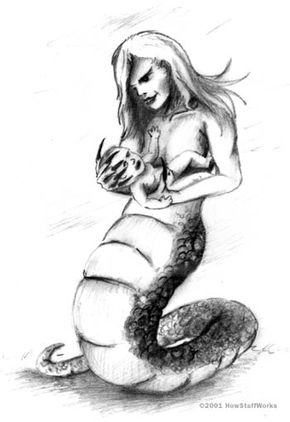
The ancient Greeks feared similar creatures, notably Lamia, a demoness with the head and torso of a woman and the lower body of a snake. In one version of the legend, Lamia was one of Zeus' mortal lovers. Filled with anger and jealousy, Zeus' wife, the goddess Hera, made Lamia insane so she would eat all her children. Once Lamia realized what she had done, she became so angry that she turned into an immortal monster, sucking the blood from young children out of jealousy for their mothers.
![]() Like Lilith and Lamastu, Lamia is depicted as half woman, half animal. She has the torso of a woman and the lower body of a snake. |
The Greeks also feared the empusai, the malicious daughters of Hecate, the goddess of witchcraft. The empusai, who could change form, came up from Hades (the underworld) at night as beautiful women. They would seduce shepherds in the field, and then devour them. A similar creature, the baobhan sith, shows up in Celtic folklore.
Vampire-like figures also have a long history in the mythology of Asia. Indian folklore describes a number of nightmarish characters, including rakshasa, gargoyle-like shape-shifters who preyed on children, and vetala, demons who would take possession of recently dead bodies to wreak havoc on the living. In Chinese folklore, corpses could sometimes rise from the grave and walk again. These k'uei were created when a person's p'o (lower spirit) did not pass onto the afterlife at death, usually because of bad deeds during life. The p'o, angered by its horrible fate, would reanimate the body and attack the living at night. One particularly vicious sort of k'uei, known as the Kuang-shi (or Chiang-shi), could fly and take different forms. The Kuang-shi was covered in white fur, had glowing red eyes and bit into its prey with sharp fangs.
Nomadic tribes and traveling traders spread different vampire legends throughout Asia, Europe and the Middle East. As these stories traveled, their various elements combined to form new vampire myths. In the past 1,000 years, vampire legends have been especially pervasive of eastern European contributions. In the next section, we'll look at these creatures, the direct predecessors of the modern vampire.
Later Vampires
The Dracula legend, and the modern vampire legend that came out of it, was directly inspired by the folklore of eastern Europe. History records dozens of mythical vampire figures in this region, going back hundreds of years. These vampires all have their particular habits and characteristics, but most fall into one of two general categories:- Demons (or agents of the devil) that reanimated corpses so they could walk among the living
- Spirits of dead people that would not leave their own body
| |
By many accounts, these undead corpses were required to return to their grave regularly to rest. When townspeople believed that someone had become a vampire, they would exhume the corpse and try to get rid of the evil spirit. They might try an exorcism ritual, but more often they would destroy the body. This might entail cremation, decapitation or driving a wooden stake through the heart. Bodies might also be buried face down, so the undead corpses would dig deeper into the earth, rather than up into shallower ground. Some families secured stakes above the corpse so it would impale itself if it tried to escape.
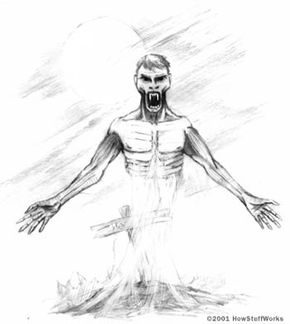
The vampires in Moldavia, Wallachia and Transylvania (now Romania) were commonly called strigoi. Strigoi were almost exclusively human spirits who had returned from the dead. Unlike the upir or vrykolakas, the strigoi would pass through different stages after rising from the grave. Initially, a strigo might be an invisible poltergeist, tormenting its living family members by moving furniture and stealing food. After some time, it would become visible, looking just as the person did in life. Again, the strigo would return to its family, stealing cattle, begging for food and bringing disease. Strigoi would feed on humans, first their family members and then anyone else they happened to come across. In some accounts, the strigoi would suck their victims' blood directly from the heart.
![]() The strigo of eastern Europe: Strigoi, reanimated corpses that prey on the living, inspired much of the modern vampire legend. |
Initially, a strigo needed to return to the grave regularly, just like an upir. If townspeople suspected someone had become a strigo, they would exhume the body and burn it, or run spikes through it. But after seven years, if a strigo was still around, it could live wherever it pleased. It was said that strigoi would travel to distant towns to begin new lives as ordinary people, and that these secret vampires would meet with each other in weekly gatherings.
In addition to undead strigoi, referred to as strigoi mort, people also feared living vampires, or strigoi viu. Strigoi viu were cursed living people who were doomed to become strigoi mort when they died. Babies born with abnormalities, such as a tail-like protrusion or a bit of fetal membrane tissue attached to the head (called a caul), were usually considered strigoi viu. If a strigoi mort living among humans had any children, the offspring were cursed to become undead strigoi in the afterlife. When a known strigoi viu died, the family would destroy its body to ensure that it would not rise from the grave.
In other parts of eastern Europe, strigoi-type creatures were known as vampir, or vampyr, most likely a variation on the Russian upir. Western European countries eventually picked up on this name, and "vampyr" (later "vampire") entered the English language.
In the 17th and 18th centuries, vampire hysteria spread through eastern Europe. People reported seeing their dead relatives walking around, attacking the living. Authorities dug up scores of graves, burning and staking the corpses. Word of the vampire scare spread to western Europe, leading to a slew of academic speculations on the creatures, as well as vampire poems and paintings. These works in turn inspired an Irishman named Bram Stoker to write his vampire novel, "Dracula." In the next section, we'll see how this work fits into the evolution of vampire lore.
Modern Vampires
Abraham (Bram) Stoker, a theater manager and part-time novelist, was not the first author to feature the vampire in a literary work, but his version is the one that really caught on. This is largely due to the novel's unforgettable villain, Count Dracula, as well as the foreboding setting. Stoker arrived at both elements through extensive research. He set much of the action in the mysterious mountains of the Transylvania province of Romania, and he based his vampires on eastern European and gypsy folklore.Selectively sampling from several versions of the vampire myth and adding some details of his own, Stoker formed the standard for the modern vampire. Unlike the vampires in the eastern European tradition, Stoker's monster loses power in the sunlight, is repelled by crucifixes and has acute intelligence. Interestingly, Stoker's vampires do not have reflections, while many earlier vampire creatures were fascinated by their own reflection.
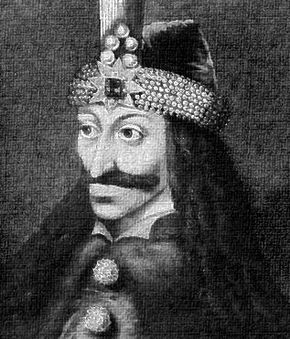
Stoker's research also turned up a name for his villain. The original Dracula was a real person, Prince Vladislav Basarab, who ruled Wallachia in the mid 1400s. His father was known as Vlad Dracul (translated as either "Vlad the dragon" or "Vlad the devil"), in recognition of his induction into a society called The Order of the Dragon. Vlad Jr. was sometimes referred to as Vlad Dracula, meaning "son of Dracul," but more often he was called "Vlad Tepes," meaning "Vlad the Impaler." This was in reference to Vlad's predilection for impaling his enemies on long wooden stakes.
![]() Count Dracula's namesake, Prince Vlad Tepes, was infamous for his viciousness on and off the battlefield. |
The real Dracula had a reputation for unfathomable brutality (a reputation many Romanians claim is inaccurate), but there is not much evidence showing that people believed he was a vampire. Stoker's fictional villain is not closely modeled after the real Dracula, though they are sometimes linked in movies based on the book. Mainly, Stoker borrowed the name of the prince, as well as his social standing. Unlike the wandering, homeless strigoi, Stoker's vampire was a wealthy aristocratic type, hiding out in a grandiose castle.
| To this end, she tortured and killed hundreds of people, mostly young women. Eventually, she was tried for her crimes and imprisoned in a small room in her castle, where she died. See Court TV's Crime Library for more information on Elizabeth Bathory. |
The vampire has continued to evolve over the years, as novelists and filmmakers reinterpret and expand the mythology. In Anne Rice's popular novels, she takes vampires to the next level, giving them a conscience and a range of emotions. In her work, vampires are not necessarily evil -- they are presented as real, rounded people. On the television show "Buffy the Vampire Slayer," creator Joss Whedon has pursued similar ideas, exploring the idea of a vampire with a soul.
Academics have also maintained an interest in vampire lore and its roots. In the next section, we'll look at some modern theories of what might have inspired the vampire legend.
Origins of Belief
While the majority of vampire scholars focus on the cultural roots of vampire lore, some historians have looked to physical origins. There is no scientific evidence of actual vampires, but there are a number of real medical conditions that might result in vampiric behavior or appearance.
| According to some believers, this sort of vampire has been around for thousands of years. Some claim this phenomenon inspired the undead vampires of folklore. |
A more likely physical root of vampirism is catalepsy, a peculiar physical condition associated with epilepsy, schizophrenia and other disorders that affect the central nervous system. During a cataleptic episode, a person essentially freezes up: The muscles become rigid, so that the body is very stiff, and the heart rate and respiration slow down. Someone suffering from acute catalepsy could very well be mistaken for a corpse.
Today, doctors have the knowledge and tools to accurately determine whether or not someone is alive, but in the past, people would decide based only on appearance. Embalming was unknown in most of the world until relatively recently, so a body would have been put right in the ground as is. A cataleptic episode can last many hours, even days, which would allow enough time for a burial. When the person came to, he or she might have been able to dig themselves out and return home. If the person did suffer from a psychological disorder, such as schizophrenia, he or she might have exhibited the strange and disturbing behavior associated with vampires.
The behavior of actual corpses might have suggested vampirism as well. After death, fingernails and hair often appear to continue growing because the surrounding skin recedes, which may give the impression of life. Gases in the body expand, extending the abdomen, as if the body had gorged itself. If you were to stake a decomposing corpse, it could very well rupture, draining all sorts of fluids. This might be taken as evidence that the corpse had been feeding on the living.
While these conditions might have fueled a fear of the undead, the root causes of vampire lore are most likely psychological rather than physical. Death is one of the most mysterious aspects of life, and all cultures are preoccupied with it to some degree. One way to get a handle on death is to personify it -- to give it some tangible form. At their root, Lamastu, Lilith and similar early vampires are explanations for a terrifying mystery, the sudden death of young children and fetuses in the womb. The strigoi and other animated corpses are the ultimate symbols of death -- they are the actual remains of the deceased.
Vampires also personify the dark side of humanity. Lilith, Lamastu and the other early vampire demonesses are the opposite of the "good wife and mother." Instead of caring for children and honoring a husband, they destroy babies and seduce men. Similarly, undead vampires feed on their family, rather than supporting it. By defining evil through supernatural figures, people can get a better handle on their own evil tendencies -- they externalize them.
The appearance of so many vampire-like monsters throughout history, as well as our continued fascination with vampires, demonstrates that this is a universal response to the human condition. It's simply human nature to cast our fears as monsters.
To learn more about the rich mythology of vampires, as well as related creatures, check out the links on the next page.
Lots More Information
Related HowStuffWorks Articles
- How Halloween Works
- How Bigfoot Works
- How Urban Legends Work
- How Blood Works
- How Bats Work
- How Nostradamus Works
- How Mummies Work
- How Chupacabras Work
- Why is it considered unlucky when the 13th day of the month falls on a Friday?
More Great Links