
The Parts of an Aircraft Carrier
With about a billion individual pieces, the U.S. Nimitz-class supercarriers are among the most complex machines on earth. But on a conceptual level, they're pretty simple. They're designed to do four basic jobs:
- Transport a variety of aircraft overseas
- Launch and land airplanes
- Serve as a mobile command center for military operations
- House all the people who do these things
To accomplish these tasks, a carrier needs to combine elements of a ship, an air force base, and a small city. Among other things, it needs:
Advertisement
- A flight deck, a flat surface on the top of the ship where aircraft can take off and land
- A hangar deck, an area below deck to stow aircraft when not in use
- An island, a building on top of the flight deck where officers can direct flight and ship operations
- Room for the crew to live and work
- A power plant and propulsion system to move the boat from point to point and to generate electricity for the entire ship
- Various other systems to provide food and fresh water and to handle things that any city has to deal with, like sewage, trash and mail, as well as carrier-based radio and television stations and newspapers
- The hull, the main body of the ship, which floats in water
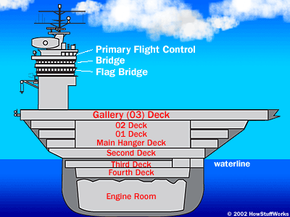
The diagrams below show how these various components fit together.
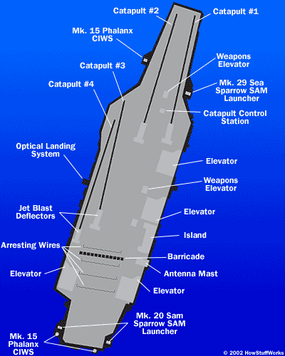
The hull of the ship is made up of extremely strong steel plates, measuring several inches thick. This heavy body is highly effective protection against fire and battle damage. The ship's structural support largely comes from three horizontal structures extending across the entire hull: the keel (the iron backbone on the bottom of the ship), the flight deck and the hangar deck.
The hull portion below the water line is rounded and relatively narrow, while the section above water flares out to form the wide flight-deck space. The lower section of the ship has a double bottom, which is pretty much what it sounds like -- there are two layers of steel plating: the bottom plating of the ship and another layer above it, separated by a gap. The double bottom provides extra protection from torpedos or accidents at sea. If the enemy hits the bottom of the ship, smashing a hole in the outer steel layer, the second layer will prevent a massive leak.
In the next section, we'll look at how a supercarrier is constructed.