Two astronauts practice in the Neutral Buoyancy Simulator at Marshall Space Center in Huntsville, Ala. Training underwater helps astronauts see what it's like to work in microgravity.
Dennis Keim/NASA
Astronaut Training Environments
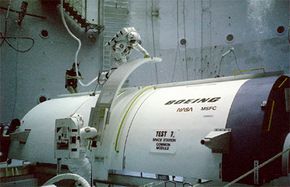
Astronauts have to be prepared both for general space travel and for their specific mission. To get them ready, NASA has a variety of environments for astronaut training.
Some training facilities and simulators include:
- The Jake Garn Training Facility: The Garn facility at the Johnson Space Center prepares astronauts for key space shuttle operations. A motion-based trainer simulates the vibrations, noise and views the astronauts experience during shuttle launch and landing, while a fixed-base simulator is used for rendezvous and payload operations training. Garn also houses a functional space station simulator, which familiarizes astronauts with the in-orbit laboratory systems of the International Space Station.
- The Space Vehicle Mockup Facility (SVMF): Like the Garn facility, the SVMF at Johnson Space Center consists of components that prepare astronauts for both shuttle and station operations. The Full Fuselage Trainer (FFT) is a full-scale mockup of the space shuttle orbiter -- without the wings. The Crew Compartment Trainer (CCT) includes full-sized mockups of a shuttle flight deck and a mid-deck, complete with high-fidelity components, such as panels, seats and lights. A second CCT, which can be rotated into seven unique positions, is used to simulate specific flight and contingency attitudes. Finally, the Space Station Mockup and Training Facility (SSMTF) is a full-scale replica of the International Space Station, providing as much realism as possible to match conditions that will be experienced upon the orbiting space station.
- The Virtual Reality (VR) Laboratory: Astronauts preparing for spacewalks or robotic arm operations test their skills in the VR Laboratory at Marshall Space Flight Center. In a simulated microgravity environment generated by powerful computers, astronauts -- wearing special gloves, video display helmet, chest pack and controller -- learn how to orient themselves in outer space, where up and down are indistinguishable and where even minor tweaks with a thruster can send someone spinning off into space.
Pilot astronauts are also required to train in the air. Flying a modified Gulfstream jet aircraft designed to mimic the space shuttle, pilots practice both shuttle approach and landing techniques. This is crucial, because the runway approach of a shuttle is nearly seven times steeper than that of a commercial airliner. Pilots will fly more than 1,000 approaches in this aircraft before ever landing the shuttle. Pilot astronauts also train in the T-38 Talon aircraft, a supersonic trainer jet.
At the end of the advanced mission training phase, an astronaut is finally ready to carry out his or her assigned mission. But as we'll see in the next section, having well-trained astronauts is just one of many requirements that must be met before a shuttle lifts off on a pillar of fire from Cape Canaveral.
Women in Space
Jerrie Cobb was the first female pilot to pass all the tests for the Mercury program in 1961.
Arden Wilfong/NASA
The first woman in space was cosmonaut Valentina Tereshkova. She flew aboard Vostok 6, which launched on June 14, 1964, to rendezvous with the Vostok 5 spacecraft carrying Valery Bykovsky. Tereshkova was an expert parachutist and one of several women trained in the Soviet cosmonaut program.
NASA probably could have placed a woman in space even sooner than the Soviets had the American political and social climate been different. As NASA's director of space medicine, Dr. William Randolph Lovelace proposed the idea of female astronauts in early 1959. He argued that women are smaller and lighter, require less oxygen and cope better with stress. Lovelace recruited 24 women to participate in a program that became known as First Lady Astronaut Trainees. One of those trainees was Jerrie Cobb. Although she never flew in space, Cobb underwent physical tests similar to those taken by the Mercury astronauts, passing all training exercises and ranking in the top two percent of all astronaut candidates of both genders.
It would be another 23 years before an American woman traveled into space. The woman was physicist Sally Ride, who joined NASA in 1978 and flew aboard the Space Shuttle Challenger in 1983.
On the next page we'll look at what it's like to work as an astronaut.
