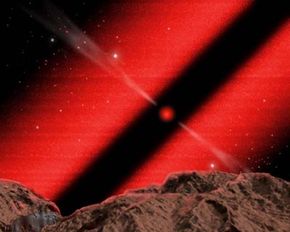
Artist concept of the near vicinity of the black hole at the core of galaxy NGC 4261.
Photo courtesy NASA/Space Telescope Science Institute (J. Gitlin, artist)
You may have heard someone say, "My desk has become a black hole!" You may have seen an astronomy program on television or read a magazine article on black holes. These exotic objects have captured our imagination ever since they were predicted by Einstein's Theory of General Relativity in 1915.
What are black holes? Do they really exist? How can we find them? In this article, we will examine black holes and answer all of these questions!
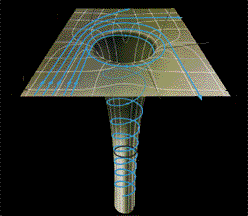
Artist concept of a giant black hole: The arrows show the paths of massive objects in and around the opening of the black hole.
Photo courtesy NASA
Stellar mass black holes form when massive stars die.
If you have read How Stars Work, then you know that a star is a huge, amazing fusion reactor. Because stars are so massive and made out of gas clouds, their own intense gravity is always trying to collapse them.
Advertisement
The fusion reactions happening in the core are like a giant fusion bomb that is trying to explode the star. The balance between the gravitational forces and the explosive forces is what defines the size of the star.
As the star dies, the nuclear fusion reactions stop because all their fuel gets burned up. At the same time, the gravity of the dying star pulls material inward and compresses the core. As the core compresses, it heats up and eventually creates a supernova explosion in which the material and radiation blasts out into space.
What remains is the highly compressed and extremely massive core. The core's gravity is so strong that even light waves cannot escape.
This object is now a stellar mass black hole and literally disappears from view. Because the stellar black hole's gravity is so strong, the core sinks through the fabric of space-time, creating a hole in — this is why the object is called a black hole.
History and Theory
The concept of an object from which light could not escape (e.g., black hole) was originally proposed by Pierre Simon Laplace in 1795.
Using Newton's Theory of Gravity, Laplace calculated that if an object were compressed into a small enough radius, then the escape velocity of that object would be faster than the speed of light.
The Event Horizon
The core becomes the central part of the black hole called the singularity. The opening of the hole is called the event horizon.
You can think of the event horizon as the mouth of the black hole. Once something passes the event horizon, it is gone for good. Once inside the event horizon, all "events" (points in space-time) stop, and nothing (even light) can escape.
The radius of the event horizon is called the Schwarzschild radius, named after astronomer Karl Schwarzschild, whose work led to the theory of black holes.
Advertisement
Types of Black Holes
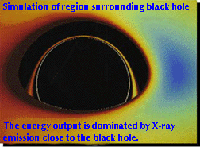
Artist concept of a black hole and its surroundings: The blackened circle is the event horizon, and the egg-shaped region is the ergosphere.
Photo courtesy NASA
There are two types of black holes:
Schwarzschild: Non-rotating black hole
Kerr: Rotating black hole
The Schwarzschild black hole is the simplest black hole, in which the core does not rotate. This type of black hole only has a singularity and an event horizon.
Advertisement
The Kerr black hole, which is probably the most common form in nature, rotates because the star from which it was formed was rotating. When the rotating star collapses, the core continues to rotate, and this carries over to the black hole (conservation of angular momentum). The Kerr black hole has the following parts:
Singularity: the collapsed core
Event horizon: the opening of the hole
Ergosphere: an egg-shaped region of distorted space around the event horizon (The distortion is caused by the spinning of the black hole, which "drags" the space around it.)
Static limit: the boundary between the ergosphere and normal space
If an object passes into the ergosphere it can still be ejected from the black hole by gaining energy from the hole's rotation.
However, if an object crosses the event horizon, it will be sucked into the black hole and never escape. What happens inside the black hole is unknown; even our current theories of physics do not apply in the vicinity of a singularity.
Even though we cannot see a black hole, it does have three properties that can or could be measured:
Mass
Electric charge
Rate of rotation (angular momentum)
As of now, we can only measure the mass of the black hole reliably by the movement of other objects around it. If a black hole has a companion (nearby stars or disks of material), it is possible to measure the radius of rotation or speed of orbit of the material around the unseen black hole. The mass of the black hole can be calculated using Kepler's Modified Third Law of Planetary Motion or rotational motion.
Advertisement
How We Detect Black Holes
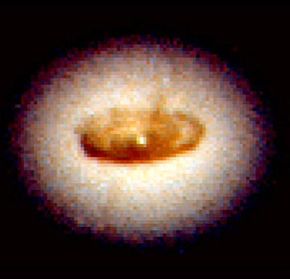
Hubble Space Telescope direct image of the core of galaxy NGC 4261.
Photo courtesy NASA/Space Telescope Science Institute Credit: L. Ferrarese (Johns Hopkins University) and NASA
Although we cannot see black holes, we can detect or guess the presence of one by measuring its effects on objects around it, such as:
Mass estimates from objects orbiting a black hole or spiraling into the core
Gravitational lens effects
Emitted radiation
Mass
Many stellar black holes have objects around them, and by looking at the behavior of the objects you can detect the presence of a black hole. You then use measurements of the movement of objects around a suspected black hole to calculate the black hole's mass.
Advertisement
What you look for is a star or a disk of gas that is behaving as though there were a large mass nearby. For example, if a visible star or disk of gas has a "wobbling" motion or spinning and there is not a visible reason for this motion and the invisible reason has an effect that appears to be caused by an object with a mass greater than three solar masses (too big to be a neutron star), then it is possible that a black hole is causing the motion.
You then estimate the mass of the black hole by looking at the effect it has on the visible object.
For example, in the core of galaxy NGC 4261, there is a brown, spiral-shaped disk that is rotating. The disk is about the size of our solar system, but its mass is much greater than the mass of the sun. Such a huge mass for a disk might indicate that a black hole is present within the disk.
Gravity Lens
Einstein's General Theory of Relativity predicted that gravity could bend space. This was later confirmed during a solar eclipse when a star's position was measured before, during and after the eclipse.
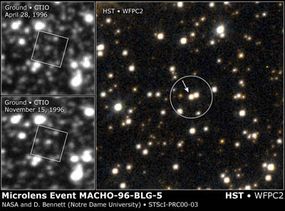
The star's position shifted because the light from the star was bent by the sun's gravity. Therefore, an object with immense gravity (like a galaxy or black hole) between the Earth and a distant object could bend the light from the distant object into a focus, much like a lens can. This effect can be seen in the image below.
These images show the brightening of MACHO-96-BL5 from ground-based telescopes (left) and the Hubble Space Telescope (right).
Photo courtesy NASA/Space Telescope Science Institute Credit: NASA and Dave Bennett (University of Notre Dame)
In the image, the brightening of MACHO-96-BL5 happened when a gravitational lens passed between it and the Earth. When the Hubble Space Telescope looked at the object, it saw two images of the object close together, which indicated a gravitational lens effect.
The intervening object was unseen. Therefore, scientists concluded that a black hole had passed between Earth and the object.
Emitted Radiation
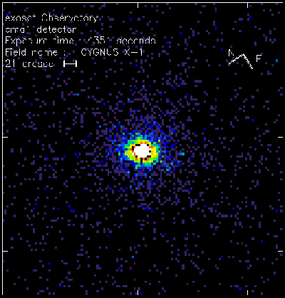
When material falls into a black hole from a companion star, it gets heated to millions of degrees Kelvin and accelerated. The superheated materials emit X-rays, which can be detected by X-ray telescopes such as the orbiting Chandra X-ray Observatory.
The star Cygnus X-1 is a strong X-ray source and is considered to be a good candidate for a black hole. Stellar winds from the companion star, HDE 226868, blow material onto the accretion disk surrounding the black hole. As this material falls into the black hole, it emits X-rays.
X-ray image of Cygnus X-1 taken from orbiting Chandra X-ray Observatory
Photo courtesy NASA/CXC
In addition to X-rays, gigantic black holes can also eject materials at high speeds to form jets. Many distant galaxies have been observed with such jets.
Currently, scientists think that these galaxies have supermassive black holes (billions of solar masses) at their centers that produce the jets as well as strong radio emissions. One such example of a host galaxy with a supermassive black hole is M87.
It is important to remember that such black holes are not cosmic vacuum cleaners — they will not consume everything. So although we cannot see massive black holes, there is indirect evidence that they exist. They have been associated with time travel and worm holes and remain fascinating objects in the universe.
Advertisement
Black Hole FAQ
What are black holes made of?
A stellar black hole forms when a massive star dies and its matter is squished together into an incredibly tiny space.
How many black holes are there?
Scientists estimate that in our own Milky Way galaxy alone, there's anywhere from 10 million to a billion black holes.
What is the most common type of black hole?
The Kerr black hole is probably the most common black hole formation in nature.
Where do black holes lead to?
If a massive object crosses the event horizon, it will be sucked into the black hole and never escape. What happens inside the black hole is unknown; even our current theories of physics do not apply in the vicinity of a singularity.
What are the two types of black holes?
The two types of black holes are Schwarzschild (non-rotating black holes) and a Kerr (rotating black holes).