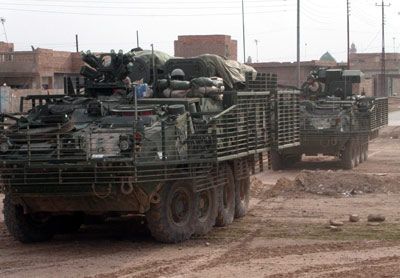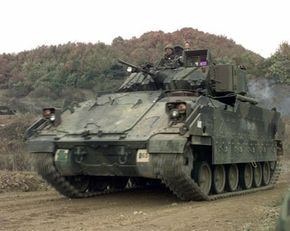
Before and during combat, the U.S. military uses the Bradley Fighting Vehicle to scout enemy positions and transport troops into hostile territory. This 500-horsepower, amphibious vehicle has enough armaments to destroy enemy tanks and provide protective fire for the troops it carries to battle.
![]() Photo courtesy Department of Defense - Defense Visual Information Center M2A1 Bradley Fighting Vehicle. See more Bradley Vehicle pictures. |
Developed as a replacement for the M113 series of armored personnel carriers, the Bradley is more powerful and faster than its predecessor. There are two main variations of the Bradley: the M2 and the M3. The primary purpose of the M2 is to provide transport to battle, and the M3 is designed to battle enemy tanks and perform reconnaissance.
In this article, we'll ride into battle with the Bradley Fighting Vehicle. You will learn about the Bradley's power and weaponry and how it was developed.
Bradley was the first chairman of the Joint Chiefs of Staff (1949 - 1953) and was promoted to a 5-star general during his tenure in that post. Bradley died in 1981, the same year the vehicle bearing his name entered service. |
Power
|
An upgraded M2A2 Bradley has a 600-horsepower engine that delivers a power-to-weight ratio of 24 horsepower per ton.
Similar to a tank, the Bradley is a tracked vehicle with six dual-tired road wheels and three track-return rollers on each side. One track-return roller is a double roller. The other two rollers support only the inside half of the track.
![]() Photo courtesy U.S. Army The Bradley Fighting Vehicle is equipped with tank-like tracks. Soldiers operate their Bradley during an operation to search for weapons and munitions in areas of anti-Coalition activity along the Iraq-Syria border. |
The Bradley is designed to cross any terrain, even water, and can transition to amphibious mode in five minutes. The newest Bradley models, the M2A3 and M3A3, have an inflatable pontoon that is fitted to the front and sides of the vehicle.
![]() |
![]() Photos courtesy Department of Defense - Defense Visual Information Center M2 Bradley in amphibious mode |
The tracks propel the Bradley through the water at a top speed of about 4 mph (6.4 km/hr).
|
Riding in the Belly of the Beast
The M2 Infantry Fighting Vehicle has a three-man crew, including a commander, gunner and driver. The original M2 also carries seven, fully equipped soldiers. The enhanced M2A2 carries six soldiers. The M3 Cavalry Fighting Vehicle has the same three-man crew, but only accommodates two additional soldiers.
![]() Photo courtesy Department of Defense - Defense Visual Information Center A U.S. Army M2A2 Bradley crew member stands up through the open turret hatch. |
Inside the vehicle, the driver sits in the left front of the hull in a two-thirds reclining position. The only vision available to the crew is periscopes. The driver's station has four periscopes. The center periscope can be interchanged with a night vision scope.
![]() Photo courtesy Department of Defense - Defense Visual Information Center Driver's location in an M2A2 Bradley |
The commander sits to the right of the main armament. An M13A1 filter is located in the commander's station to provide breathable air in case of a gas attack. The gunner is located to the left of the turret. The turret is a large section on top of the Bradley that is equipped with a machine gun (more on firepower later). Two-power day/thermal sights and the customary periscopes are available to the gunner. The gunner's view also includes an optical relay to the commander.
A compartment for transported troops is in the back of the vehicle. This compartment includes a single-piece hatch in the roof and a hydraulically operated rear ramp for troop entry and exit. The M2 also features six firing ports.
![]() Photo courtesy U.S. Army |
![]() Photo courtesy Department of Defense - Defense Visual Information Center Rear views of the Bradley Fighting Vehicle |
The Bradley is equipped with an automatic fire detection and suppression system, which is also included in the engine compartment, as well as a central nuclear, biological and chemical protective suite.
![]() Photo courtesy Department of Defense - Defense Visual Information Center Interior view of the M3 Bradley |
The entire Bradley is covered with aluminum armor, and the rear and sides are also covered with spaced laminate armor. The turret has an additional layer of steel, and the hull bottom has additional anti-mine armor.
|
|