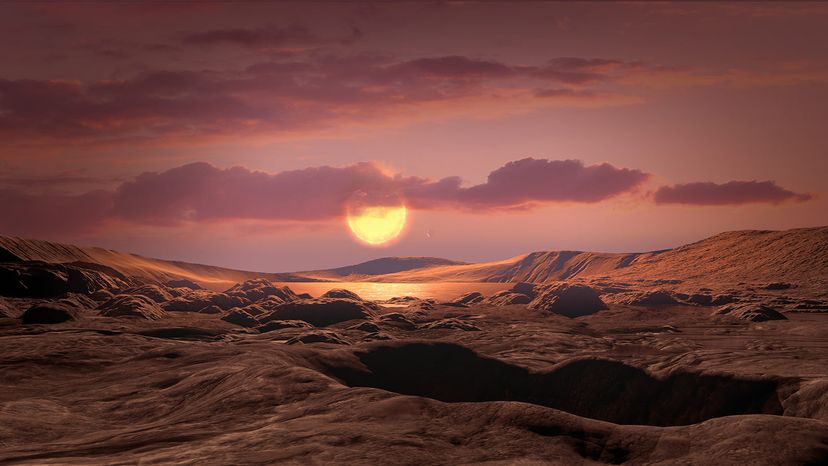
This artist's illustration shows what Kepler-1649c, an Earth-like planet, could look like from its surface. NASA/Ames Research Center/Daniel Rutter
You stand in a perpetual sunset, beneath an eerie, reddish-orange sky laced with thin clouds. At the edge of a vast sea, solid ground rises slowly from the water, giving way to lowlands covered in vegetation. The plants bask in temperatures reaching 40 degrees Fahrenheit (4 degrees Celsius), but their leaves aren't green — they're black and spread open wide to absorb the scant energy washing across the landscape.
You've come to this paradise from your permanent home, an outpost located on the dark, frozen side of the planet. You hike down the lowland hills to the water's edge. As you gaze at the horizon, you vow that, next year, you'll bring the whole family so they can enjoy the color and heat and light. Then you realize that next year is just 37 days away, and you feel suddenly small and insignificant in a vast, overwhelming universe.
Advertisement
This could be your future Earth. No, really. That was an artistic representation of a planet called Gliese 581g, which was big news in 2010, but that scientists now doubt exists.
Still, that hasn't stopped them from looking for other Earth-like planets. Thanks to advanced planet-hunting techniques and some serious equipment, astronomers are locating thousands of candidates outside our solar systems. These are planets orbiting other sun-like stars — called exoplanets — and scientists are coming to a sobering, almost frightening realization: The universe may be filled with billions of planets, some of which most certainly resemble Earth. At least superficially. But what does it really mean for a planet to resemble Earth?
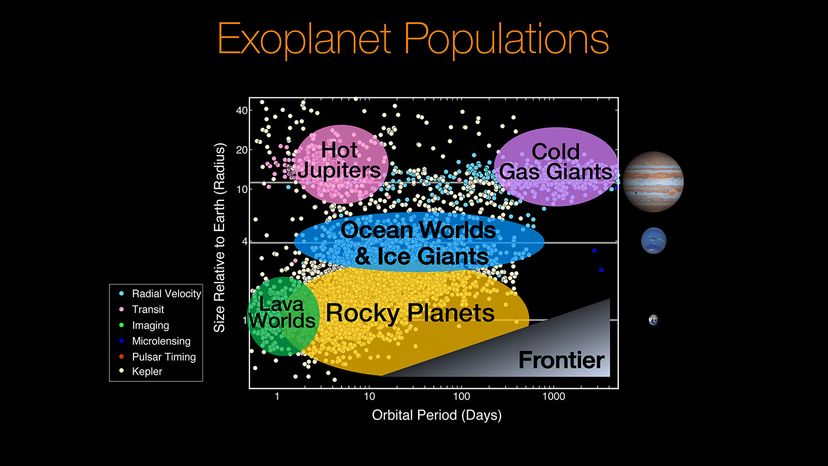
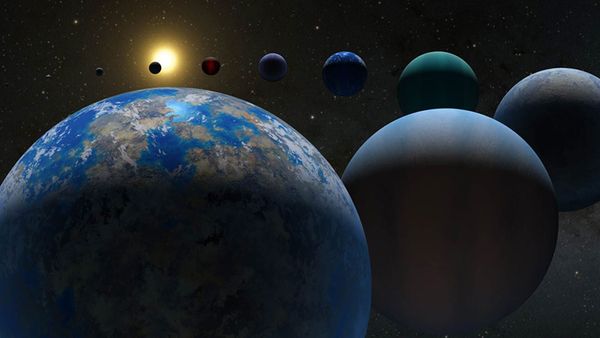
The population of exoplanets detected by the Kepler mission is compared to those detected by other surveys using various methods. Note that Kepler discovered several rocky planets (yellow area). NASA/Ames Research Center/Natalie Batalha/Wendy Stenzel
If another Earth exists in the universe, wouldn't it need to look like, well, Earth? Sure, but the odds of finding a blue world exactly 7,926 miles (12,756 kilometers) across and tilted on its axis nearly 24 degrees seem about as remote as finding an Elvis Presley impersonator who looks good in sequined leather and can snarl out a tune better than the King himself.
It doesn't hurt to look, of course, and astronomers are doing just that. The idea isn't necessarily to find an exact match, but a close one. For example, astronomers have discovered several so-called "super-Earths" — planets that are slightly larger than our home. These are far better matches than planets as large as Jupiter or Saturn.
Advertisement
In fact, behemoths like Jupiter and Saturn are known as gas giants because they're nothing more than giant balls of hydrogen, helium and other gases with little or no solid surface. Gas giants, with their stormy, multicolored atmospheres, may offer spectacular sights, but they'll never make good digs.
Smaller planets, including Earth and super-Earth lookalikes, are much more likely to become incubators of life. Astronomers refer to these pipsqueaks as terrestrial planets because they possess heavy-metal cores surrounded by a rocky mantle. Terrestrial planets tend to stick close to their host stars, which means they have smaller orbits and thus much shorter years.
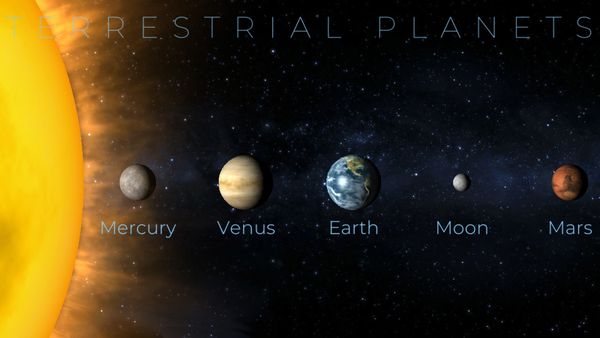
Terrestrial planets are also more likely to lie in the Goldilocks zone. Also called the habitable zone or life zone, the Goldilocks region is an area of space in which a planet is just the right distance from its home star so that its surface is neither too hot nor too cold. Earth, of course, fills that bill, while Venus roasts in a runaway greenhouse effect and Mars exists as a frozen, arid world. In between, the conditions are just right so that liquid water remains on the planet's surface without freezing or evaporating out into space. Now the search is on to find another planet in the Goldilocks zone of another solar system.
Advertisement
Methods for Hunting Exoplanets
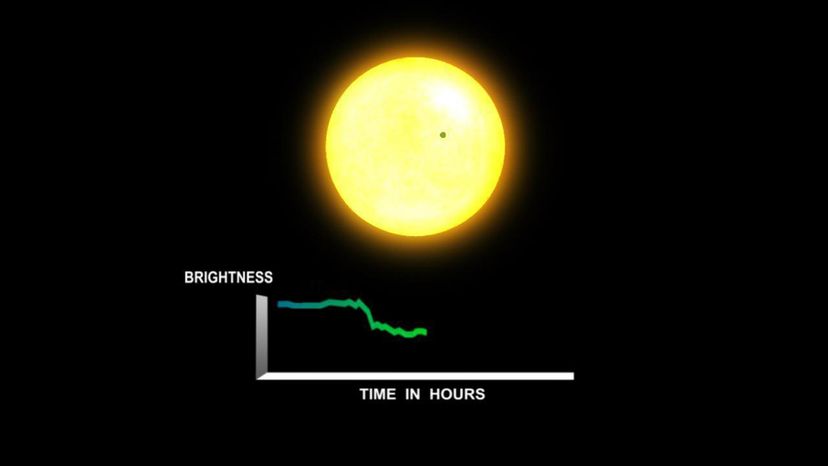
When a planet crosses in front of its star as viewed by an observer, the event is called a transit. Transits by terrestrial planets produce a small change in a star's brightness of about 1/10,000 (100 parts per million, ppm), lasting for 2 to 16 hours. This change must be periodic if it is caused by a planet. NASA
One of the great problems in the search for exoplanets is detecting the darn things. Most are simply too small and too far away to be observed directly. Our Earth-based telescopes can't resolve a faraway planet as a dot separate from its host star. Luckily, astronomers have other means at their disposal, and they all call for sophisticated telescopes armed with photometers (devices that measure light), spectrographs and infrared cameras.
The first method, known as the wobble method, looks for changes in a star's relative velocity caused by the gravitational tug of a nearby planet. These tugs cause the star to surge toward Earth and then away, creating periodic variations that we can detect by analyzing the spectrum of light from the star. As it surges toward Earth, its light waves are compressed, shortening the wavelength and shifting the color to the blue side of the spectrum. As it surges away from Earth, its light waves spread out, increasing the wavelength and shifting the color to the red side of the spectrum. Larger planets intensify the wobble of their parent stars, which is why this technique has been so efficient at finding gas giants several times larger than Earth.
Advertisement
What's one thing that all planets can do well? Block light. If a planet's orbit crosses between its parent star and Earth, it will block some of the light and cause the star to dim. Astronomers call this a transit, and the related planet-hunting technique the transit method. Telescopes equipped with sensitive photometers can easily discern large planets, but they can also catch even the slight dimming caused by an Earth-sized object.
Finally, some astronomers have been turning to a technique known as microlensing. Microlensing occurs when one star passes precisely in front of another star. When this happens, the gravity of the foreground star acts like a magnifying lens and amplifies the brightness of the background star. If a planet orbits the foreground star, its additional gravity intensifies the amplification effect. This handily reveals the planet, which would otherwise be invisible to other detection techniques.
Advertisement
Kepler and TESS
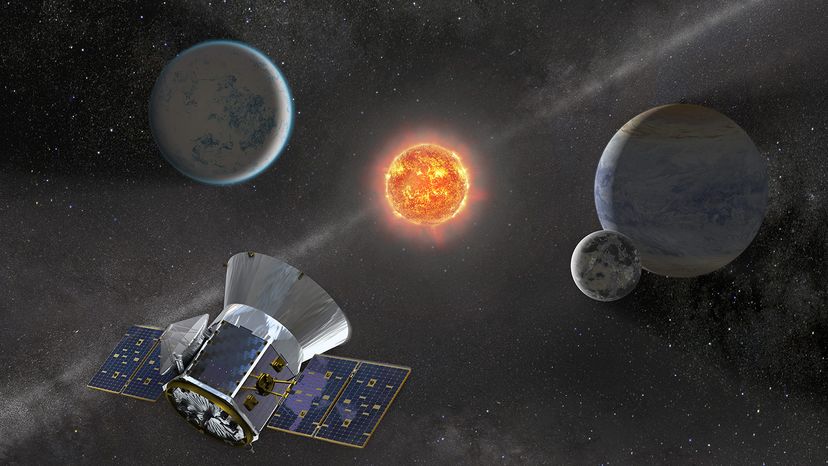
An artist's concept of TESS observing an M dwarf star with orbiting planets. NASA's Goddard Space Flight Center
We said earlier that the basic requirements for a habitable planet would be one with a rocky surface (rather than a gassy one), with liquid water (as opposed to water vapor) and in the Goldilocks zone of not too hot and not too cold. So, what tools are being used to find these types of exoplanets?
The first exoplanets were detected with the Hubble telescope in the 1990s. But the first NASA mission to discover Earth-like planets orbiting stars outside our own solar system was the Kepler space telescope, launched in 2009. Equipped with a highly sensitive photometer, Kepler monitored the brightness of over 150,000 stars, searching for tiny, periodic dips in their light caused by the transit of planets across their faces. This transit technique allowed Kepler to identify more than 2,600 exoplanets including 12 planets in the habitable zones of their star. These included Gliese 581c and Kepler 62f.
Advertisement
The Kepler mission ended in 2018 and was followed by the Transiting Exoplanet Survey Satellite (TESS). TESS' mission is to find exoplanets, also using the transit method. TESS will cover a sky area 400 times larger than Kepler did and study stars 30 to 100 times brighter.
Earth-like Exoplanets
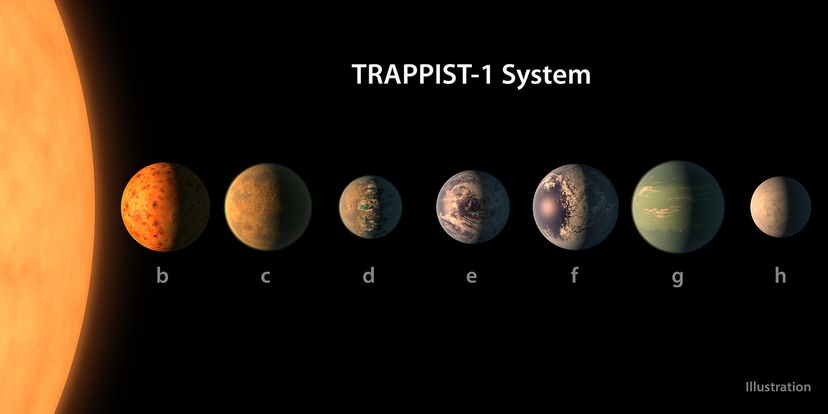
This artist's concept shows what the TRAPPIST-1 planetary system may look like, based on available data about the planets’ diameters, masses and distances from the host star, as of Feb. 2017. NASA/JPL-Caltech
Here are some of the most exciting discoveries of Earth-like planets in distant worlds.
GJ 667Cc
In February 2012, an international team of scientists reported the results of their wobble-based research focused on GJ 667C, an M-class dwarf star associated with two other orange dwarfs located about 22 light-years from Earth. The astronomers were hoping to learn more about a previously discovered super-Earth (GJ 667Cb) with an orbital period of just 7.2 days, but their observations led to something better — GJ 667Cc, another super-Earth with an orbital period of 28 days. The planet, which sits comfortably in the Goldilocks zone of GJ 667C, receives 90 percent of the light that Earth receives. Most of this light is in the infrared spectrum, which means the planet likely absorbs a higher percentage of the energy coming to it. The bottom line: GJ 667Cc may absorb the same amount of energy from its star that Earth soaks up from the sun and may, as a result, support liquid water and life as we know it. Later observations detected that the planet was extremely hot and thus not likely good for habitation.
Advertisement
Kepler-452b
Kepler-452b, often referred to as Earth's "cousin," is an exoplanet located approximately 1,400 light-years away from us. Discovered by NASA's Kepler spacecraft in 2015, it was the first near-Earth world found within the habitable zone of its star, Kepler-452, where conditions could be favorable for the existence of liquid water on its surface. It is one of the Kepler planets. Kepler-452b has a diameter about 1.6 times that of Earth, and orbits its star in a similar fashion, taking around 385 days to complete one orbit. These are zones within which liquid water can exist on a planet's surface.
TRAPPIST-1e
The TRAPPIST-1 system, discovered in 2016 has seven planets orbiting a small, cool star known as TRAPPIST-1. Situated about 40 light-years away, this system ignited excitement because it was the largest collection of Earth-sized planets ever found outside our solar system. All seven planets orbit much closer than Mercury does to our sun, yet their location within the star's habitable zone offers the possibility of liquid water on their surfaces. These exoplanets, named TRAPPIST-1b to TRAPPIST-1h, also seemed to be rocky. Some are tidally locked, always showing the same face to their star. This means that one side of the planet is in permanent daylight with scorching sun, while the other side is in permanent freezing darkness. But after further investigation, it appears that TRAPPIST-1e may be the only planet in the system still hospitable to life; the rest are either too close or too far from their star.
GJ 1002b and GJ 1002c
Other habitable zone planets are GJ 1002b and GJ 1002c which orbit the red dwarf star GJ 1002, located approximately 16 light-years away from Earth. These rocky planets have about the same mass as Earth. GJ 1002b takes around 10 days to orbit its star, while GJ 1002c takes just over 21 days. The two planets were discovered in 2022.
TOI 700e
In early 2023, NASA announced the discovery by TESS of TOI 700e, a planet about the same size as our own. While its composition remains unknown, scientists speculated that it could have a rocky surface like Earth. Being located within the zone of habitable planets could allow it have liquid water, too. TOI 700e takes 28 days to orbit its star and may be tidally locked. (For comparison, our moon is tidally locked to our Earth, but Earth is not tidally locked to the sun, its star.)
In other words, even with the basic parameters we just mentioned, there's a lot more to consider before we can truly call a planet "Earth-like." Missions like the James Webb Space Telescope, which can see the atmospheres of exoplanets, might tell us a lot more.
This article was updated in conjunction with AI technology, then fact-checked and edited by a HowStuffWorks editor.
"Found 20 light years away: the new Earth." Daily Mail. April 26, 2007. http://www.dailymail.co.uk/pages/live/articles/technology/technology.html?in_page_id=1965&in_article_id=450467
"Hunting for another Earth-like planet." BBC News. Aug. 7, 2007. http://news.bbc.co.uk/2/hi/science/nature/6933841.stm
Clavin, Whitney. "NASA's Kepler Confirms Its First Planet In Habitable Zone." Jet Propulsion Laboratory. Dec. 5, 2011. (Feb. 8, 2012) http://www.jpl.nasa.gov/news/news.cfm?release=2011-373
Courtland, Rachel. "Is first life-friendly exoplanet an 'eyeball'?" NewScientist. Jan. 13, 2011. (Feb. 8, 2012) http://www.newscientist.com/article/mg20927953.700-is-first-lifefriendly-exoplanet-an-eyeball.html
Dunham, Will. "Burned-out star harbors sign of Earthlike planets." Reuters. Aug. 16, 2007. http://www.reuters.com/article/scienceNews/idUSN1636758720070816
NASA. "White dwarfs." December 2010. http://imagine.gsfc.nasa.gov/docs/science/know_l2/dwarfs.html
Nelson, Bryn. "Black Plants and Twilight Zones." Scientific American. December 2010.
Planet Quest: The Search for Another Earth. Jet Propulsion Laboratory. (Feb. 8, 2012) http://planetquest.jpl.nasa.gov/
Reich, Eugenie Samuel. "Beyond the Stars." Nature. Vol. 470, February 2011.
Reuters. "White dwarf harbors signs of Earth-like planets." CNN.com. Aug. 17, 2007. http://www.cnn.com/2007/TECH/space/08/17/white.dwarf.reut/index.html
Sasselov, Dimitar D. and Diana Valencia. "Planets We Could Call Home." Scientific American. August 2010.
Stephens, Tim. "New super-Earth detected within the habitable zone of a nearby star." University of California Santa Cruz. Feb. 2, 2012. (Feb. 8, 2012) http://news.ucsc.edu/2012/02/habitable-planet.html
Than, Ker. "Newfound Planet Has Earth-Like Orbit." Space.com. Aug. 2, 2007. http://www.space.com/scienceastronomy/070802_redgiant_planet.html
Than, Ker. "Scientists find most Earthlike planet yet." MSNBC. April 25, 2007. http://www.msnbc.msn.com/id/18293978/
Villard, Ray and Kailash Sahu. "The Milky Way Contains at Least 100 Billion Planets According to Survey." HubbleSite News Center. Jan. 11, 2012. (Feb. 8, 2012) http://hubblesite.org/newscenter/archive/releases/2012/07
Cite This!
Please copy/paste the following text to properly cite this HowStuffWorks.com article: