
The Sun
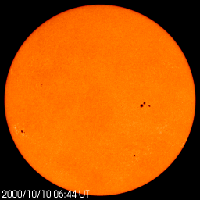
The sun is our nearest star. Like the moon, the sun is big, bright, and can be observed easily with a telescope, provided that you take the proper safety precautions. In fact, observing the sun is one of the few astronomical projects that you can do during the day.
The easiest features to observe on the sun are sunspots, magnetic storms on the sun. You can observe sunspots whether you are projecting the sun's image or using a proper solar filter. You can make drawings of sunspots and note their movement across the solar disc. From this information, you can estimate the speed of the sun's rotation. Another popular activity is counting sunspots and keeping track of their activity -- sunspot activity changes over the 11-year solar cycle.
Advertisement
If you are viewing the sun with a proper filter, you can see the limb darkening effect. This is an effect in which the edge of the sun appears slightly darker than the inner portions, because you are looking through a thicker portion of the sun's atmosphere toward the edge than toward the middle.
If observing conditions are good, and you've got a little luck, you may see the bubbles or granulations of the sun's surface. You may also catch small bright areas around a sunspot group called faculae, which are elevated regions of hot gases. Finally, if you are very lucky, you could catch a glimpse of a solar flare if you observe a sunspot group near the sun's edge.
A rare solar sight is that of a solar eclipse, when the moon passes between the Earth and the sun and blocks out the sun's disc. During a solar eclipse is the only time that you can see the sun's corona. In fact, many amateur astronomers become so obsessed with viewing solar eclipses that they chase them around the world. Click here for a list of upcoming solar and lunar eclipses and their locations.
Note -- When observing the sun through a telescope, heat will build up inside the tube. This heat can damage the telescope's optical parts. To prevent this, turn the telescope away periodically to allow it to cool. Some observers have a separate small telescope that they use exclusively for solar observing.