
More Bridge Forces: Resonance
You can think of resonance as the vibrational equivalence of a snowball rolling down a hill and becoming an avalanche. It begins as a relatively small, periodic stimulus of a mechanical system, such as wind buffeting a bridge. These vibrations, however, are more or less in harmony with the bridge's natural vibrations. If unchecked, the vibration can increase drastically, sending destructive, resonant vibrations traveling through a bridge in the form of torsional waves.
The most noteworthy example of resonance occurred in 1940, when resonant vibrations destroyed the Tacoma Narrows Bridge in Washington. The incident was especially shocking at the time as the structure was designed to withstand winds of up to 120 miles (193 kilometers) per hour and collapsed in a mere 40-mile (64-kilometer) wind.
Advertisement
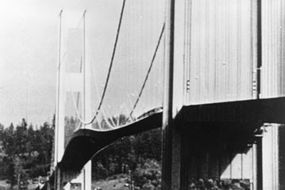
Close examination of the situation suggested that the bridge's deck-stiffening truss was insufficient for the span, but this alone couldn't bring such a structure down. As it turned out, the wind that day was at just the right speed and hit the bridge at just the right angle to set off the deadly vibration. Continued winds increased the vibrations until the waves grew so large and violent that they broke the bridge apart. The effect is similar to that of a singer shattering a glass with her voice.
Wind isn't the only potential threat, however. When an army marches across a bridge, the soldiers often "break step" so that their rhythmic marching will not start resonating throughout the bridge. A sufficiently large army marching at just the right cadence could set the deadly vibration into motion.
In order to mitigate fully the resonance effect in a bridge, engineers incorporate dampeners into the bridge design to interrupt the resonant waves and prevent them from growing.
Another way to halt resonance is to give it less room to run wild. If a bridge boasts a solid roadway, then a resonant wave can easily travel the length of the bridge and wreak havoc. But if a bridge roadway is made up of different sections with overlapping plates, then the movement of one section merely transfers to another via the plates, generating friction. The trick is to create enough friction to change the frequency of the resonant wave. Changing the frequency prevents the wave from building.
Alas, there's one more major force to reckon with capable of destroying bridges. Any guesses as to what it is?