
Tension and Compression: Two Forces Every Bridge Knows Well
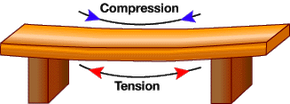
What allows an arch bridge to span greater distances than a beam bridge, or a suspension bridge to stretch over a distance seven times that of an arch bridge? The answer lies in how each bridge type deals with the important forces of compression and tension.
Tension: What happens to a rope during a game of tug-of-war? It undergoes tension from the two sweaty opposing teams pulling on it. This force also acts on bridge structures, resulting in tensional stress.
Advertisement
Compression: What happens when you push down on a spring and collapse it? You compress it, and by squishing it, you shorten its length. Compressional stress, therefore, is the opposite of tensional stress.
Compression and tension are present in all bridges, and as illustrated, they are both capable of damaging part of the bridge as varying load weights and other forces act on the structure. It's the job of the bridge design to handle these forces without buckling or snapping.
Buckling occurs when compression overcomes an object's ability to endure that force. Snapping is what happens when tension surpasses an object's ability to handle the lengthening force.
The best way to deal with these powerful forces is to either dissipate them or transfer them. With dissipation, the design allows the force to be spread out evenly over a greater area, so that no one spot bears the concentrated brunt of it. It's the difference in, say, eating one chocolate cupcake every day for a week and eating seven cupcakes in a single afternoon.
In transferring force, a design moves stress from an area of weakness to an area of strength. As we'll dig into on the upcoming pages, different bridges prefer to handle these stressors in different ways.