
Carbon and Kimberlite
Carbon is one of the most common elements in the world and is one of the four essentials for the existence of life. Humans are more than 18 percent carbon. The air we breathe contains traces of carbon. When occurring in nature, carbon exists in three basic forms:
- Diamond - an extremely hard, clear crystal
- Graphite - A soft, black mineral made of pure carbon. The molecular structure is not as compact as diamond's, which makes it weaker than diamond.
- Fullerite - A mineral made of perfectly spherical molecules consisting of exactly 60 carbon atoms. This allotrope was discovered in 1990.
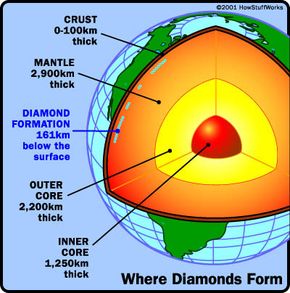
Diamonds form about 100 miles (161 km) below the Earth's surface, in the molten rock of the Earth's mantle, which provides the right amounts of pressure and heat to transform carbon into diamond. In order for a diamond to be created, carbon must be placed under at least 435,113 pounds per square inch (psi or 30 kilobars) of pressure at a temperature of at least 752 degrees Fahrenheit (400 Celsius). If conditions drop below either of these two points, graphite will be created. At depths of 93 miles (150 km) or more, pressure builds to about 725,189 psi (50 kilobars) and heat can exceed 2,192 F (1,200 C). Most diamonds that we see today were formed millions (if not billions) of years ago. Powerful magma eruptions brought the diamonds to the surface, creating kimberlite pipes.
Advertisement
Kimberlite is named after Kimberley, South Africa, where these pipes were first found. Most of these eruptions occurred between 1,100 million and 20 million years ago.
Kimberlite pipes are created as magma flows through deep fractures in the Earth. The magma inside the kimberlite pipes acts like an elevator, pushing the diamonds and other rocks and minerals through the mantle and crust in just a few hours. These eruptions were short, but many times more powerful than volcanic eruptions that happen today. The magma in these eruptions originated at depths three times deeper than the magma source for volcanoes like Mount St. Helens, according to the American Museum of Natural History.
The magma eventually cooled inside these kimberlite pipes, leaving behind conical veins of kimberlite rock that contain diamonds. Kimberlite is a bluish rock that diamond miners look for when seeking out new diamond deposits. The surface area of diamond-bearing kimberlite pipes ranges from 2 to 146 hectares (5 to 361 acres).
Diamonds may also be found in river beds, which are called alluvial diamond sites. These are diamonds that originate in kimberlite pipes, but get moved by geological activity. Glaciers and water can also move diamonds thousands of miles from their original location. Today, most diamonds are found in Australia, Borneo, Brazil, Russia and several African countries, including South Africa and Zaire.
In the next section, we'll learn why the properties of diamond make it such a unique gem.