Introduction to How Earthquakes Work

More on China

Geography of China

How Beijing Works

History of China

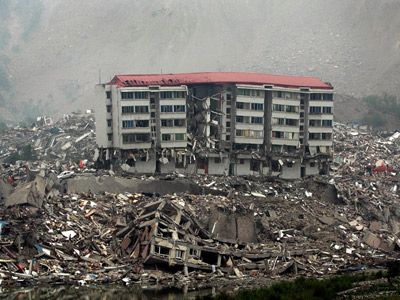
As recently witnessed in China and Iceland, an earthquake is one of the most terrifying phenomena that nature can whip up. We generally think of the ground we stand on as "rock-solid" and completely stable. An earthquake can shatter that perception instantly, and often with extreme violence.

Up until relatively recently, scientists only had unsubstantiated guesses as to what actually caused earthquakes. Even today there is still a certain amount of mystery surrounding them, but scientists have a much clearer understanding.

Earthquake Image Gallery

Family members gather at the remains of the collapsed Juyuan middle school, where six children died in Dujiangyan, in southwest China Sichuan province on May 12, 2008 .
AFP/AFP/Getty Images
Family members gather at the collapsed Juyuan middle school, where six children died in southwest China Sichuan province on May 12, 2008, after an earthquake measuring 7.8 rocked the province. See more earthquake images.

There has been enormous progress in the past century: Scientists have identified the forces that cause earthquakes, and developed technology that can tell us an earthquake's magnitude and origin. The next hurdle is to find a way of predicting earthquakes, so they don't catch people by surprise.

In this article, we'll find out what causes earthquakes, and we'll also find out why they can have such a devastating effect on us.

Shaking Ground­
An earthquake is a vibration that travels through the earth's crust. Technically, a large truck that rumbles down the street is causing a mini-earthquake, if you feel your house shaking as it goes by, but we tend to think of earthquakes as events that affect a fairly large area, such as an entire city. All kinds of things can cause earthquakes:

  • volcanic eruptions
  • meteor impacts
  • underground explosions (an underground nuclear test, for example)
  • collapsing structures (such as a collapsing mine)

But the majority of naturally-occurring earthquakes are caused by movements of the earth's plates, as we'll see in the next section.

Earthquake Facts

Quiz Corner
Did you know earthquakes can make lakes suddenly disappear?
Test your knowledge in the Disappearing Lake Quiz.

We only hear about earthquakes in the news every once in a while, but they are actually an everyday occurrence on our planet. According to the United States Geological Survey, more than three million earthquakes occur every year. That's about 8,000 a day, or one every 11 seconds!

The vast majority of these 3 million quakes are extremely weak. The law of probability also causes a good number of stronger quakes to happen in uninhabited places where no one feels them. It is the big quakes that occur in highly populated areas that get our attention.

residential earthquake damage in Prince William Sound, Alaska
Photo courtesy NGDC
Residential damage in Prince William Sound, Alaska, due to
liquefaction caused by a 1964 9.2-magnitude earthquake.


Earthquakes have caused a great deal of property damage over the years, and they have claimed many lives. In the last hundred years alone, there have been more than 1.5 million earthquake-related fatalities. Usually, it's not the shaking ground itself that claims lives -- it's the associated destruction of man-made structures and the instigation of other natural disasters, such as tsunamis, avalanches and landslides.

In the next section, we'll examine the powerful forces that cause this intense trembling and find out why earthquakes occur much more often in certain regions.

Plate Tectonics

T­he biggest scientific breakthrough in the history of seismology -- the study of earthquakes -- came in the middle of the 20th century, with the development of the theory of plate tectoni­cs. Scientists proposed the idea of plate tectonics to explain a number of peculiar phenomenon on earth, such as the apparent movement of continents over time, the clustering of volcanic activity in certain areas and the presence of huge ridges at the bottom of the ocean.

earthquake pic
Hulton Collection/Getty Images
The basic theory of plate tectonics is that the surface layer of the earth -- the lithosphere -- is comprised of many plates that slide over the lubricating athenosphere layer.­


­ The basic theory is that the surface layer of the earth -- the lithosphere -- is comprised of many plates that slide over the lubricating athenosphere layer. At the boundaries between these huge plates of soil and rock, three different things can happen:

  • Plates can move apart - If two plates are moving apart from each other, hot, molten rock flows up from the layers of mantle below the lithosphere. This magma comes out on the surface (mostly at the bottom of the ocean), where it is called lava. As the lava cools, it hardens to form new lithosphere material, filling in the gap. This is called a divergent plate boundary.

  • Plates can push together - If the two plates are moving toward each other, one plate typically pushes under the other one. This subducting plate sinks into the lower mantle layers, where it melts. At some boundaries where two plates meet, neither plate is in a position to subduct under the other, so they both push against each other to form mountains. The lines where plates push toward each other are called convergent plate boundaries.

  • Plates slide against each other - At other boundaries, plates simply slide by each other -- one moves north and one moves south, for example. While the plates don't drift directly into each other at these transform boundaries, they are pushed tightly together. A great deal of tension builds at the boundary.

Where these plates meet, you'll find faults -- breaks in the earth's crust where the blocks of rock on each side are moving in different directions. Earthquakes are much more common along fault lines than they are anywhere else on the planet.

In the next section, we'll look at some different types of faults and see how their movement creates earthquakes.

­

Faults

Scientists identify four types of faults, characterized by the position of the fault plane, the break in the rock and the movement of the two rock blocks:
  • In a normal fault (see animation below), the fault plane is nearly vertical. The hanging wall, the block of rock positioned above the plane, pushes down across the footwall, which is the block of rock below the plane. The footwall, in turn, pushes up against the hanging wall. These faults occur where the crust is being pulled apart, due to the pull of a divergent plate boundary.


Normal fault

  • The fault plane in a reverse fault is also nearly vertical, but the hanging wall pushes up and the footwall pushes down. This sort of fault forms where a plate is being compressed.
  • A thrust fault moves the same way as a reverse fault, but the fault line is nearly horizontal. In these faults, which are also caused by compression, the rock of the hanging wall is actually pushed up on top of the footwall. This is the sort of fault that occurs in a converging plate boundary.


Reverse fault

  • In a strike-slip fault, the blocks of rock move in opposite horizontal directions. These faults form when the crust pieces are sliding against each other, as in a transform plate boundary


Strike-slip fault

In all of these types of faults, the different blocks of rock push very tightly together, creating a good deal of friction as they move. If this friction level is high enough, the two blocks become locked -- the friction keeps them from sliding against each other. When this happens, the forces in the plates continue to push the rock, increasing the pressure applied at the fault.

If the pressure increases to a high enough level, then it will overcome the force of the friction, and the blocks will suddenly snap forward. To put it another way, as the tectonic forces push on the "locked" blocks, potential energy builds. When the plates are finally moved, this built-up energy becomes kinetic. Some fault shifts create visible changes at the earth's surface, but other shifts occur in rock well under the surface, and so don't create a surface rupture.

offset crop rows due to a lateral strike slip fault earthquake in Guatamala
Photo courtesy USGS
Crop rows offset by a lateral strike slip fault shifting in the 1976 earthquake that shook El Progresso, Guatemala.

The initial break that creates a fault, along with these sudden, intense shifts along already formed faults, are the main sources of earthquakes. Most earthquakes occur around plate boundaries, because this is where the strain from the plate movements is felt most intensely, creating fault zones, groups of interconnected faults. In a fault zone, the release of kinetic energy at one fault may increase the stress -- the potential energy -- in a nearby fault, leading to other earthquakes. This is one of the reasons that several earthquakes may occur in an area in a short period of time.

shifted railroad tracks due to the earthquake in Guatamala
Photo courtesy USGS
Railroad tracks shifted by the 1976 Guatemala earthquake

Every now and then, earthquakes do occur in the middle of plates. In fact, one of the most powerful series of earthquakes ever recorded in the United States occurred in the middle of the North American continental plate. These earthquakes, which shook several states in 1811 and 1812, originated in Missouri. In the 1970s, scientists found the likely source of this earthquake: a 600-million-year-old fault zone buried under many layers of rock.

The vibrations of one earthquake in this series were so powerful that they actually rang church bells as far away as Boston! In the next section, we'll examine earthquake vibrations and see how they travel through the ground.

Seismic Waves

When a sudden break or shift occurs in the earth's crust, the energy radiates out as seismic waves, just as the energy from a disturbance in a body of water radiates out in wave form. In every earthquake, there are several different types of seismic waves.

structural damage caused by an Alaskan earthquake
Photo courtesy USGS
Structural damage caused by vibrations from
the 1964 Alaska earthquake

Body waves move through the inner part of the earth, while surface waves travel over the surface of the earth. Surface waves -- sometimes called long waves, or simply L waves -- are responsible for most of the damage associated with earthquakes, because they cause the most intense vibrations. Surface waves stem from body waves that reach the surface.

There are two main types of body waves.

  • Primary waves, also called P waves or compressional waves, travel about 1 to 5 miles per second (1.6 to 8 kps), depending on the material they're moving through. This speed is greater than the speed of other waves, so P waves arrive first at any surface location. They can travel through solid, liquid and gas, and so will pass completely through the body of the earth. As they travel through rock, the waves move tiny rock particles back and forth -- pushing them apart and then back together -- in line with the direction the wave is traveling. These waves typically arrive at the surface as an abrupt thud.

  • Secondary waves, also called S waves or shear waves, lag a little behind the P waves. As these waves move, they displace rock particles outward, pushing them perpendicular to the path of the waves. This results in the first period of rolling associated with earthquakes. Unlike P waves, S waves don't move straight through the earth. They only travel through solid material, and so are stopped at the liquid layer in the earth's core.


Click the play button to start the earthquake.
When P and S waves reach the earth's surface,
they form L waves. The most intense L waves
radiate out from the epicenter.

Both sorts of body waves do travel around the earth, however, and can be detected on the opposite side of the planet from the point where the earthquake began. At any given moment, there are a number of very faint seismic waves moving all around the planet.

Surface waves are something like the waves in a body of water -- they move the surface of the earth up and down. This generally causes the worst damage because the wave motion rocks the foundations of manmade structures. L waves are the slowest moving of all waves, so the most intense shaking usually comes at the end of an earthquake.

In the next section, we'll see how scientists can calculate the origin of an earthquake by detecting these different waves.

Seismology

a shifted fence due to a strike slip fault earthquake in San Fransisco
Photo courtesy USGS
A fence along a strike slip fault that shifted in the 1906 San Francisco earthquake.
We saw in the last section that there are three different types of seismic waves, and that these waves travel at different speeds. While the exact speed of P and S waves varies depending on the composition of the material they're traveling through, the ratio between the speeds of the two waves will remain relatively constant in any earthquake. P waves generally travel 1.7 times faster than S waves.

Using this ratio, scientists can calculate the distance between any point on the earth's surface and the earthquake's focus, the breaking point where the vibrations originated. They do this with a seismograph, a machine that registers the different waves. To find the distance between the seismograph and the focus, scientists also need to know the time the vibrations arrived. With this information, they simply note how much time passed between the arrival of both waves and then check a special chart that tells them the distance the waves must have traveled based on that delay.

If you gather this information from three or more points, you can figure out the location of the focus through the process of trilateration. Basically, you draw an imaginary sphere around each seismograph location, with the point of measurement as the center and the measured distance (let's call it X) from that point to the focus as the radius. The surface of the circle describes all the points that are X miles away from the seismograph. The focus, then, must be somewhere along this sphere. If you come up with two spheres, based on evidence from two different seismographs, you'll get a two-dimensional circle where they meet. Since the focus must be along the surface of both spheres, all of the possible focus points are located on the circle formed by the intersection of these two spheres. A third sphere will intersect only twice with this circle, giving you two possible focus points. And because the center of each sphere is on the earth's surface, one of these possible points will be in the air, leaving only one logical focus location.

For a more thorough discussion of trilateral calculation, check out How GPS Receivers Work.

Richter Scale

Whenever a major earthquake is in the news, you'll probably hear about its Richter Scale rating. You might also hear about its Mercalli Scale rating, though this isn't discussed as often. These two ratings describe the power of the earthquake from two different perspectives.


Photo courtesy NGDC
Destruction caused by a (Richter) magnitude 6.6 earthquake in Caracas, Venezuela. The 1967 earthquake took 240 lives and caused more than $50 million worth of property damage.

The Richter Scale is used to rate the magnitude of an earthquake -- the amount of energy it released. This is calculated using information gathered by a seismograph. The Richter Scale is logarithmic, meaning that whole-number jumps indicate a tenfold increase. In this case, the increase is in wave amplitude. That is, the wave amplitude in a level 6 earthquake is 10 times greater than in a level 5 earthquake, and the amplitude increases 100 times between a level 7 earthquake and a level 9 earthquake. The amount of energy released increases 31.7 times between whole number values.

The largest earthquake on record registered an 9.5 on the currently used Richter Scale, though there have certainly been stronger quakes in Earth's history. The majority of earthquakes register less than 3 on the Richter Scale. These tremors, which aren't usually felt by humans, are called microquakes. Generally, you won't see much damage from earthquakes that rate below 4 on the Richter Scale. Major earthquakes generally register at 7 or above.

damage to a school in Anchorage, Alaska due to an earthquake
Photo courtesy NGDC
Damage to a school in Anchorage, Alaska, caused by the 1964 Prince William Sound earthquake. The earthquake, which killed 131 people and caused $538 million of property damage, registered an 9.2 on the Richter Scale.

Richter ratings only give you a rough idea of the actual impact of an earthquake. As we've seen, an earthquake's destructive power varies depending on the composition of the ground in an area and the design and placement of manmade structures. The extent of damage is rated on the Mercalli Scale. Mercalli ratings, which are given as Roman numerals, are based on largely subjective interpretations. A low intensity earthquake, one in which only some people feel the vibration and there is no significant property damage, is rated as a II. The highest rating, a XII, is applied only to earthquakes in which structures are destroyed, the ground is cracked and other natural disasters, such as landslides or Tsunamis, are initiated.

damage from an earthquake in Niigata, Japan
Photo courtesy NGDC
Damage from a magnitude 7.4 earthquake that
hit Niigata, Japan, in 1964.

Richter Scale ratings are determined soon after an earthquake, once scientists can compare the data from different seismograph stations. Mercalli ratings, on the other hand, can't be determined until investigators have had time to talk to many eyewitnesses to find out what occurred during the earthquake. Once they have a good idea of the range of damage, they use the Mercalli criteria to decide on an appropriate rating.

Liquefaction
In some areas, severe earthquake damage is the result of liquefaction of soil. In the right conditions, the violent shaking from an earthquake will make loosely packed sediments and soil behave like a liquid. When a building or house is built on this type of sediment, liquefaction will cause the structure to collapse more easily. Highly developed areas built on loose ground material can suffer severe damage from even a relatively mild earthquake. Liquefaction can also cause severe mudslides, like the ones that took so many lives in the recent earthquake that shook Central America. In this case, in fact, mudslides were the most significant destructive force, claiming hundreds of lives.

Predicting Earthquakes

We understand earthquakes a lot better than we did even 50 years ago, but we still can't do much about them. They are caused by fundamental, powerful geological processes that are far beyond our control. These processes are also fairly unpredictable, so it's not possible at this time to tell people exactly when an earthquake is going to occur. The first detected seismic waves will tell us that more powerful vibrations are on their way, but this only gives us a few minutes warning, at most.

damage in downtown Anchorage, Alaska
Photo courtesy USGS
Damage in downtown Anchorage, Alaska, caused by the 1964 Prince William Sound earthquake.

Scientists can say where major earthquakes are likely to occur, based on the movement of the plates in the earth and the location of fault zones. They can also make general guesses of when they might occur in a certain area, by looking at the history of earthquakes in the region and detecting where pressure is building along fault lines. These predictions are extremely vague, however -- typically on the order of decades. Scientists have had more success predicting aftershocks, additional quakes following an initial earthquake. These predictions are based on extensive research of aftershock patterns. Seismologists can make a good guess of how an earthquake originating along one fault will cause additional earthquakes in connected faults.

Another area of study is the relationship between magnetic and electrical charges in rock material and earthquakes. Some scientists have hypothesized that these electromagnetic fields change in a certain way just before an earthquake. Seismologists are also studying gas seepage and the tilting of the ground as warning signs of earthquakes. For the most part, however, they can't reliably predict earthquakes with any precision.

So what can we do about earthquakes? The major advances over the past 50 years have been in preparedness -- particularly in the field of construction engineering. In 1973, the Uniform Building Code, an international set of standards for building construction, added specifications to fortify buildings against the force of seismic waves. This includes strengthening support material as well as designing buildings so they are flexible enough to absorb vibrations without falling or deteriorating. It's very important to design structures that can take this sort of punch, particularly in earthquake-prone areas. See this article on How Smart Structures Will Work for more on how scientists are creating new ways to protect buildings from seismic activity.


Photo courtesy USGS
Bridge columns cracked by the
Loma Prieta, Calif. earthquake of 1989.

Another component of preparedness is educating the public. The United States Geological Survey (USGS) and other government agencies have produced several brochures explaining the processes involved in an earthquake and giving instructions on how to prepare your house for a possible earthquake, as well as what to do when a quake hits. 


Photo courtesy USGS
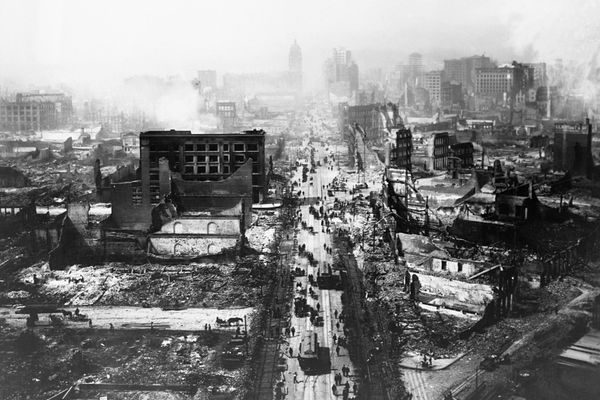
The great San Francisco fire of 1906 was initiated by a powerful earthquake. The earthquake vibrations and catastrophic fire destroyed most of the city,
leaving 250,000 people homeless.

In the future, improvements in prediction and preparedness should further minimize the loss of life and property associated with earthquakes. But it will be a long time, if ever, before we'll be ready for every substantial earthquake that might occur. Just like severe weather and disease, earthquakes are an unavoidable force generated by the powerful natural processes that shape our planet. All we can do is increase our understanding of the phenomenon and develop better ways to deal with it. To learn more about earthquakes, check out the USGS Web site, or any of the other sites listed in the Links section.

Earthquake Pictures

Pavement split by an earthquake
KAZUHIRO NOGI/AFP/Getty Images
Earthquakes can be caused by underground explosions or collapsing structures as well as by natural movements of the earth's plates.

Rift in ground from earthquake
AGUNG SWASTIKA/AFP/Getty Images
An earthquake can shatter our perspective of the ground we walk on as "rock solid."

Earthquake caused building collapse
SAJJAD QAYYUM/AFP/Getty Images
An earthquake's destructive power varies depending on the composition of the ground in an area and the design and placement of manmade structures.

Rock wall split by earthquake
Photo by China Photos/Getty Images
Highly developed areas built on loose ground material can suffer severe damage from even a relatively mild earthquake.

Landslide damage from earthquake
JAIME RAZURI/AFP/Getty Images
Earthquakes can precipitate other natural disasters, such as avalanches and landslides.

Road split by earthquake
Koichi Kamoshida/Getty Images
Surface waves are responsible for most of the damage associated with earthquakes, because they cause the most intense vibrations.

Property damage from earthquake
RENDRA TRISNADI/AFP/Getty Images
Earthquakes that cause property damage are usually rated 5 or higher on the Richter Scale.

Child peers through wall damaged in earthquake
AAMIR QURESHI/AFP/Getty Images
It's important to design structures that can withstand the force of an earthquake, especially in quake-prone areas.

Man on road after earthquake
ADEK BERRY/AFP/Getty Images
Seismologists have had more success predicting locations of aftershocks than of initial earthquakes.

Family left homeless by earthquake
JEWEL SAMAD/AFP/Getty Images
The loss of home and belongings in an earthquake can be catastrophic for quake survivors.

See more earthquake pictures

Lots More Information

Related HowStuffWorks Articles

More Great Links