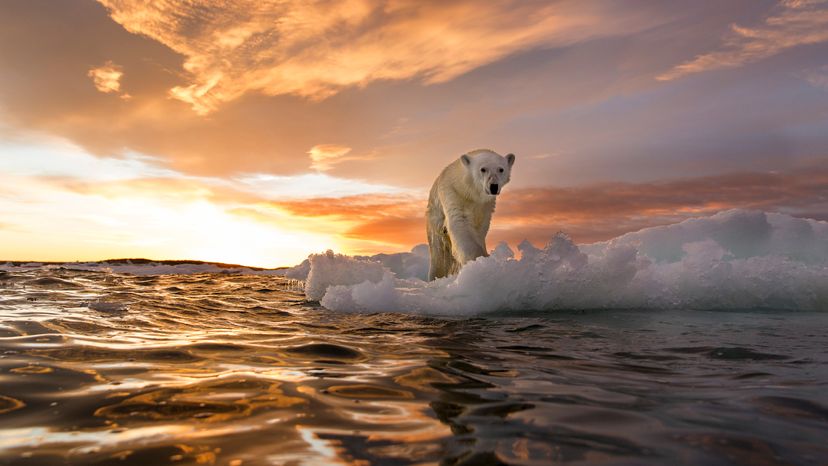
Do you know the effects of global warming? Paul Souders / Getty Images
Global warming was once an uncommon term used by a few scientists who were growing concerned over the effects of decades of pollution on long-term weather patterns. Today, the idea of global warming is well known, if not well understood. It is not unusual to hear someone complaining about a hot day or a freak storm and remark, "It's global warming."
Well, is it? In this article, we'll learn what global warming is, what causes it, what its current effects are and what the future effects could be. Although there has been a scientific consensus on global warming, some aren't sure it's something we need to worry about. We'll examine some proposed changes in the United States' national policies related to curbing global warming and the criticisms and concerns surrounding them.
Advertisement
Global warming is a significant increase in the Earth's climatic temperature over a relatively short period of time as a result of the activities of humans.
In specific terms, an increase of 1 or more degrees Celsius in a period of one hundred to two hundred years would be considered global warming. Over the course of a single century, an increase of even 0.4 degrees Celsius would be significant.
To understand what this means, let's start by reviewing the difference between weather and climate.
Weather is local and short-term. If it snows in the town where you live next Tuesday, that's weather. Climate is long-term and doesn't relate to one small location. The climate of an area is the average weather conditions in a region over a long period of time. If the part of the world you live in has cold winters with lots of snow, that would be part of the climate for the region you live in. The winters there have been cold and snowy for as long as weather has been recorded, so we know generally what to expect.
It's important to understand that when we talk about climate being long-term, we mean really long-term. Even a few hundred years is pretty short-term when it comes to climate. In fact, changes in climate sometimes take tens of thousands of years. That means if you happen to have a winter that isn't as cold as usual, with not very much snow -- or even two or three such winters in a row -- that isn't a change in climate. That's just an anomaly -- an event that falls outside of the usual statistical range but doesn't represent any permanent, long-term change.
Advertisement
It's also important to understand that even small changes in climate can have major effects. When scientists talk about "the Ice Age," you probably envision the world frozen, covered with snow and suffering from frigid temperatures. In fact, during the last ice age (ice ages recur roughly every 50,000 to 100,000 years), the earth's average temperature was only 5 Celsius degrees cooler than modern temperature averages [Source: NASA].
Global warming is a significant increase in the Earth's climatic temperature over a relatively short period of time as a result of the activities of humans.
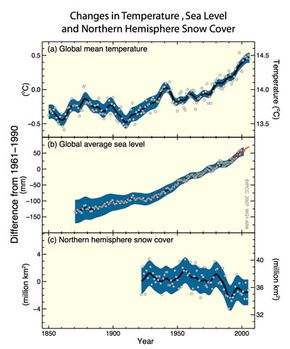
In specific terms, an increase of 1 or more Celsius degrees in a period of one hundred to two hundred years would be considered global warming. Over the course of a single century, an increase of even 0.4 degrees Celsius would be significant. The Intergovernmental Panel on Climate Change (IPCC), a group of over 2,500 scientists from countries across the world, convened in Paris in February, 2007 to compare and advance climate research. The scientists determined that the Earth has warmed .6 degrees Celsius between 1901 and 2000. When the timeframe is advanced by five years, from 1906 to 2006, the scientists found that the temperature increase was .74 degrees Celsius.
Other observations from the IPCC include:
Of the last 12 years, 11 have ranked among the warmest years since 1850.
The warming trend of the last 50 years is nearly double that of the last 100 years, meaning that the rate of warming is increasing.
The ocean's temperature has increased at least to depths of 3,000 meters (over 9,800 feet); the ocean absorbs more than 80 percent of all heat added to the climate system.
Glaciers and snow cover have decreased in regions both in the Northern and Southern hemispheres, which has contributed to the rise of sea levels.
Average Arctic temperatures increased by nearly twice the global average rate over the last 100 years (the IPCC also noted that Arctic temperatures have are highly variable from decade to decade).
The area covered by frozen ground in the Arctic has decreased by approximately 7 percent since 1900, with seasonal decreases of up to 15 percent.
Precipitation has increased in eastern regions of the Americas, northern Europe and parts of Asia; other regions such as the Mediterranean and southern Africa have experienced drying trends.
Westerly winds have been growing stronger.
Droughts are more intense, have lasted longer and covered larger areas than in the past.
There have been significant changes in extreme temperatures -- hot days and heat waves have become more frequent while cold days and nights have become less frequent.
While scientists have not observed an increase in the number of tropical storms, they have observed an increase in the intensity of such storms in the Atlantic correlated with a rise in ocean surface temperatures.
Natural Changes in Climate
It can take the Earth thousands of years to warm up or cool down just 1 degree when it happens naturally. In addition to recurring ice-age cycles, the Earth's climate can change due to volcanic activity, differences in plant life, changes in the amount of radiation from the sun, and natural changes in the chemistry of the atmosphere.
Advertisement
The Greenhouse Effect
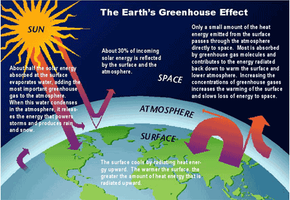
Courtesy U.S. Global Change Research Program
Global warming is caused by an increase in the greenhouse effect. The greenhouse effect is not a bad thing by itself -- it's what allows Earth to stay warm enough for life to survive.
Although it's not a perfect analogy, you can think of the Earth sort of like your car sitting out in a parking lot on a sunny day. You've probably noticed that your car is always much hotter inside than the outside temperature if it's been sitting there for a while. The sun's rays enter through your car's windows. Some of the heat from the sun is absorbed by the seats, the dashboard and the carpeting and floor mats. When those objects release this heat, it doesn't all get out through the windows. Some is reflected back in. The heat radiated by the seats is a different wavelength than the light of the sun that made it through the windows in the first place. So a certain amount of energy is going in, and less energy is going out. The result is a gradual increase in the temperature inside your car.
Advertisement
The greenhouse effect is a little more complicated than your hot car. When the sun's rays hit the Earth's atmosphere and the surface of the Earth, approximately 70 percent of the energy stays on the planet, absorbed by land, oceans, plants and other things. The other 30 percent is reflected into space by clouds, snow fields and other reflective surfaces [Source: NASA]. But even the 70 percent that gets through doesn't stay on earth forever (otherwise the Earth would become a blazing fireball). The Earth's oceans and land masses eventually radiate heat back out. Some of this heat makes it into space. The rest of it ends up getting absorbed when it hits certain things in the atmosphere, such as carbon dioxide, methane gas and water vapor. After these components in our atmosphere absorb all this heat, they emit energy (also in the form of heat). The heat that doesn't make it out through Earth's atmosphere keeps the planet warmer than it is in outer space, because more energy is coming in through the atmosphere than is going out. This is all part of the greenhouse effect that keeps the Earth warm.
Earth Without the Greenhouse Effect
What would Earth look like if there weren't any greenhouse effect at all? It would probably look a lot like Mars. Mars doesn't have a thick enough atmosphere to reflect enough heat back to the planet, so it gets very cold there. Some scientists have suggested that we could terraform the surface of Mars by sending "factories" that would spew water vapor and carbon dioxide into the air. If enough material could be generated, the atmosphere might start to thicken enough to retain more heat and allow plants to live on the surface. Once plants spread across Mars, they would start producing oxygen. After a few hundred or thousand years, Mars might actually have an environment that humans could simply walk around in -- all thanks to the greenhouse effect.
Global Warming: What's Happening?
Power plants, cattle and cars are major contributors of greenhouse gases such as carbon dioxide and methane.
Courtesy NASA
The greenhouse effect happens because of certain naturally occurring substances in the atmosphere. Unfortunately, since the Industrial Revolution, humans have been pouring huge amounts of those substances into the air.
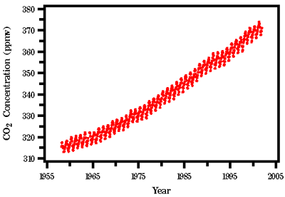
Carbon dioxide (CO2) is a colorless gas that is a by-product of the combustion of organic matter. It makes up less than 0.04 percent of Earth's atmosphere, most of which was put there by volcanic activity very early in the planet's life. Today, human activities are pumping huge amounts of CO2 into the atmosphere, resulting in an overall increase in carbon dioxide concentrations [Source: Keeling, C.D. and T.P. Whorf]. These increased concentrations are considered the primary factor in global warming, because carbon dioxide absorbs infrared radiation. Most of the energy that escapes Earth's atmosphere comes in this form, so extra CO2 means more energy absorption and an overall increase in the planet's temperature.
Advertisement
Carbon dioxide concentration as measured at Mauna Loa, Hawaii
Courtesy NOAA, Dave Keeling and Tim Whorf (Schipps Institution of Oceanography)
The Worldwatch Institute reports that carbon emissions worldwide have increased from about 1 billion tons in 1900 to about 7 billion tons in 1995. The Institute also notes that the average surface temperature of Earth has gone from 14.5 degrees C in 1860 to 15.3 degrees C in 1980.
The IPCC says that the pre-industrial amount of CO2 in the Earth's atmosphere was about 280 parts per million (ppm), meaning that for every million molecules of dry air, 280 of them were CO2. In contrast, 2005 levels of CO2 were measured at 379 ppm [Source: IPCC].
Nitrous oxide (N2O) is another important greenhouse gas. Although the amounts being released by human activities are not as great as the amounts of CO2, nitrous oxide absorbs much more energy than CO2 (about 270 times as much). For this reason, efforts to curb greenhouse gas emissions have focused on N2O as well [Source: Soil Conservation Council of Canada]. The use of large amounts of nitrogen fertilizer on crops releases nitrous oxide in great quantities, and it is also a by-product of combustion.
Methane is a combustible gas, and it is the main component of natural gas. Methane occurs naturally through the decomposition of organic material and is often encountered in the form of "swamp gas." Man-made processes produce methane in several ways:
By extracting it from coal
From large herds of livestock (i.e., digestive gases)
Methane acts much like carbon dioxide in the atmosphere, absorbing infrared energy and keeping heat energy on Earth. The IPCC says that methane's concentration in the atmosphere in 2005 was 1,774 parts per billion (ppb) [Source: IPCC]. While there isn't as much methane as carbon dioxide in the atmosphere, methane can absorb and emit twenty times more heat than CO2 [Source: Hopwood, Nick and Cohen, Jordan]. Some scientists even speculate that a large-scale venting of methane into the atmosphere (such as from the release of huge chunks of methane ice locked under the oceans) could have created brief periods of intense global warming that led to some of the mass extinctions in the planet's distant past [Source: Discover Magazine].
What will actually happen if the entire planet warms up a few degrees? Read the next section to find out.
Carbon Dioxide and Methane Concentrations
Carbon dioxide and methane concentrations in 2005 exceeded their natural ranges of the last 650,000 years. Much of this increase in concentration is due to burning fossil fuels.
Advertisement
Effects of Global Warming: Sea Level
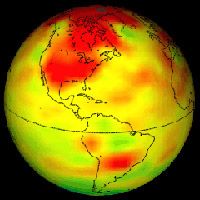
Some possible effects of global warming are the inundation of low-lying islands due to rising sea levels, increased frequency of severe storms and the retreat of glaciers and icecaps.
Photo courtesy NASA
We have seen that an average drop of just 5 degrees Celsius over thousands of years can cause an ice age; so what will happen if the Earth's average temperature increases a few degrees in just a few hundred years? There is no clear answer. Even short-term weather predictions are never perfectly accurate because weather is a complex phenomenon. When it comes to long-term climate predictions, all we can manage are educated guesses based on our knowledge of climate patterns through history.
Glaciers and ice shelves around the world are melting [Source: Guardian Unlimited]. The loss of large areas of ice on the surface could accelerate global warming because less of the sun's energy would be reflected away from Earth to begin with (refer back to our discussion of the greenhouse effect). An immediate result of melting glaciers would be a rise in sea levels. Initially, the rise in sea level would only be an inch or two. Even a modest rise in sea levels could cause flooding problems for low-lying coastal areas. However, if the West Antarctic Ice Sheet were to melt and collapse into the sea, it would push sea levels up 10 meters (more than 32 feet), and many coastal areas would completely disappear beneath the ocean [Source: NASA].
Advertisement
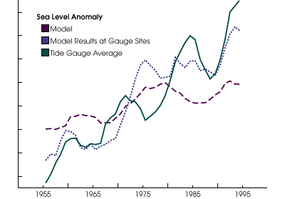
Research predictions indicate a rising sea level.
Photo courtesy Earth Observatory, NOAA
The IPCC estimates that sea levels rose 17 centimeters (or about 6.7 inches) in the 20th century. Scientists project rising sea levels to continue through the 21st century, with levels increasing between 7 and 22 inches by 2100. The IPCC did not consider changes in ice flow in these projections due to a lack of scientific data. Sea levels will likely be greater than the range of projections, but we can't be sure by how much until more data can be gathered about the effect of global warming on ice flows.
With a rise in the overall temperature of the ocean, ocean-borne storms such as tropical storms and hurricanes, which get their fierce and destructive energy from the warm waters they pass over, could increase in force.
If the rising temperature affects glaciers and ice shelves, could the polar ice caps be in danger of melting and causing the oceans to rise? We'll look at this danger in the next section.
Water Vapor, The Other Greenhouse Gas
Water vapor is the most abundant greenhouse gas, but it is more often than not a result of climate changes rather than man-made emissions. Water or moisture on the Earth's surface absorbs heat from the sun and the surroundings. When enough heat has been absorbed, some of the liquid's molecules may have enough energy to escape from the liquid and begin to rise into the atmosphere as a vapor. As the vapor rises higher and higher, the temperature of the surrounding air becomes lower and lower. Eventually, the vapor loses enough heat to the surrounding air to allow it to turn back into a liquid. Earth's gravitational pull then causes the liquid to "fall" back down, completing the cycle. This cycle is also called a "positive feedback loop."
Water vapor is more difficult to measure than the other greenhouse gases and scientists are uncertain as to the exact part that it plays in global warming. Scientists believe there is a correlation between the increase of carbon dioxide in our atmosphere and the increase of water vapor. The NOAA Web site has this to say:
As water vapor increases in the atmosphere, more of it will eventually also condense into clouds, which are more able to reflect incoming solar radiation (thus allowing less energy to reach the Earth's surface and heat it up).
Advertisement
If the Polar Ice Caps Melt
Photo courtesy NOAA
Are the polar ice caps in danger of melting and causing the oceans to rise? This could happen, but no one knows when it might happen.
The Earth's main ice-covered landmass is Antarctica at the South Pole, with about 90 percent of the world's ice (and 70 percent of its fresh water). Antarctica is covered with ice an average of 2,133 meters (7,000 feet) thick. If all of the Antarctic ice melted, sea levels around the world would rise about 61 meters (200 feet). But the average temperature in Antarctica is -37°C, so the ice there is in no danger of melting. In fact, in most parts of the continent it never gets above freezing.
Advertisement
At the other end of the world, the North Pole, the ice is not nearly as thick as at the South Pole. The ice floats on the Arctic Ocean. If it melted, sea levels would not be affected.
There is a significant amount of ice covering Greenland, which would add another 7 meters (20 feet) to the oceans if it melted. Because Greenland is closer to the equator than Antarctica, the temperatures there are higher, so the ice is more likely to melt. Scientists from the Universities of London and Edinburgh say that ice loss in Antarctica and Greenland together contribute approximately 12 percent of the rise in sea levels [Source: Science Daily].
But there might be a less dramatic reason than polar ice melting for the higher ocean level -- the higher temperature of the water. Water is most dense at 4 degrees Celsius. Above and below this temperature, the density of water decreases (the same weight of water occupies a bigger space). So as the overall temperature of the water increases it naturally expands a little bit making the oceans rise.
Advertisement
Effects of Global Warming: Seasons and Ecosystems
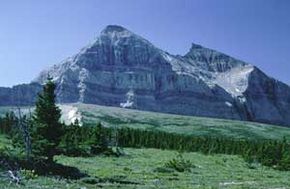
Photo courtesy U.S. Geological Survey
Less abrupt changes would occur around the world as average temperatures increased. In temperate areas with four seasons, the growing season would be longer with more precipitation. This could be beneficial in many ways for these areas. However, less temperate parts of the world would likely see an increase in temperature and a sharp decrease in precipitation, causing long droughts and potentially creating deserts.
Because the Earth's climate is so complex, no one is really sure how much a change to one region's climate will affect other regions. For example, scientists at the University of Colorado theorize that the decrease in sea ice in the Arctic could reduce snowfall in Colorado because Arctic cold fronts would be less intense. This could impact everything from farmlands to the ski industry.
Advertisement
The most devastating effects, and also the hardest to predict, are the effects on the world's living ecosystems. Many ecosystems are very delicate, and the slightest change can kill off several species as well as any other species that depend on them. Most ecosystems are interconnected, so the chain reaction of effects could be immeasurable. The results could be something like a forest gradually dying off and turning to grassland or entire coral reefs dying. Many species of plants and animals would adapt or move to deal with the shift in climate, but many would become extinct.
Some ecosystems are already changing drastically due to a shift in climate. The University of Alberta reports that much of what once was tundra in northern Canada is turning into forests. They also noticed that the change from tundra to forest isn't linear; instead, it seems that the change happens in sudden spurts.
The human cost of global warming is hard to quantify. Thousands of lives per year could be lost as the elderly or ill suffer from heat stroke and other heat-related trauma. Poor and underdeveloped nations would suffer the worst effects, since they would not have the financial resources to deal with the problems that come with an increase in temperature. Huge numbers of people could die from starvation if a decrease in precipitation limits crop growth and from disease if coastal flooding leads to widespread water-borne illness.
The Carnegie Institution estimates that around $5 billion in crop losses per year are due to global warming. Farmers see a decrease of about 40 million metric tons of cereal grains like wheat, barley and corn each year. Scientists discovered that an increase of 1 degree Fahrenheit in average temperature results in a 3 to 5 percent drop in crop yields [Source: Science Daily].
Next, we'll find out why some people aren't concerned about global warming.
Does Not Compute
The IPCC used computer models to simulate climate change and discovered that only models that included human contributions to global warming portrayed an accurate representation of today's climate. When the models did not include such considerations, the climates they simulated did not resemble our own.
Advertisement
Is Global Warming a Real Problem?
Despite a scientific consensus on the subject, some people don't think global warming is happening at all. There are several reasons for this:
They don't think the data show a measurable upward trend in global temperatures, either because we don't have enough long-term historical climate data or because the data we do have isn't clear enough.
A few scientists think that data is being interpreted incorrectly by people who are already worried about global warming. That is, these people are looking for evidence of global warming in the statistics, instead of looking at the evidence objectively and trying to figure out what it means.
Some argue any increase in global temperatures we are seeing could be a natural climate shift, or it could be due to other factors than greenhouse gases.
Most scientists recognize that global warming does seem to be happening, but a few don't believe that it is anything to be worried about. These scientists say that the Earth is more resistant to climate changes on this scale than we think. Plants and animals will adapt to subtle shifts in weather patterns, and it is unlikely anything catastrophic will happen as a result of global warming. Slightly longer growing seasons, changes in precipitation levels and stronger weather, in their opinion, are not generally disastrous. They also argue that the economic damage caused by cutting down on the emission of greenhouse gases will be far more damaging to humans than any of the effects of global warming.
Advertisement
In a way, the scientific consensus may be a moot point. The real power to enact significant change rests in the hands of those who make national and global policy. Some policymakers in the United States are reluctant to propose and enact changes because they feel the costs may outweigh any risks global warming poses. Some common concerns, claims and complaints include:
A change in the United States' policies in emissions and carbon production could result in a loss of jobs.
India and China, both of which continue to rely heavily on coal for their main source of energy, will continue to cause environmental problems even if the United States changes its energy policies (critics of these policymakers point out that this approach employs the tu quoque logical fallacy).
Since scientific evidence is about probabilities rather than certainties, we can't be certain that human behavior is contributing to global warming, that our contribution is significant, or that we can do anything to fix it.
Technology will find a way to get us out of the global warming mess, so any change in our policies will ultimately be unnecessary and cause more harm than good.
What's the correct answer? It can be hard to figure out. Most scientists will tell you that global warming is real and that it is likely to do some kind of harm, but the extent of the problem and the danger posed by its effects are wide open for debate.
In the next section, we'll see if there's anything we can do to help prevent global warming.
An Economist's Take
Dr. Peter Tsigaris, an economist at Thompson Rivers University, says that taking steps to curb global warming makes sense from both an environmental and an economic standpoint. He estimates that addressing global warming by changing our dependency on fossil fuels and other behavior would cost an estimated one percent of global Gross Domestic Product (GDP) per year, while taking no action could cost 5 percent of global GDP each year. Extreme climate change could result in a cost of 20 percent GDP or greater. [Source: Science Daily]
Advertisement
Can We Stop Global Warming?
Hydrogen-powered cars, the increased use of solar cells, and hydro-electric power plants are possible ways to reduce the emission of greenhouse gases.
Courtesy BMW AG, Munich, Germany; DOE/NREL; SunLine Transit Agency
Though scientists warn that global warming will likely continue for centuries because of the long natural processes involved, there are a few things we can do to decrease the effects. Basically, they all boil down to this: Don't use as much of the stuff that creates greenhouse gases. On a local level, you can help by using less energy. The electricity that operates many of the devices in our homes comes from a power plant, and most power plants burn fossil fuels to generate that power. Turn off lights when they're not in use. Take shorter showers to use less hot water. Use a fan instead of an air conditioner on a warm day.
Here are some other specific ways you can help decrease greenhouse-gas emissions:
Advertisement
Make sure your car is properly tuned up. This allows it to run more efficiently and generate fewer harmful gases.
Walk or ride your bike if possible, or carpool on your way to work. Cars burn fossil fuel, so smaller, more fuel-efficient cars emit less CO2, particularly hybrid cars.
Turn lights and other appliances off when you're not using them. Even though a light bulb doesn't generate greenhouse gas, the power plant that generates the electricity used by the light bulb probably does. Switch from incandescent light bulbs to fluorescent bulbs, which use less energy and last longer.
Recycle. Garbage that doesn't get recycled ends up in a landfill, generating methane. Recycled goods also require less energy to produce than products made from scratch.
Plant trees and other plants where you can. Plants take carbon dioxide out of the air and release oxygen.
Don't burn garbage. This releases carbon dioxide and hydrocarbons into the atmosphere.
To really stem the emission of greenhouse gases, we need to develop non-fossil fuel energy sources. Hydro-electric power, solar power, hydrogen engines and fuel cells could all create big cuts in greenhouse gases if they were to become more common.
At the international level, the Kyoto treaty was written to reduce CO2 and other greenhouse gas emissions worldwide. Thirty-five industrialized nations have committed to reducing their output of those gases to varying degrees. Unfortunately, the United States, the world's primary producer of greenhouse gases, did not sign the treaty.
Al Gore's book and documentary "An Inconvenient Truth" got a lot of people talking about global warming.
Photo courtesy Consumer Guide Products
In March, 2007, former Vice President Al Gore testified in front of Congress and urged them to make some very challenging changes in national policy. These include:
Freeze carbon production at the current level and create programs to reduce carbon production by 90 percent by 2050
Shift taxation from employment and production to a taxation upon pollution
Create an international treaty that would effectively comply with the Kyoto treaty without carrying the same perceived political baggage
Halt the construction of all new coal-based power facilities unless they comply with restrictions on carbon production
Increase emission standards across the board for both the automobile industry and power facilities
Ban incandescent light bulbs
Gore admits that the decision to enact these and other proposed responses to global warming can be difficult. He also says that climate change is not just a crisis, but the most important crisis mankind has ever faced.
For more information on global warming and related topics, check out the links on the next page.
Alley, Richard et al. "Climate Change 2007: The Physical Science Basis - Summary for Policymakers." Intergovernmental Panel on Climate Change. http://www.ipcc.ch
Earth Observatory: Global Warming http://earthobservatory.nasa.gov/Library/GlobalWarming
The EPA Global Warming Kids Page http://www.epa.gov/globalwarming/kids
Flavin, Christopher and Tunali, Odil. "Climate of Hope: New Strategies for Stabilizing the World's Atmosphere." Worldwatch Institute, 1996. ISBN 1-878071-32-7.
Jones, Laura, editor. "Global Warming: The Science and the Politics." The Fraser Institute, 1997. ISBN 0-88975-184-6.
Kruglinski, Susan. "What Caused the Biggest Kill of All?" Discover Magazine, 2003.
NOAA: Global Warming http://www.ncdc.noaa.gov/oa/climate/globalwarming.html
RealClimate http://www.realclimate.org
Science Daily: Earth and Climate http://www.sciencedaily.com/news/earth_climate
Singer, S. Fred. "Hot Talk, Cold Science: Global Warming's Unfinished Debate." The Independent Institute, 1998. ISBN 0-945999-78-x.
Tesar, Jenny. "Global Warming." Facts On File, 1991. ISBN 0-8160-2490-1.
Cite This!
Please copy/paste the following text to properly cite this HowStuffWorks.com article: