The orbiter must provide you with an environment similar to Earth. You must have air, food, water, and a comfortable temperature. The orbiter must also take away the wastes that your body produces (carbon dioxide, urine, feces) and protect you from fire. Let's look at these various aspects of the orbiter's life support system.
On board the space shuttle, you need to have the following:
- atmosphere similar to Earth
- carbon dioxide removed
- contaminating or trace gases removed
- normal humid environment
Our atmosphere is a mixture of gases (78 percent nitrogen, 21 percent oxygen, 1 percent other gases) at a pressure of 14 lbs/in2 (1 atm) that we breathe in and out. The space shuttle must provide a similar atmosphere. To do this, the orbiter carries liquid oxygen and liquid nitrogen in two systems of pressurized tanks, which are located in the mid-fuselage (each system has two tanks for a total of four tanks). The cabin pressurization system combines the gases in the correct mixture at normal atmospheric pressure. While in orbit, only one oxygen-nitrogen system is used to pressurize the orbiter. During launch and landing, both systems of each gas are used.
Five loops of fans circulate the atmosphere. The circulated air picks up carbon dioxide, heat and moisture:
- Chemical carbon dioxide canisters remove carbon dioxide by reacting it with lithium hydroxide. These canisters are located in the lower deck of the crew compartment and changed every 12 hours.
- Filters and charcoal canisters remove trace odors, dust and volatile chemicals from leaks, spills and outgassing.
- A cabin heat exchanger in the lower deck cools the air and condenses the moisture, which collects in a slurper. Water from the slurper is moved with air to a fan separator, which uses centrifugal force to separate water from air. The air is recirculated and the water goes to a wastewater tank.
Besides air, water is the most important quantity aboard the orbiter. Water is made from liquid oxygen and hydrogen in the space shuttle's fuel cells (the fuel cells can make 25 lb (11 kg) of water per hour). The water passes through a hydrogen separator to eliminate any trapped hydrogen gas (excess hydrogen gas is dumped overboard). The water is then stored in four water storage tanks located in the lower deck. Each tank can hold 165 lb (75 kg). The water tanks are pressurized by nitrogen so that water can flow to the mid-deck for use by the crew. Drinkable water is then filtered to remove microbes and can be warmed or chilled through various heat exchangers depending upon the use (food preparation, consumption, personal hygiene). Excess water produced by the fuel cells gets routed to a wastewater tank and subsequently dumped overboard.
Outer space is an extremely cold environment and temperatures will vary drastically in different parts of the orbiter. You might think that heating the orbiter would be a problem. However, the electronic equipment generates more than enough heat for the ship. The problem is getting rid of the excess heat. So the temperature control system has to carry out two major functions:
- Distribute heat where it is needed on the orbiter (mid-fuselage and aft sections) so that vital systems do not freeze in the cold of space.
- Get rid of the excess heat.
To do this, the shuttle has two methods to handle temperature control:
- Passive methods - generally simple, handle small heat loads and require little maintenance Insulating materials (blankets), surface coatings, paints - reduce heat loss through the walls of the various components just like your home insulation. Electrical heaters - use electrically-heated wires like a toaster to heat various areas.
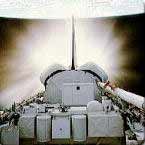
- Active methods - more complex, use fluid to handle large heat loads, require maintenance Cold plates - metal plates that collect heat by direct contact with equipment or conduction Heat exchangers - collect heat from equipment using fluid. The equipment radiates heat to a fluid (water, ammonia) which in turn passes heat on to freon. Both fluids are pumped and recirculated to remove heat. Pumps, lines, valves - transport the collected heat from one area to another. Radiators - located on the inside surfaces of the cargo bay doors that radiate the collected heat to outer space Flash evaporator/ammonia boilers - these devices are located in the aft fuselage and transfer heat from Freon coolant loops overboard when cargo bay doors are closed or when cargo bay radiators are overloaded. Flash evaporator Freon coolant loops wrap around an inner core. The evaporator sprays water on the heated core. The water evaporates removing heat. The water vapor is vented overboard. Ammonia boiler Freon coolant loops pass through a tank of pressurized ammonia. Heat released from the freon causes the ammonia to boil. Ammonia vapor is dumped overboard.
The cabin heat exchanger also controls the cabin temperature. It circulates cool water to remove excess heat (cabin air is also used to cool electronic equipment) and transfers this heat to a Freon exchanger. The Freon then transfers the heat to other orbiter systems (e.g., cryogenic gas tanks, hydraulic systems) and radiates excess heat to outer space.
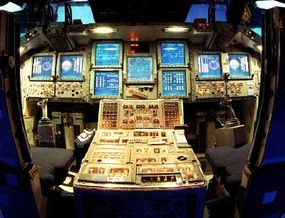
The orbiter has internal fluorescent floodlights that illuminate the crew compartment. The orbiter has external floodlights to illuminate the cargo bay. Finally, the control panels are lighted internally for easy viewing.
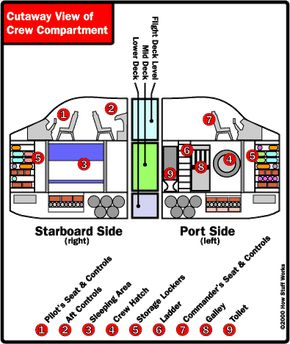
Food is stored on the mid-deck of the crew compartment. Food comes in several forms (dehydrated, low moisture, heat-stabilized, irradiated, natural and fresh). The orbiter has a galley-style kitchen module along the wall next to the entry hatch, which is equipped with the following:
- food storage compartments
- food warmers
- a food preparation area with warm and cold water outlets
- metal trays so the food packages and utensils do not float away
Like any home, the orbiter must be kept clean, especially in space when floating dirt and debris could present a hazard. Wastes are made from cleaning, eating, work and personal hygiene. For general housecleaning, various wipes (wet, dry, fabric, detergent and disinfectant), detergents, and wet/dry vacuum cleaners are used to clean surfaces, filters and the astronauts. Trash is separated into wet trash bags and dry trash bags, and the wet trash is placed in an evaporator that will remove the water. All trash bags are stowed in the lower deck to be returned to Earth for disposal. Solid waste from the toilet is compacted, dried and stored in bags where it is returned to Earth for disposal (burning). Liquid waste from the toilet goes to the wastewater tank where it is dumped overboard.
Fire is one of the most dangerous hazards in space. The orbiter has a Fire Detection and Suppression Subsystem that consists of the following:
- area smoke detectors on each deck
- smoke detectors in each rack of electrical equipment
- alarms and warning lights in each module
- non-toxic portable fire extinguishers (carbon dioxide-based)
- personal breathing apparatus - mask and oxygen bottle for each crew member
After a fire is extinguished, the atmosphere control system will filter the air to remove particulates and toxic substances.
Next, we'll look at the technologies that help the space shuttle navigate, change direction and communicate from space.