Introduction to How Space Stations Work
Imagine waking up in the morning, looking out your window and seeing this view. Breathtaking, isn't it? What would it be like to live in space? Is it only science fiction, or will it be a real possibility in the near future?
![]() Photo courtesy NASA View of the Florida peninsula from space. |
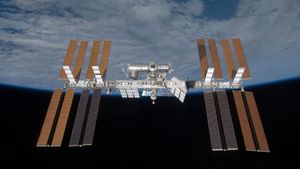
For years, and for various reasons, people (scientists, astronauts, science fiction writers, the general public) have dreamed of having a permanent space station in orbit around Earth. For some, space stations are a place to do cutting edge scientific research in an environment that can not be matched on Earth. For others, space stations are a place for business, where unique materials (crystals, semiconductors, pharmaceuticals) can be manufactured in better forms than on Earth. Still others dream of space stations as staging points for expeditions to the planets and stars, as tourist attractions, or even as new cities and colonies that could relieve an overpopulated planet. Whatever the dream, space stations are not that far off. The United States and Russia have had orbiting space stations since 1971 and are now cooperating with other nations to build the International Space Station, a place that will maintain a permanent human presence in space.
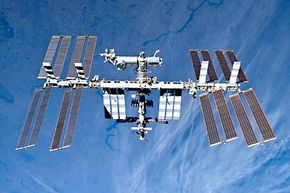
![]() Photo courtesy NASA Artist's concept of the completed International Space Station. See more Space Station pictures. |
What will the space station look like? What will it be like to live and work in space? What problems are involved in establishing a space station? What will it be used for? In this article, we will examine the fascinating world of space stations.
A Little History
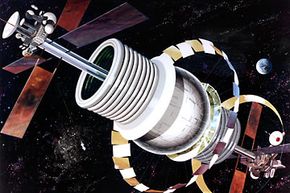
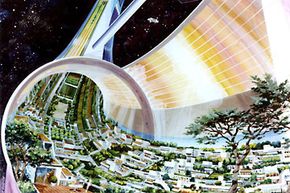
![]() Photo courtesy NASA Credit: Rick Guidice Artist's concept of a space colony. |
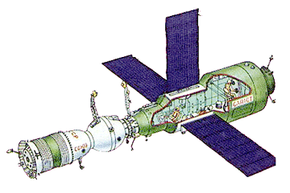
Salyut
The Russians (then the Soviet Union) were the first to place a space station, called Salyut 1, in orbit in 1971. The Salyut 1 station was a combination of the Almaz and Soyuz spacecraft systems. It was about 45 feet (15 meters) long and held three main compartments that housed dining and recreation areas, food and water storage, a toilet, control stations, exercise equipment and scientific equipment. The Soyuz 11 crew was the first crew to live on Salyut 1 for 24 days; but tragically, they died upon returning to Earth. Further missions to Salyut 1 were canceled, and the Soyuz spacecraft was redesigned.
During the 1970s, the Russians launched several other Salyut space stations (Salyuts 4-7) where they tested the new Soyuz spacecraft, developed and tested unmanned docking supply ships called Progress ships, conducted scientific experiments and logged some of the longest space flights at that time. The Salyut program eventually led to the development of Russia's Mir space station.
![]() Photo courtesy NASA Diagram of the Salyut-4 space station docked to a Soyuz spacecraft. |
Skylab
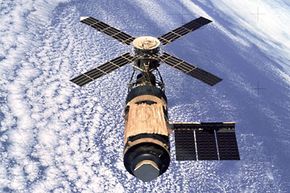
The United States placed its first, and only, space station, called Skylab 1, in orbit in 1973. During the launch, the station was damaged. A critical meteoroid shield and one of the station's two main solar panels were ripped off and the other solar panel was not fully stretched out. That meant that Skylab had little electrical power and the internal temperature rose to 126 degrees Fahrenheit (52 degrees Celsius). The first crew was launched 10 days later to fix the ailing station. The astronauts stretched out the remaining solar panel and set up an umbrella-like sunshade to cool the station. With the station repaired, that crew and two subsequent crews spent a total of 112 days in space, conducting scientific and biomedical research.
![]() Photo courtesy NASA Diagram of the Skylab 1 orbiting workshop. |
![]() Photo courtesy NASA Photograph of Skylab 1 in orbit after its repairs. Note the gold sunshade. |
Skylab was modified from the third stage of a Saturn V moon rocket. Skylab had the following parts:
- Orbital Workshop - living and working quarters for the crew
- Airlock Module - allowed access to the outside of the station
- Multiple Docking Adapter - allowed more than one Apollo spacecraft to dock to the station at once
- Apollo Telescope Mount - contained telescopes for observing the sun, stars and Earth (remember that the Hubble Space Telescope had not been built yet!)
- Apollo spacecraft - command and service module for transporting the crew to and from the Earth's surface
Mir
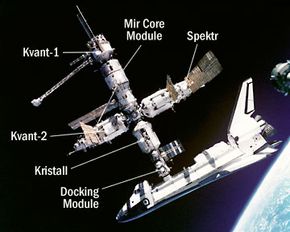
In 1986, the Russians launched the Mir space station; Mir was intended to be a permanent home in space. Mir contains the following parts:
- Core Assembly
- living quarters - individual crew cabins, toilet, shower, kitchen, trash storage
- transfer compartment - where additional station modules can be attached
- intermediate compartment - connects working module to the rear docking ports
- assembly compartment - where the fuel tanks and rocket engines are located
- Kvant-1 Astrophysics module - contains telescopes to study galaxies, quasars and neutron stars
- Kvant-2 Scientific and Airlock module - provides equipment for biological research, Earth observations and spacewalk capabilities
- Kristall Technological module - used for biological and material processing experiments; contains a docking port that can be used by the U.S. space shuttle
- Priroda Remote Sensing module - contains radar and spectrometers to study the Earth's atmosphere
- Docking module - contains ports for future shuttle dockings
- Progress supply ship - unmanned resupply ship that brings new food and equipment form Earth and removes waste materials from the station
- Soyuz spacecraft - main transport to and from Earth's surface
![]() Photo courtesy NASA Artist's drawing of Mir space station with a docked space shuttle. |
In preparation for the International Space Station (ISS), NASA astronauts (including Norm Thagard, Shannon Lucid, Jerry Linenger and Michael Foale) spent time aboard Mir. Mir was damaged by a fire during Linenger's stay, and crashed with a Progress supply ship during Foale's stay. The Russian space agency could no longer afford to maintain Mir, so NASA and the Russian space agency had planned to junk the station in order to concentrate on the ISS. Although a private movement (Keep Mir Alive!) and a company (MirCorp) publicly campaigned to repair and privatize the aging space station, the Russian Space Agency decided on November 16, 2000, to bring Mir down to Earth. On February 2001, Mir's rocket engines were fired to slow it down. Mir re-entered the Earth's atmosphere on March 23, 2001, burned and broke up. Debris crashed in the south Pacific Ocean about 1,000 miles (1,667 km) east of Australia.
The International Space Station (ISS)
In 1984, President Ronald Reagan proposed that the United States, in cooperation with other countries, build a permanently inhabited space station. Reagan envisioned a station that would have government and industry support. The U.S. forged a cooperative effort with 14 other countries (Canada, Japan, Brazil, and the European Space Agency -- United Kingdom, France, Germany, Belgium, Italy, The Netherlands, Denmark, Norway, Spain, Switzerland, Sweden). During the planning of the ISS and after the fall of the Soviet Union, the United States invited Russia to cooperate in the ISS in 1993; this brought the number of participating countries to 16. NASA is taking the lead in coordinating the ISS's construction.
Click on the country's name to see what part
of the International Space Station it will be responsible for.
ISS Facts
|
The assembly of the ISS in orbit began in 1998. The ISS has more than 100 components and will require 44 spaceflights by at least three space vehicles (space shuttle, Soyuz and Russian Proton rocket) to deliver the components into orbit. One-hundred sixty spacewalks, totaling 1,920 man-hours, will be required to assemble and maintain the ISS, which is scheduled for completion in 2010 and will have an anticipated life of 10 years at a projected total cost of $35 to $37 billion. When completed, the ISS will be able to house up to seven astronauts. It will have the following major components:
- Control Module (Zarya) or Functional Cargo Block - contains propulsion (two rocket engines), command and control systems
- Nodes (three) - connect major portions of the ISS
- Service Module (Zvezda) - contains living quarters and life support for early parts of the ISS, docking ports for Progress resupply ships and rocket engines for attitude control and re-boost
- Scientific Laboratories (six) - contain scientific equipment and a robotic arm to move payload on an outside platform
- Laboratory Module - shirt-sleeve environment facility for research on microgravity, life sciences, Earth sciences and space sciences
- Truss - long, tower-like spine for attaching modules, payloads and systems equipment
- Mobile Servicing System - robotic system that will move along the truss; equipped with remote arm for assembly and maintenance activities
- Transfer Vehicles - a Soyuz capsule and a Crew Return Vehicle (X-38) for emergency evacuation
- Electrical Power System - solar panels and equipment for generating, storing, managing and distributing electrical power
![]() Photo courtesy NASA ISS in orbit showing (top to bottom) Node-1, Control Module, Service Module and a Progress supply ship (September 2000). |
On October 31, 2000, the first crew of the ISS (shown below) was launched from Russia. The three-member crew spent almost five months aboard the ISS, activating systems, and conducting experiments.
![]() Photo courtesy NASA The first ISS crew (left to right): flight engineer Sergei Krikalev, mission commander William Shepherd and Soyuz commander Yuri Gidzenko. |
The first crew returned to Earth on March 21, 2001. The ISS has since been manned by a series of three- and two-member crews:
- Crew 2 - March to August 2001
- Crew 3 - August to December 2001
- Crew 4 - December 2001 to June 2002
- Crew 5 - June to December 2002
- Crew 6 - November 2002 to May 2003
- Crew 7 - April to October 2003
- Crew 8 - October 2003 to April 2004
- Crew 9 - April to October 2004
- Crew 10 - October 2004 to April 2005
- Crew 11 - April to October 2005
- Crew 12 - September 2005 to April 2006
- Crew 13 - March to September 2006
- Crew 14 - Launched September 2006
Sustaining a Permanent Environment in Space
To sustain a permanent environment in outer space where people can live and work, the ISS must be able to provide the following things:- life support
- atmosphere control, supply and recycling
- water recycling
- temperature control
- food supply
- waste removal
- fire protection
- propulsion - move the station in orbit
- communications and tracking - talk with ground-based flight controllers
- navigation - find its way around
- electrical power
- computers - coordinate and handle information
- resupply - methods of getting new supplies and removing waste
- emergency escape route
Life Support
We take for granted all of the things that the Earth and our society provides to keep us alive. We have a constant supply of fresh air. The carbon dioxide that we exhale gets recycled by plants. We have a large supply of fresh water from rivers, lakes and streams that we use for drinking, showers, cooking and laundry. We are warmed by heaters or the sun and cooled by air conditioning. We have fire protection from local fire stations. All of these things must be designed into the ISS.
Atmosphere Control, Supply and Recycling
Astronauts on board the ISS need to have the following:
- Atmosphere similar to Earth's
- Carbon dioxide that they exhale removed
- Contaminating or trace gases removed
- Normal humid environment
- The Russian Elektron generator will make oxygen by splitting water into hydrogen and oxygen (electrolysis).
- Solid fuel oxygen generators or oxygen candles will be burned to make additional oxygen, if required.
- The space shuttle or Progress supply ships will bring nitrogen from Earth, and store it in external tanks on the station.
- In later phases of construction, external tanks will supply oxygen; these tanks can be refilled by the space shuttle. In the final stage, an additional electrolysis oxygen generator will be added to the station.
- The pressure control assembly (a system of pumps and valves) will mix the nitrogen and oxygen in the right percentages, monitor the atmospheric pressure and depressurize the station when necessary to prevent overpressure or to extinguish a fire during an emergency.
The trace contaminant control system will filter cabin air to remove trace odors and volatile chemicals from leaks, spills and outgassing. As a backup, the harmful impurities filter will also be used.
The station's heating system will control the humidity and circulate the atmosphere throughout the station.
Finally, the major constituent analyzer will constantly monitor the amount and type of gases in the cabin air, and control the atmosphere supply and recycling systems.
Water Recycling
Besides air, water is the most important element aboard the ISS. Initially, the space shuttle and Progress supply vehicles will bring water from Earth. On the ISS, water will be highly conserved. There will be no long, luxurious showers. In fact, most astronauts get by with sponge baths. The water recovery and management subsystem will collect, recycle and distribute water from various sources including:
- Sink
- Shower
- Urine - from the astronauts and from laboratory animals onboard
- Spacesuit wastewater
- Heating and cooling systems
- Cabin air - moisture exhaled by astronauts and laboratory animals
- The space shuttle's fuel cells
Temperature Control
Outer space is an extremely cold environment, and temperatures will vary drastically in different parts of the ISS. You might think that heating the ISS would be a problem. However, the electronic equipment generates more than enough heat for the station. The problem is getting rid of the excess heat. So the temperature control system has to carry out two major functions -- distributing heat where it is needed on the station and getting rid of the excess. To do this, the ISS has two methods to handle temperature control:
- Passive methods - generally simple; handle small heat loads and require little maintenance
- insulating materials, surface coatings, paints - reduce heat loss through the walls of the various modules, just like your home insulation
- electrical heaters - use electrically-heated wires like a toaster to heat various areas
- heat pipes - use liquid ammonia in a pipe to transfer heat from a warm area to a cold area over short distances. The ammonia evaporates at the warm end of the pipe, travels to the cold end and condenses, giving up heat; then the liquid travels back to the warm end along the walls of the pipe (capillary action).
- Active methods - more complex; use fluid to handle large heat loads; require maintenance
- cold plates - metal plates that collect heat by direct contact with equipment or conduction
- heat exchangers - collect heat from equipment using fluid. The equipment radiates heat to a fluid (ammonia), which in turn passes heat on to water. Both fluids are pumped and recirculated to remove heat.
- pumps, lines, valves - transport the collected heat from one area to another
- heat rejection units - large, winged structures, similar to solar panels, that radiate the collected heat to outer space
Food Supply
The space shuttle and Progress supply ships will bring food to the ISS. Food comes in several forms (dehydrated, low moisture, heat-stabilized, irradiated, natural, fresh). The ISS has a galley (kitchen) equipped with the following:
- Food storage compartments
- Food warmers
- A food preparation area
- Table with restraints (straps, footholds) so the astronauts do not float away
- Metal trays that stop the food packages and utensils from floating away
Waste Removal
Like any home, the ISS must be kept clean. This is especially important in space, where floating dirt and debris could present a hazard. Wastes are made from cleaning, eating, work and personal hygiene. For general housecleaning, astronauts will use various wipes (wet, dry, fabric, detergent, disinfectant), detergents and wet/dry vacuum cleaners to clean surfaces, filters and themselves. Trash will be collected in bags, stowed in a Progress supply ship and returned to Earth for disposal. Solid waste from the toilet is compacted, dried and stored in bags, where it is returned to Earth for disposal (burning). Water reclaimed from solid waste is processed and purified for drinking purposes.
Fire Protection
Fire is one of the most dangerous hazards in space. During astronaut Jerry Linenger's stay on Mir, a fire broke out. The Mir crew extinguished the fire, but not before the station was damaged. The ISS has a fire detection and suppression subsystem that consists of the following:
- Area smoke detectors in each module
- Smoke detectors in each rack of electrical equipment
- Alarms and warning lights in each module
- Nontoxic portable fire extinguishers - foam or liquid extinguishers that are either carbon dioxide (from the United States) or nitrogen-compound-based (from Russia)
- Personal breathing apparatus - mask and oxygen bottle for each crew member
Propulsion, Communications and Power
The ISS orbits the Earth at an altitude of 217 to 285 miles (362 to 475 km). At this altitude, the Earth's atmosphere is extremely thin, but still thick enough to drag on the ISS and slow it down. As the ISS slows down, it loses altitude. In addition to atmospheric drag, solar flares also slow the station down and cause it to lose altitude. So the ISS will need to be boosted periodically to maintain its proper altitude. The command and service modules have rocket engines that can be used to boost the ISS in the early stages. However, the Progress supply ships will do most of the reboosting. Each reboosting event requires two rocket engine burns. During the burns, work on the ISS will be suspended. After the burns, station life will return to normal.The ISS must be able to talk with flight controllers on the ground daily, for the routine operation of the station. In addition, crew members must be able to communicate with each other within the ISS and when conducting spacewalks outside the station.
Talking with the Ground
NASA's Mission Control in Houston will send signals to a 60-foot radio antenna at White Sands Test Facility in New Mexico. White Sands will relay the signals to a pair of Tracking and Data Relay satellites in orbit 22,300 miles above the Earth. The satellites will relay the signals to the U.S. portion of the ISS and/or the space shuttle if it is attached. During the early phase, signals will be sent through the Russian Space Agency's communications system of ground stations and/or satellites.
The ISS has two systems for communicating with the ground:
- S-band - voice, commands, telemetry and data files
- Ku-band (high bandwidth) - video and transfer of two-way data files
The Internal Audio Subsystem (IAS) will provide intercom, telephone and alarm system communications within the ISS's pressurized modules. The IAS will also connect with the following:
- Ultra-High Frequency (UHF), to talk with spacewalkers
- External connectors, to talk with a docked space shuttle
- Russian segment's audio system
Navigation
The ISS must be able to know precisely where it is in space, where other objects are and how to go from one point in space to another, especially during reboosting. To know where it is and how fast it is moving, the ISS uses both U.S. and Russian global positioning systems (GPS). To know which way it is pointing, its attitude, the ISS has several gyroscopes. The combination of all this information will help the ISS move from one point to another in space. In addition, the Russian navigation system uses sighting on the stars, sun and Earth's horizon for navigation.
Power
We take for granted having electrical power to operate our homes. For example, to use your toaster or coffee maker, you plug it into the wall without a second thought. Like in your home, all of the onboard systems of the ISS will require electrical power. Eight large solar arrays will provide electrical power from the sun. Each array is 109 feet (33 m) long and covers an area of 27,000 ft2 (approximately 2508 m2), or about one acre. On each array are two blankets of solar cells. Each blanket is on one side of a telescoping mast that can extend and retract to fold or form the array. The mast turns on a gimbal, so that it can keep the solar cells facing the sunlight. The Russian modules also have 72- to 97-foot (22- to 30-m) solar arrays that provide power.
Like a power grid on Earth, the arrays will generate primary power -- approximately 160 volts of DC electricity. The primary power will be converted by a secondary transformer to provide a regulated 124-volt DC current to be used by the station's equipment. There are also power converters onboard to meet the different currents required by U.S. and Russian equipment. The primary power will also be used to charge the ISS's three nickel-hydrogen battery stations, which will provide power when the ISS passes through the Earth's shadow in each orbit.
Computers
By the time the ISS is completed, there will be more than 100 computers aboard. Computers will be used for the following:
- Operations of the ISS (such as housekeeping functions, payload operations, rendezvous and docking)
- Interface with the crew (IBM Thinkpads with 80386 microprocessors and Windows operating systems)
- Caution and warning systems
- Data acquisition and processing from experiments
Re-supply
If we need new supplies, we go to the grocery store or other retailers. In the ISS, they have to call for "home-delivery." Progress supply ships will be used to ferry new supplies (food, water, medicines,oxygen, nitrogen, fuel, equipment, clothing, personal items) to the ISS. Progress ships will also remove solid waste from the ISS. The space shuttle can bring new supplies to the ISS as well, along with equipment for construction. In addition to Progress and the space shuttle, two new supply vehicles are being developed by the European Space Agency (ESA) and National Space Development Agency of Japan. The ESA's vehicle will be like Progress, capable of supplying nine tons of cargo, including food, clothing, fuel, water, oxygen and nitrogen; the vehicle will also be able to reboost the ISS. The Japanese craft, called the Hope Transfer Vehicle, will be capable of delivering pressurized cargo (food, water, clothing), but not fuel, oxygen or nitrogen.
Escape
If a crew member has a serious injury or illness, he or she will need to get back to Earth as soon as possible. The whole crew of the space station might have to evacuate in the case of a serious fire, or some other life-threatening damage to the station. So there has to be a way to escape the station quickly. A Soyuz capsule will always be docked at the ISS, capable of carrying two people in a medical emergency, or three people in other emergencies. A crew will take a fresh Soyuz capsule to the station every six months.
NASA is designing and building a crew-return vehicle (CRV), called the X-38, for emergency use. The X-38 will be capable of transporting seven people to the surface.
![]() Photo courtesy NASA Artist's rendering of the X-38 leaving the ISS. |
![]() Photo courtesy NASA X-38 in free flight test. |
The X-38 will weigh 20,000 pounds (9,072 kg). Its design is a lifting body style -- that is, the shape of the body, instead of wings, generates lift -- with a de-orbit engine. This engine weighs 95,000 pounds (43,000 kg), and can only slow the craft down for re-entry. The X-38 also has a parafoil parachute and landing skids. The craft will fire its de-orbit engine and throw its engine away once the fuel is gone. When the X-38 re-enters the atmosphere, it will be protected from the heat of re-entry by ceramic tiles, like the space shuttle. Once through the atmosphere, the X-38 will glide toward its landing site, use its parachute to slow down and steer, and touchdown on its skid. While the X-38 is designed to fly automatically, it can also be flown manually.
Living and Working Aboard the ISS
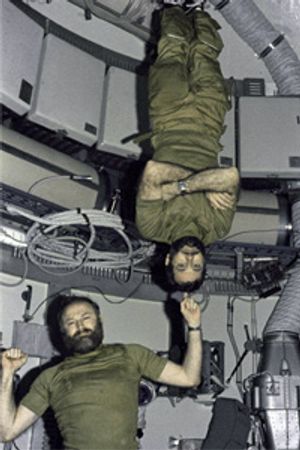
The first space station crew members will spend a lot of their time setting up the station, building its components and conducting various scientific experiments and Earth observations. The crew will live in the service module at first. This module has spartan living quarters, but provides everything the crew needs -- personal sleeping quarters, a toilet, hygiene facilities, a kitchen with a table, a treadmill and a stationary bicycle. Astronauts will have to exercise frequently to keep from losing bone and muscle mass, which happens with prolonged weightlessness.
- Sleeping in space is quite different from sleeping on Earth. Instead of a bed, you have a wall-mounted sleeping bag that you slip into and zip up. The bag is also equipped with arm restraints to prevent your arms from floating above your head while you sleep.
-
While stations such as Skylab and Mir have been equipped with a shower, most astronauts take sponge baths using washcloths or moistened towelettes. This reduces the amount of water consumed. Each astronaut will also have a personal hygiene kit with a toothbrush, toothpaste, shampoo, razor and other basic toiletries.
-
The food on the ISS will be mainly frozen, dehydrated or heat-stabilized, and drinks will be dehydrated. Astronauts will collect food trays and utensils, locate their individually-packaged meal from a storage compartment, prepare the items (rehydrate if necessary), heat the items (microwave, forced-air convection oven), place them in the tray and eat. After the meal, they will place the used items in a trash compactor, and clean and stow the utensils and trays. Interestingly, astronauts get to select their menus approximately five months before their flight.
-
In weightless conditions, the body loses bone and muscle mass. To counter these losses, astronauts will have to exercise daily. The service module is equipped with a treadmill and a stationary bicycle. Astronauts must strap themselves onto these devices so that they do not float away while exercising.
-
Once the ISS is completed, work will involve maintaining the station (fixing broken equipment, repairing structures, etc.) and conducting scientific experiments and observations. The station will have six scientific laboratories. Closet-sized racks along the walls of the laboratory module will hold the equipment, and the astronauts will use footholds and restraints so they won't float away while working. The experiment racks will also have remote video and data links so that scientists on the ground will be able to monitor the experiments on-board the ISS continuously. The Japanese laboratory module will have a platform open to space, for determining the effects of the space environment on materials.
- Working in weightlessness, or microgravity, is very different from what we are used to. For example, as I write this article at my computer, I do not have to worry about floating off of my chair, or having the papers on my desk float away. This is not the case in the ISS. As we have mentioned above, many places (experiment racks, kitchen area, crew quarters) will have restraints to keep the astronauts and equipment from floating away. And while I can walk the corridor in my office with no trouble, astronauts on the ISS will have to use handholds mounted on the walls of the station to keep themselves stable as they move around.
- The crew will have to perform spacewalks during construction and maintenance of the ISS. Initially, the crew will perform spacewalks from the Russian service module using Russian spacesuits. Because spacesuits operate at lower pressures than the station, the astronauts will have to reduce the air pressure of the entire station prior to the spacewalk, so that the spacewalker's body can adjust; otherwise, the spacewalker might get the bends.
Once the Joint Airlock Module (JAM) arrives at the ISS, the crew will be able to use both Russian and American spacesuits, and the entire station will no longer have to be depressurized prior to a spacewalk. To prepare for a spacewalk, the spacewalkers will have to do the following:
- Enter the JAM with their spacesuits and equipment
- Reduce the pressure in the airlock from 14.7 lb/in2 (1 atm) to 10.2 lbs/in2 (0.7 atm)
- "Camp-out" overnight in order to:
- adjust to the low pressure used in spacesuits -- 4.3 lbs/in2 (0.3 atm)
- eliminate nitrogen from the space walker's body, thereby reducing the chance of decompression sickness
- Put the spacesuit on
- Pre-breathe pure oxygen (spacesuits use pure oxygen) for a few minutes prior to the space walk
- Open the airlock doors
- Conduct the spacewalk
- Internal parts that are more easily replaced
- Carbon-dioxide absorption cartridges that are reusable and removable
- Metal sizing rings that adjust the fit for individual users
- New gloves with increased flexibility and dexterity
- Enhanced radio with more channels, so more people can talk at once
- New heaters, and a cooling system shut-off (ISS spacewalkers will have to work in shadows, where it is colder; shuttle spacewalkers were able to work in the sun, because the shuttle could be turned easily toward sunlight)
- Helmet-mounted flood lights and spot lights
- Jet-pack that allows an untethered astronaut to fly back to the station in an emergency (if he should slip away from the ISS)
![]() Photo courtesy NASA Astronauts training for the many space walks that will be involved in ISS construction and maintenance. |
The ISS will have robotic arms to assist spacewalkers and move large items such as construction modules and some supply ships.
All work and no play makes for cranky astronauts. This has been observed on space shuttle, Skylab and Mir missions. Crews do need to have leisure time. What can you do with free time on the ISS? You can read, play games or e-mail your friends. However, most astronauts say that what they like to do most is look out the window at the Earth below.
Habitation Module
The United States will provide an additional habitation module, the trans-hab module, for extra crew quarters.
![]() Photo courtesy NASA The proposed U.S. trans-hab module. |
This habitation module will be able to sleep four astronauts. Each cabin will have a sleeping bag (note that it is upright on the wall), a desk with a computer, and footholds.
![]() Photo courtesy NASA Crew quarters of trans-hab module. |
The module will also have a wardroom with a galley, table and storage area. This will be a place for the astronauts to eat and gather for meetings.
![]() Photo courtesy NASA The wardroom of the trans-hab module. |
The module will also contain a level for crew health care, which includes exercise and medical equipment as well as storage space.
![]() Photo courtesy NASA The exercise area of the trans-hab module. |
Uses of the ISS
The ISS will be used mostly for scientific research in the unique environment of microgravity. The ISS will be four times larger than Mir, and capable of staying in orbit much longer than the space shuttle, which orbits for three weeks. Researchers from governments, industry and educational institutions will be able to use the facilities on the ISS. The types of research that will be done include:- Microgravity science
- Life science
- Earth science
- Space science
- Engineering research and development
- Commercial product development
Microgravity Science
Gravity influences many physical processes on Earth. For example, gravity alters the way that atoms come together to form crystals. In microgravity, near-perfect crystals can be formed. Such crystals can yield better semi-conductors for faster computers, or for more efficient drugs to combat diseases.
![]() Photo courtesy NASA Candle flame in microgravity |
Another effect of gravity is that it causes convection currents to form in flames, which leads to unsteady flames. This makes the study of combustion very difficult. However, in microgravity, simple, steady, slow-moving flames result; these types of flames make it easier to study the combustion process. The resulting information could yield a better understanding of the combustion process, and lead to better designs of furnaces or the reduction of air pollution by making combustion more efficient.
The ISS will be equipped with a state-of-the-art laboratory for studying the effects of microgravity on these processes.
Life Science
Life as we know it has evolved in a world of gravity. Our body shape and plan have been influenced by gravity. We have skeletons to help support us against the force of gravity. Our senses can tell us which direction is up or down, because we can sense gravity. But exactly how does gravity influence living things? The ISS gives us the opportunity to study plants and animals in the absence of gravity. For example, when a plant seed sprouts, the roots grow down and the shoots or leaves grow up (gravitropism); somehow, the young plant must sense gravity to do this. So what would happen if seeds were to grow in microgravity? These types of experiments will be done on the ISS.
Long-term exposure to weightlessness causes our bodies to lose calcium from bones, tissue from muscles and fluids from our body. These effects of weightlessness are similar to the effects of aging (decreased muscle strength, osteoporosis). So exposure to microgravity may give us new insights into the aging process. If we can develop countermeasures to prevent the degrading effects of microgravity, perhaps we can prevent some of the physical effects of aging. The ISS will provide long-term exposure to microgravity that could not be obtained by using other spacecraft.
The ISS will allow us to test ecological life support systems that are similar to the way that the Earth provides life support. We can grow plants in large quantities in space to make oxygen, remove carbon dioxide and provide food. This information will be important for long interplanetary space voyages, such as a trip to Mars or Jupiter.
Earth Science
ISS's orbit will cover 75 percent of Earth's surface for observation. With on-board instruments, the astronauts will be able to:
- Study climate and weather
- Study geology
- Gather information on atmospheric quality
- Map vegetation, land use and mineral resources
- Monitor health of rivers, lakes and oceans
![]() Photo courtesy NASA / JPL Space-based radar image of Cape Cod, MA, showing forests (green), marshes (dark blue), developed areas (pink) and ponds/sandy areas (black) |
The data gathered from these studies will help us understand how the Earth's biosphere works and how to minimize mankind's devastating influences on it.
Space Science
The ISS will be an orbiting platform above the Earth's atmosphere. Like the Hubble Space Telescope, telescopes on board the ISS will have clear views of the sun, stars and planets, without the interference of the Earth's atmosphere. Instruments on board the ISS will look for planets around other stars and search in distant galaxies for clues to the origin of the universe. Instruments on the ISS will be able to be repaired and interchanged more easily than those on the Hubble Space Telescope.
Engineering Research and Development
Much of the ISS engineering research and development will go toward studying the effects of the space environment on materials and developing new technologies for space exploration, including:
- New construction techniques for building things in space
- New space technologies, including solar cells and storage
- New satellite and spacecraft communications systems
- Advanced life-support systems for future spacecraft
![]() Photo courtesy NASA LDEF in orbit as seen from the space shuttle. |
![]() Photo courtesy NASA Streak in the LDEF metal caused by prolonged exposure to atomic oxygen. |
Materials can be placed on the ISS in open platforms and exposed to the space environment for years. These materials could be interchanged for analysis more easily than on satellites. The information retrieved will help design better materials for making satellites last longer in the space environment.
Commercial Product Development
As mentioned above, more perfect crystals can be grown aboard the space station, which will help to develop better drugs, catalysts for extracting oil, and semi-conductors. Again, the ISS will have dedicated laboratories for manufacturing these products, and a much longer time in orbit than could be achieved by the space shuttle.
The Future of Space Stations
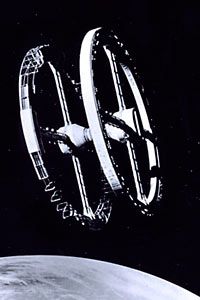
We are just beginning the development of space stations. The ISS will be a vast improvement over Salyut, Skylab and Mir; but we are still a long way from the realization of large space stations or colonies as envisioned by science fiction writers. None of our space stations thus far have had any gravity, for two reasons:
- We want a place without gravity so that we can study the effects of gravity.
- We lack the technology to practically rotate a large structure, like a space station, to produce artificial gravity.
![]() Photo courtesy NASA Credit: Rick Guidice Artist's conception of the inside of space colony. |
Another popular idea deals with where a space station should be placed. As we have seen, the ISS will need periodic reboosting because of its position in low Earth orbit. However, there are two places between the Earth and moon called Lagrange Points L-4 and L-5, and at these points, the Earth's gravity and the moon's gravity are counter-balanced so that an object placed there would not be pulled toward the Earth or moon. The orbit would be stable and require no boosting. A society called the L5 Society was formed more than 20 years ago to push the idea of placing space stations in orbit at these points. As we learn more from our experiences on the ISS, we may build larger and better space stations that would enable us to live and work in space, and the dreams may become reality.
Lots More Information
Related HowStuffWorks Links- How Mars Works
- How the Hubble Space Telescope Works
- How Space Wars Will Work
- How Space Tourism Will Work
- How Space Planes Will Work
- HSW's Space Q&A
- Mars Explained
More Great Links
- Virtual Reality Tour of the International Space Station
- NASA Spacelink: ISS Educational Materials
- See the International Space Station from Your Backyard
- Boeing: ISS Home Page
- Where is the International Space Station: On-Line Tracking