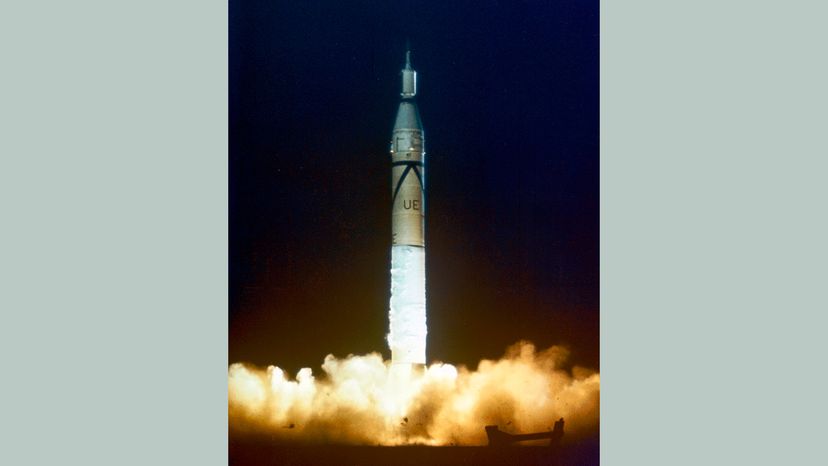
When the satellite Sputnik orbited Earth in October 1957, The Soviet Union pulled ahead in the space race. The Cold War was on, and the United States scrambled to respond in kind. Branches of the U.S. military had been developing satellites since the mid-1940s, but now it became clear that a dedicated space agency was in order. President Dwight Eisenhower and Senator Lyndon B. Johnson led the drive. It took Congress almost a full year after Sputnik's launch to get the National Aeronautics and Space Administration (NASA) off the ground. Not a minute was wasted in eliminating the Soviets' lead: Even before NASA was up and running, the U.S. sent its own satellite into orbit. America was officially in the Space Age.
NASA became operational on Oct. 1, 1958. Right from the start, its goals were lofty: The administration planned to expand human knowledge of space; lead the world in space-related technological innovation; develop vehicles that can carry both equipment and living organisms into space; and coordinate with international space agencies to achieve the greatest possible scientific advancements. Over the last 60 years, NASA has achieved every one of those goals, and it continues to seek answers to some of the biggest mysteries in science as it evolves with a changing world.
Advertisement
The administration has always reflected the changing values of U.S. society. In response to public opinion, it's encouraged all kinds of technological innovations and gathered vital data on planet Earth's climate. Yet NASA's main aspiration remains the same: Explore every corner of space to expand our knowledge of the universe.
In this article, we'll look at some of NASA's greatest achievements to date. It's hard to choose from among the incredible feats on NASA's résumé, but some of its successes are more monumental than others. This list presents some of those great moments in science, beginning with the launch of the first U.S. spacecraft: Explorer 1, a little satellite that made a huge discovery.