Introduction to How the Hubble Space Telescope Works
Imagine having an "eye" on the universe, being able to look out at a distant star or nebula with amazing clarity. With such a telescope, you could peer billions of light years away and see things that happened billions of years ago. Astronomers are doing just that with the Hubble Space Telescope!
Hubble Telescope Image Gallery
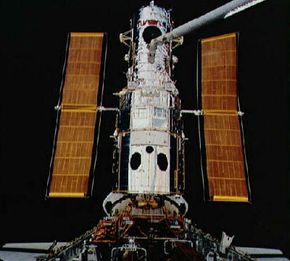
![]() Photo courtesy NASA / Space Telescope Science Institute (STScI) Credit: NASA, A. Fruchter and the ERO Team (STScI) The Hubble Space Telescope is deployed from the cargo bay of the space shuttle. See more Hubble Telescope pictures. |
What exactly is the Hubble Space Telescope? Why is it so special? How does it produce such amazing images and where can we see them? In this edition of How Stuff Works, we will look closely at this amazing instrument that has revolutionized astronomy!
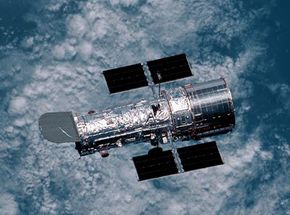
![]() Photo courtesy NASA Artist's concept of the Hubble Space Telescope. |
In 1946, an astrophysicist named Dr. Lyman Spitzer (1914-1997) proposed that a telescope in space would reveal much clearer images, of even farther-off objects, than any ground-based telescope. This was an outrageous idea considering no one had yet launched a rocket into outer space. As the U.S. space program developed and excelled in the 1960s and 1970s, Spitzer lobbied NASA and Congress to develop a space telescope. In 1975, the European Space Agency (ESA) and NASA began developing the space telescope. In 1977, Congress approved funds for the space telescope, and NASA named Lockheed Martin Aerospace Company as the prime contractor to oversee its construction.
In 1983, the space telescope was named after American astronomer Edwin Hubble, whose observations of variable stars in distant galaxies confirmed that the universe was expanding and gave support to the "Big Bang" theory. The Hubble Space Telescope (HST) took 8 years to build, held five scientific instruments, had more than 400,000 parts and had 26,000 miles of electrical wiring. HST was reported to be 50 times more sensitive than ground-based telescopes, with 10 times better resolution. After a long delay due to the Challenger disaster, HST went into orbit in 1990.
COSTAR
Almost immediately after it was deployed, astronomers found that they could not focus the telescope. They discovered that the primary mirror had been ground to a wrong dimension at the Perkin-Elmer Corporation's factory. Although the defect in the mirror was less than one-fiftieth the size of a human hair, it caused the HST to suffer spherical aberration and produce fuzzy images.
Scientists came up with a replacement "contact" lens called COSTAR (Corrective Optics Space Telescope Axial Replacement) to correct the defect in the HST. COSTAR consisted of several small mirrors that would intercept the beam from the flawed mirror, correct for the defect and relay the corrected beam to the scientific instruments at the focus of the mirror.
![]() Photo courtesy NASA Small mirrors that made up the COSTAR. |
COSTAR replaced one of the scientific instruments when it was installed during a 1993 servicing mission by shuttle astronauts.
![]() Photo courtesy NASA Space Shuttle astronauts servicing the Hubble Space Telescope. |
![]() Photo courtesy NASA Image of the galaxy M100 before (left) and after (right) the Hubble Space Telescope's corrective optics were installed. |
When the HST was tested after the servicing mission, the images were vastly improved. Now, all of the instruments placed in the HST have built-in corrective optics for the mirror's defect, and COSTAR is no longer needed.
HST is compound telescope design (i.e. Ritchey-Chretien design). Light enters the telescope through the opening and bounces off the primary mirror to a secondary mirror. The secondary mirror reflects the light through a hole in the center of the primary mirror to a focal point behind the primary mirror. At the focal point, smaller, half-reflective, half-transparent mirrors distribute the light to the various scientific instruments. As mentioned above, the corrective optics were initially supplied by COSTAR, but are now built-in to new scientific instruments.
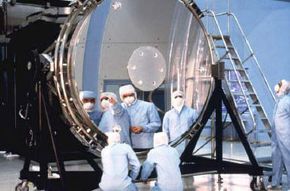
![]() Photo courtesy NASA / STScI Pre-flight inspection of the Hubble Space Telescope's primary mirror. |
HST's mirrors are made of glass and coated with layers of pure aluminum (three-millionths of an inch thick) and magnesium fluoride (one-millionth of an inch thick) to make them reflect visible, infra-red and ultraviolet light. The primary mirror weighs 1,825 pounds (828 kg). The secondary mirror weighs 27.4 pounds (12.3 kg).
Hubble Telescope Systems
|
- primary mirror
- secondary mirror
- corrective optics
- Wide Field Planetary Camera 2 (WFPC2)
- Near Infrared Camera and Multi-Object Spectrometer (NICMOS)
- Space Telescope Imaging Spectrograph (STIS)
- Advanced Camera for Surveys (ACS)
- Fine Guidance Sensors (FGS)
- Power
- Communications
- Steering
- Computing
- Structure
Diagram of the Hubble Space Telescope
Mouse over the "Telescope Functions" to examine each function.
Note: The Faint Object Camera was replaced by the Advanced Camera for Surveys in March 2002.
In the next section, we'll look at some of the cameras the Hubble uses to see the furthest reaches of space.
Hubble Telescope Cameras
Scientific Instruments
By looking at the different wavelengths, or the spectrum of light, from a celestial object, you can tell many of its features or properties. To do this, HST is equipped with various scientific instruments. Each instrument uses charge-coupled devices (CCD) rather than photographic film to capture the light. The light detected by the CCDs are digital signals, which are then stored in on-board computers and relayed to Earth. The digital data are then transformed into the amazing pictures that we see in the news and magazines. Let's look at each instrument.
Wide Field Planetary Camera 2 (WFPC2)
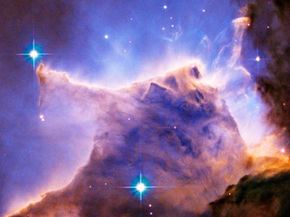
WFPC2 is the main "eye," or camera, of the HST. Like the retina of your eye, WFPC2 has four CCD chips to catch the light, three low resolution, wide-field CCD chips arranged in an "L" shape and one, high resolution planetary camera CCD chip inside that "L." All four CCD chips are exposed to the target at the same time, and the target image is centered on the desired CCD chip, either high or low resolution. It sees visible and ultraviolet light. WFPC2 can take images through various filters (red, green, blue) to make natural color pictures, such as this image of the Eagle nebula.
![]() Photo courtesy NASA / STScI Hubble Space Telescope image of the Eagle nebula using WFPC2 |
Near Infrared Camera and Multi-Object Spectrometer (NICMOS)
Often times, interstellar gas and dust can block our vision of the visible light from various celestial objects; however, it is possible to see the infra-red light, or heat, from the objects hidden in the dust and gas. To see this infra-red light, HST has three sensitive cameras which make up NICMOS. NICMOS can see through interstellar gas and dust that blocks visible light, as shown in this image of the Orion nebula. In the visible image (WFPC2), we see large clouds of dust with little or no detail; however, when we examine the infra-red image (NICMOS), we can see stars within the clouds.
![]() Photo courtesy NASA / STScI WFPC2 (left) and NICMOS (right) images of Orion Nebula. |
Because it is so sensitive to heat, the NICMOS sensors must be kept in a large "Thermos" bottle at -321 degrees Fahrenheit (77 degrees Kelvin). Initially, NICMOS was cooled with a 230-lb (104-kg) block of frozen nitrogen; but now, NICMOS is actively cooled with a machine that acts like a refrigerator.
Hubble Telescope Functions
Space Telescope Imaging Spectrograph (STIS)It's one thing to look at the light from a celestial object -- but how can you tell what the object is made of? The colors, or spectrum of light, coming from a star or other celestial object is a chemical fingerprint of that object. The specific colors tell us what elements are present in the object, and the intensity of each color tells us how much of that element is present. So to identify the colors, the specific wavelengths of light, the STIS separates the incoming colors of light much like a prism makes a rainbow.
In addition to the chemical composition, the spectrum can tell us about the temperature and motion of a celestial object. If the object is moving, the chemical fingerprint can be shifted toward the blue end (moving toward us) or the red end (moving away from us) of the spectrum. For example, the STIS slit is centered over the core of galaxy M84 (the blue rectangle in the left side of the figure below). If there were no movement, then the spectrum should be the same across the entire area of the slit. However, the light in the center of the slit is blue- and red-shifted, which indicates that this particular area (within 26 light years of the core) is spinning at a speed of 800,000 mph (400 kps). Astronomers calculated that, to cause such a spin, a massive black hole (~300 million solar masses) must be present in the galaxy's core.
![]() Photo courtesy NASA / STScI WFPC2 (left) and STIS (right) images of galaxy M84. The slit of the STIS is centered over the area shown in the blue rectangle on the left. |
Advanced Camera for Surveys (ACS)
Hubble's Faint Object Camera (FOC) was replaced in March 2002 -- it now boasts the Advanced Camera for Surveys (ACS), which, according to CNN.com, offers 10 times the optical clarity of the FOC. To learn about the ACS, check out the Space Telescope Science Institute and the Ball Aerospace ACS page. For example, when aimed at Betelgeuse (a red star in the shoulder of the constellation Orion), the FOC can actually image the surface of the star. This is the first time that the surface of a star other than our sun has been imaged. From the image, scientists determined that Betelgeuse has a mysterious hot spot on its surface that is 2000 degrees Kelvin hotter than the rest of the star's surface.
![]() Photo courtesy NASA / STScI Credit: Andrea Dupree (Harvard-Smithsonian CfA), Ronald Gilliland (STScI), NASA and ESA FOC image of the star Betelgeuse (left) in the constellation Orion (Betelgeuse is marked by the yellow X). |
Fine Guidance Sensors (FGS)
The FGS are used to point the telescope and to make detailed, precise measurements of the positions of stars, the separation of binary stars and the diameter of stars. There are three FGS in the Hubble; two are used to point the telescope and keep it fixed on its target, looking for "guide" stars in the HST field near the target. When each FGS finds a guide star, it locks on to it and feeds information back to the HST steering system to keep that guide star in its field. While two FGS are steering the telescope, one is free to make astrometric measurements (star positions). Astrometric measurements are important for detecting planets, because orbiting planets cause the parent stars to wobble in their motion across the sky.
Spacecraft Systems
As mentioned above, the HST is also a spacecraft. It must have power, communicate with the ground and be able to change its attitude (orientation). Let's take a look at these systems. Power
All of the instruments and computers on board the HST need electrical power. This electrical power is supplied by two large solar panels, each panel measuring 40 feet (12.2 m). The solar panels provide 2,400 watts of electricity, which is equal to the electricity used by sixty 40-watt light bulbs. When the HST is in the Earth's shadow, electrical power is provided by six nickel-hydrogen batteries, which provide the same storage as 20 car batteries. The batteries are re-charged by the solar panels when the HST comes around to sunlight again.
Communications
The HST must be able to talk with controllers on the ground to relay data from its observations and receive commands for its next targets. To communicate, the HST uses a series of relay satellites called the Tracking and Data Relay Satellite System (TDRSS), which is the same system used by the International Space Station.
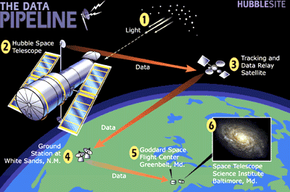
![]() Photo courtesy NASA / STScI Communications system used by the Hubble Space Telescope. |
Incoming light from an object gets received by the HST (2) and converted to digital data. The data is then sent to the TDRSS in orbit (3), which then transmits it to the Ground Receiving Station at White Sands, N.M. (4). The White Sands Facility transmits the data to NASA's Goddard Spaceflight Control Center (5), where HST operations are centered. The data are then analyzed by scientists at the nearby Space Telescope Science Institute in Baltimore, MD. (6). Most of the time, commands are relayed to the HST in advance of a planned observing run; however, real-time commands are possible when necessary.
Computing
The HST has two main computers that fit around the telescope's tube above the scientific instrument bays. One computer talks to the ground to transmit data and receive commands. The other computer is responsible for steering the HST, as well as various housekeeping functions. There are also backup computers in the event of an emergency.
Each instrument on board the HST also has microprocessors built in to move filter wheels, control the shutters, collect data and talk to the main computers.
Structure
The HST has a skeleton to hold the optics, instruments and spacecraft systems in place. To hold the optics, the HST has a truss system, which is made of graphite epoxy resin like tennis racquets and golf clubs. The truss is 17.5 ft (5.3 m) long, 9.6 ft (2.9 m) wide and weighs 252 lbs (114 kg). The tube that holds the optics and scientific instruments is made of aluminum surrounded by many layers of insulation. The insulation shields the telescope from extreme changes in temperature between sunlight and shadow.
Hubble Steering
The HST must remain fixed on a target while it takes an image, which could take up to several hours depending upon which instrument is being used by an observer. Bear in mind that the HST is moving around the Earth every 97 minutes, so focusing on a target is like keeping sight of a small object on the shore from the deck of a boat that is rapidly moving along the coast, bobbing up and down in the waves. To remain fixed on an object, the HST has three on-board systems:- Gyroscopes - sense small to large motions
- Reaction wheels - move the telescope
- FGS - sense fine motion
The HST cannot have rocket engines or gas thrusters to steer like most satellites do, because the exhaust gases would hover near the telescope and cloud the surrounding field of view. Instead, the HST has reaction wheels oriented in the three directions of motion (x/y/z or pitch/roll/yaw). The reaction wheels are flywheels, like those found in a clutch. When the HST needs to move, the flight computer tells one or more flywheels which direction to spin in and how fast, which provides the action force. In accordance with Newton's third law of motion (for every action there is an equal and opposite reaction), the HST spins in the opposite direction of the flywheels until it reaches its target.
As mentioned above, the FGS help keep the telescope fixed on its target by sighting on guide stars. Two of the three FGS find guide stars around the target within their respective fields of view. Once found, they lock onto the guide stars and send information to the flight computer to keep the guide stars within their field of view. The FGS are more sensitive than the gyroscopes; but the combination of gyroscopes and FGS can keep the HST fixed on a target for hours despite the telescope's orbital motion.
Limitations
The HST cannot observe the sun because the intense light and heat would fry its sensitive instruments. Therefore, the HST is always pointed away from the sun. In addition, the HST cannot observe Mercury or Venus because they are too close to the sun. Certain stars cannot be observed with the HST because they are too bright for some of the instruments. The magnitude limitations vary with the instrument (WFPC2, NICMOS, STIS, FOC, FGS) being used.
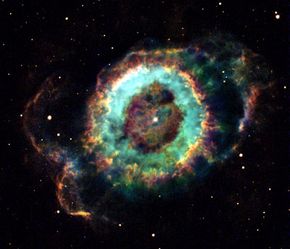
![]() Photo courtesy NASA The Eskimo Nebula. |
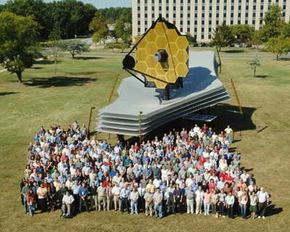
Despite its flawed early history, the HST has performed well, yielding much scientific data and beautiful images. However, the HST will not last forever. Plans are underway for a new space telescope, called the Next Generation Space Telescope (NGST). NGST will be even more sensitive than HST and provide better images of even more distant objects. (See NASA's NGST page for more information.) The age of optical space telescopes started by HST promises to revolutionize astronomy as much or more than Galileo's first use of the telescope did long ago.
To see pictures captured by the Hubble telescope, check out the next page.
Hubble Pictures
![]() Photo courtesy NASA The Stingray Nebula as photographed by the Hubble Space Telescope April 2, 1998. |
![]() Photo by NASA/Newsmakers An image taken by the Hubble of a galaxy collision more than 200 million light years away. |
![]() Photo by NASA/Newsmakers A curtain of glowing gas is wrapped around Jupiter's north pole like a lasso December 19, 2000 in a Hubble telescope photo. |
![]() Photo by NASA/Newsmakers An close-up image of the Horsehead nebula taken from NASA's Hubble Space Telescope reveals the cloud's intricate structure and resemblance to a giant seahorse, April 24, 2001. |
![]() Photo by NASA/Getty Images An image from Hubble Heritage of NGC 6782, which shows that the appearance of a galaxy can depend on the color of the light with which it is viewed. |
![]() Photo by NASA/Getty Images The Hubble Space Telescope took this image of a dying star named 'NGC 6369' on November 7, 2002. |
![]() Photo by NASA/Getty Images This image shows a halo of hot gas surrounding spiral galaxy NGC 4631 that is similar to the Milky Way galaxy. |
![]() Photo by NASA/Getty Images The Hubble Ultra Deep Field (HUDF) photograph reveals galaxies from the time shortly after the big bang. |
![]() Photo by NASA/Getty Images The mosaic image of the Crab Nebula shows a six-light-year-wide expanding remnant of a star's supernova explosion as released December 2, 2005. |
![]() HO/AFP/Getty Images This image released on October 7, 2004 shows Kepler's supernova remnant produced by combining data from NASA's three Great Observatories. |
See more Hubble pictures.
Lots More Information
Related HowStuffWorks Articles
- How Telescopes Work
- How Stars Work
- How Satellites Work
- How Space Stations Work
- How Space Elevators Will Work
- How Space Tourism Will Work
- How Mars Works
- How Black Holes Work
- Jupiter Explained
- Mercury Explained
- Neptune Explained
- Pluto Explained
- Venus Explained
- The Solar System Explained
- Our Amazing Solar System
- New Hubble peers deep into cosmic past, future - May 2002
- Hubble Primer
- HubbleSite
- NCC.com: Hubble Space Telescope
- Space Telescope Science Institute: Public Information Page
- Where Is The Hubble Space Telescope Now?
- Make a Hubble Space Telescope
- Universe Today: Hubble Space Telescope
- Space Telescope Science Institute Home Page
- NASA SpaceLink: Hubble Space Telescope
- "Do-it-yourself" Instructions for Making a Model of the Hubble Space Telescope
- Hubble Space Telescope Location
- Hubble Heritage Project Home Page: Astronomy Pictures from the Hubble Space Telescope
- NASA K-12 Internet: Live from the Hubble Space Telescope
- Best of the Hubble Space Telescope
- NASA Educator's Guide: Space-based Astronomy - downloadable PDF teaching guides
- CNN: Virtual Hubble Space Telescope
- Making Natural Color HST Pictures
- General Information
- Hubble Drawing
- Hubble Showcase
- Hubble Images by Subject
- HST Public Pictures
- Hubble Space Telescope Servicing Mission 3A
- Hubble Image Archive
- Hubble Wide Field Camera 3
- The Tech Museum: Eye on the Universe - The Hubble Space Telescope
- CosmicKids: The Hubble Space Telescope
- The Hubble Decade