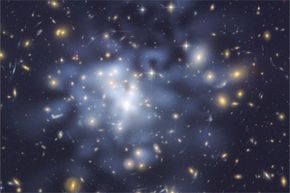
You're looking at arguably one of the best maps of dark matter that we have. Astronomers tinted the dark matter concentrations in the giant galaxy cluster Abell 1689 blue. They figured out the location of those concentrations by using gravitational lensing.
Image courtesy NASA, ESA, and D. Coe (NASA JPL/Caltech and STScI)
In Bruce Springsteen's 1978 follow-up album to "Born to Run," he uses darkness on the edge of town as a metaphor for the desolate unknown we all face as we grow up and try to understand the world. Similarly, cosmologists working to decipher the origin and fate of the universe must identify with The Boss' sense of tragic yearning.
These stargazing scientists have been facing their own darkness on the edge of town (or on the edge of galaxies) for a long time as they try to explain one of astronomy's greatest mysteries: dark matter.
Advertisement
Dark matter is a placeholder, like the x or y used in algebra class, for something unknown and heretofore unseen. One day, it will enjoy a new name, but today we're stuck with the temporary label and its connotations of shadowy uncertainty.
Just because scientists don't know what to call dark matter doesn't mean they don't know anything about it. They know, for example, that dark matter behaves differently than "normal" matter, such as galaxies, stars, planets, asteroids and all of the living and nonliving things on Earth.
Astronomers classify all of this stuff as baryonic matter, and they know its most fundamental unit is the atom, which itself is composed of even smaller subatomic particles, such as protons, neutrons and electrons.
Advertisement
Unlike baryonic matter, dark matter neither emits nor absorbs light or other forms of electromagnetic energy. Astronomers know it exists because something in the universe is exerting a significant gravitational pull on things we can see. When they measure the effects of this gravity, scientists estimate that dark matter makes up to 23 percent of the universe. Baryonic matter accounts for just 4.6 percent. And another cosmic mystery known as dark energy makes up the rest – a whopping 72 percent [source: NASA/WMAP]!
So what is dark matter? Where did it come from? Where is it now? How do scientists study the stuff when they can't see it? And what do they hope to gain by solving the puzzle? Is dark matter the secret to solidifying the standard model of particle physics, or will it fundamentally alter how we view and understand the world around us?
Advertisement
Evidence for Dark Matter: The Beginning
Astronomers have been fascinated by galaxies for centuries. First came the realization that our solar system lay swaddled within the arms of a massive body of stars. Then came evidence that other galaxies existed beyond the Milky Way. By the 1920s, scientists like Edwin Hubble were cataloging thousands of "island universes" and recording information about their sizes, rotations and distances from Earth.
One key aspect astronomers hoped to measure was the mass of a galaxy. But you can't just weigh something the size of a galaxy – you have to find its mass by other methods.
Advertisement
One method is to measure the light intensity, or luminosity. The more luminous a galaxy, the more mass it possesses. Another approach is to calculate the rotation of a galaxy's body, or disk, by tracking how quickly stars within the galaxy move around its center. Variations in rotational velocity should indicate regions of varying gravity and therefore mass.
When astronomers began measuring the rotations of spiral galaxies in the 1950s and '60s, they made a puzzling discovery. They expected to see stars near a galaxy's center – where the visible matter is more concentrated – move faster than stars at the edge. What they saw instead was that stars at the edge of a galaxy had the same rotational velocity as stars near the center.
Astronomers observed this first with the Milky Way, and then, in the 1970s, Vera Rubin confirmed the phenomenon when she made detailed quantitative measurements of stars in several other galaxies, including Andromeda (M31).
The implication of all of these results pointed to two possibilities: Something was fundamentally wrong with our understanding of gravity and rotation, which seemed unlikely given that Newton's laws had withstood many tests for centuries. Or, more likely, galaxies and galactic clusters must contain an invisible form of matter – hello, dark matter – responsible for the observed gravitational effects. As astronomers focused their attention on dark matter, they began to collect additional evidence of its existence.
Dark Matter Pioneers
The concept of dark matter didn't originate with Vera Rubin. In 1932, the Dutch astronomer Jan Hendrik Oort observed that stars in our galactic neighborhood were moving more rapidly than calculations predicted. He used the term "dark matter" to describe the unidentified mass required to cause this surge in velocity.
A year later, Fritz Zwicky began studying galaxies in the Coma cluster. Using luminosity measurements, he determined how much mass should be in the cluster and then, because mass and gravity are related, calculated how fast the galaxies should be moving. When he measured their actual velocities, however, he found that the galaxies were moving much, much faster than he expected.
To explain the discrepancy, Zwicky suggested that more mass — two orders of magnitude more — lay hidden among the visible matter. Like Oort, Zwicky called this invisible stuff dark matter [source: SuperCDMS at Queen's University].
Advertisement
Evidence for Dark Matter's Existence: New Discoveries
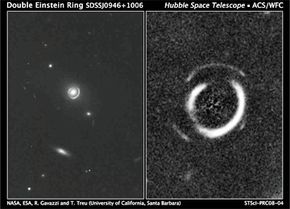
It's a double Einstein ring! Hubble snapped the photo of the gravitational field of an elliptical galaxy warping the light of two galaxies exactly behind it. Thanks, Hubble.
Image courtesy NASA, ESA, and R. Gavazzi and T. Treu (University of California, Santa Barbara)
Astronomers continued to find puzzling information as they studied the far-flung galaxies of the universe. A few intrepid stargazers turned their attention to galactic clusters – knots of galaxies (as few as 50 and as many as thousands) bound together by gravity – hoping to find pools of hot gas that had previously gone undetected and that might account for the mass being attributed to dark matter.
When they turned X-ray telescopes, such as the Chandra X-ray Observatory, toward these clusters, they did indeed find vast clouds of superheated gas. Not enough, however, to account for the discrepancies in mass.
Advertisement
The measurement of hot gas pressure in galactic clusters has shown that there must be about five to six times as much dark matter as all the stars and gas we observe [source: Chandra X-ray Observatory]. Otherwise, there wouldn't be sufficient gravity in the cluster to prevent the hot gas from escaping.
Galactic clusters have provided other clues about dark matter. Borrowing from Albert Einstein's general theory of relativity, astronomers have shown that clusters and superclusters can distort space-time with their immense mass. Light rays emanating from a distant object behind a cluster pass through the distorted space-time, which causes the rays to bend and converge as they move toward an observer. Therefore, the cluster acts as a large gravitational lens, much like an optical lens.
The distorted image of the distant object can appear in three possible ways depending on the shape of the lens:
Ring: Image appears as a partial or complete circle of light known as an Einstein ring. This happens when distant object, lensed galaxy and observer/telescope are perfectly aligned. It's kind of like a cosmic bull's-eye.
Oblong or elliptical: Image gets split into four images and appears as a cross known as an Einstein cross.
Cluster: Image appears as a series of banana-shaped arcs and arclets.
By measuring the angle of bending, astronomers can calculate the mass of the gravitational lens (the greater the bend, the more massive the lens). Using this method, astronomers have confirmed that galactic clusters indeed have high masses exceeding those measured by luminous matter and, as a result, have provided additional evidence of dark matter.
Chandra to the Rescue
In 2000, Chandra observed a gigantic cloud of hot gas enveloping the galaxy cluster Abell 2029, leading astronomers to estimate that the cluster must hold an amount of dark matter equivalent to more than a hundred trillion suns!
If other clusters have similar characteristics, then dark matter appears to account for 70 to 90 percent of the mass of the universe [source: Chandra X-ray Observatory].
Advertisement
Mapping Dark Matter
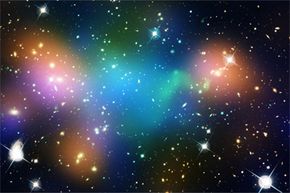
This composite image of the merging galaxy cluster Abell 520 has superimposed, "false-colored" maps that show the cluster's concentration of starlight (orange), hot gas (green) and dark matter (much of the blue).
Image courtesy NASA, ESA, CFHT, CXO, M.J. Jee (University of California, Davis), and A. Mahdavi (San Francisco State University)
As astronomers gathered clues about the existence – and staggering amount – of dark matter, they turned to the computer to create models of how the strange stuff might be organized. They made educated guesses about how much baryonic and dark matter might exist in the universe, then let the computer draw a map based on the information.
The simulations showed dark matter as a weblike material interwoven with regular visible matter. In some places, the dark matter coalesced into lumps. In other places, it stretched out to form long, stringy filaments upon which galaxies appear entangled, like insects caught in spider silk. According to the computer, dark matter could be everywhere, binding the universe together like some sort of invisible connective tissue.
Advertisement
Since then, astronomers have worked diligently to create a similar dark matter map based on direct observation. And they've been using one of the same tools – gravitational lensing – that helped prove the existence of dark matter in the first place. By studying the light-bending effects of galaxy clusters and combining the data with optical measurements, they have been able to "see" the invisible material and have begun to assemble accurate maps.
In some cases, astronomers are mapping single clusters. For example, in 2011, two teams used data from Chandra's X-ray Observatory and other instruments such as the Hubble Space Telescope to map the distribution of dark matter in a galaxy cluster known as Abell 383, which is located about 2.3 billion light-years from Earth.
Both teams came to the same conclusion: The dark matter in the cluster isn't spherical but ovoid, like an American football, oriented with one end pointing to the observers.
The researchers disagreed, however, on the density of the dark matter across Abell 383. One team calculated that the dark matter increased toward the center of the cluster, while the other measured less dark matter at the center. Even with those discrepancies, the independent efforts proved that dark matter could be detected and successfully mapped.
In January 2012, an international team of researchers published results from an even more ambitious project. Using the 340-megapixel camera on the Canada-France-Hawaii Telescope (CFHT) on Mauna Kea Mountain in Hawaii, scientists studied the gravitational lensing effects of 10 million galaxies in four different regions of the night sky over a period of five years.
When they stitched everything together, they had a picture of dark matter looking across 1 billion light-years of space – the largest map of the invisible stuff produced to date. Their finished product resembled the earlier computer simulations and revealed a vast web of dark matter stretching across space and mixing with the normal matter we've known about for centuries.
Advertisement
Identifying Dark Matter Particles
Based on the evidence, most astronomers agree that dark matter exists. Beyond that, they have more questions than answers. The biggest question, dare we say one of the biggest in all of cosmology, centers on the exact nature of dark matter. Is it an exotic, undiscovered type of matter, or is it ordinary matter that we have difficulty observing?
The latter possibility seems unlikely, but astronomers have considered a few candidates, which they refer to as MACHOs, or massive compact halo objects.
Advertisement
MACHOs are large objects that reside in the halos of galaxies but elude detection because they have such low luminosities. Such objects include brown dwarfs, exceedingly dim white dwarfs, neutron stars and even black holes. MACHOs probably contribute somewhat to the dark matter mystery, but there are simply not enough of them to account for all of the dark matter in a single galaxy or cluster of galaxies.
Astronomers think it's more likely that dark matter consists of an entirely new type of matter built from a new kind of elementary particle. At first, they considered neutrinos, fundamental particles first postulated in the 1930s and then discovered in the 1950s, but because they have such little mass, scientists are doubtful they make up much dark matter.
Other candidates are figments of scientific imagination. One is known as a WIMP (weakly interacting massive particle), and if it exists, each particle would have a mass tens or hundreds of times greater than that of a proton but interacts so weakly with ordinary matter that it's difficult to detect. WIMPs could include any number of strange particles, such as:
Neutralinos (massive neutrinos): Hypothetical particles that are similar to neutrinos, but heavier and slower. Although they haven't been discovered, they're a front-runner in the WIMPs category.
Axions: Small, neutral particles with a mass less than a millionth of an electron. Axions may have been produced abundantly during the big bang.
Photinos: Similar to photons, each with a mass 10 to 100 times greater than a proton. Photinos are uncharged and, true to the WIMP moniker, interact weakly with matter.
Scientists around the world continue to hunt aggressively for the true dark matter particle. One of their most important laboratories, CERN's Large Hadron Collider (LHC), lies deep underground in a 16.5-mile long circular tunnel that crosses the French-Swiss border.
Inside the tunnel, electric fields accelerate two proton-packed beams to absurd speeds and then allow them to collide, which liberates a complex spray of particles. The goal of LHC experiments isn't to produce WIMPs directly, but to produce other particles that might decay into dark matter. This decay process, although nearly instantaneous, would allow scientists to track momentum and energy changes that would provide indirect evidence of a brand-new particle.
Other experiments involve underground detectors hoping to register dark matter particles zipping by and through Earth (see sidebar).
Buried in Minnesota
If distant galaxies typically lie within a shroud of dark matter, then the Milky Way may, too. And if that's so, then Earth must be passing through a sea of dark matter particles as it orbits the sun, and the sun travels around the galaxy.
To find dark matter particles, the Cryogenic Dark Matter Search (CDMS) team buried an array of germanium cells deep beneath the ground in Soudan, Minnesota. If dark matter particles exist, they should pass through solid earth and strike the nuclei of the germanium atoms, which will recoil and produce tiny amounts of heat and energy.
In 2010, the team reported that it had detected two candidate WIMPs striking the array of cells. Ultimately, the scientists decided the results of the dark matter experiment weren't statistically significant, but it was another tantalizing clue in the search for the most mysterious substance in the universe.
Advertisement
Alternatives to Dark Matter
Not everyone is sold on dark matter, not by a long shot. A few astronomers believe that the laws of motion and gravity, formulated by Newton and expanded by Einstein, may have finally met their match. If that's the case, then a modification of gravity, not some unseen particle, could explain the effects attributed to dark matter.
In the 1980s, physicist Mordehai Milgrom suggested that Newton's second law of motion (force = mass x acceleration, f = ma) should be reexamined in the cases of galactic motions.
Advertisement
His basic idea was that at very low accelerations, corresponding to large distances, the second law broke down. To make it work better, he added a new mathematical constant into Newton's famous law, calling the modification MOND, or Modified Newtonian Dynamics. Because Milgrom developed MOND as a solution to a specific problem, not as a fundamental physics principle, many astronomers and physicists have cried foul.
Also, MOND can't account for evidence of dark matter discovered by other techniques that don't involve Newton's second law, such as X-ray astronomy and gravitational lenses. A 2004 revision to MOND, known as TeVeS (Tensor-Vector-Scalar gravity), introduces three different fields into space-time to replace the one gravitational field.
Because TeVeS incorporates relativity, it can accommodate phenomena such as lensing. But that didn't settle the debate. In 2007, physicists tested Newton's second law down to accelerations as low as 5 x 10-14 m/s2 and reported that f = ma holds true with no necessary modifications, making MOND seem even less attractive.
Still other alternatives regard dark matter as an illusion resulting from quantum physics. In 2011, Dragan Hajdukovic at the European Organization for Nuclear Research (CERN) proposed that empty space is filled with particles of matter and antimatter that are not only electrical opposites, but also gravitational opposites.
With different gravitational charges, the matter and antimatter particles would form gravitation dipoles in space. If these dipoles formed near a galaxy – an object with a massive gravitational field – the gravitational dipoles would become polarized and strengthen the galaxy's gravitational field. This would explain the gravitational effects of dark matter without requiring any new or exotic forms of matter.
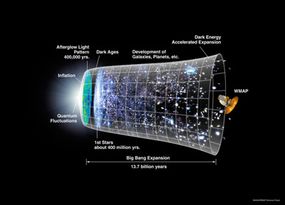
According to this timeline from NASA, the expansion of the universe is accelerating.
Image courtesy NASA
If dark matter acts like cosmic glue, astronomers must be able to explain its existence in terms of the prevailing theory of universe formation. The big bang theory states that the early universe underwent an enormous expansion and is still expanding today.
For gravity to clump galaxies together into walls or filaments, there must be large amounts of mass left over from the big bang, particularly unseen mass in the form of dark matter. In fact, supercomputer simulations of the formation of the universe show that galaxies, galactic clusters and larger structures can eventually form from aggregations of dark matter in the early universe.
Besides giving the universe structure, dark matter may play a role in its fate. The universe is expanding, but will it expand forever? Gravity will ultimately determine the fate of the expansion, and gravity is dependent upon the mass of the universe; specifically, there is a critical density of mass in the universe of 10-29 g/cm3 (equivalent to a few hydrogen atoms in a phone booth) that determines what might happen.
Closed universe: If actual mass density is greater than critical mass density, the universe will expand, slow, stop and collapse back on itself into a "big crunch."
Critical or flat universe: If actual mass density equals critical mass density, the universe will continue to expand forever, but the rate of expansion will slow more and more as time progresses. Everything in the universe will eventually become cold.
Coasting or open universe: If actual mass density is less than critical mass density, the universe will continue to expand with no change in its rate of expansion.
Measurements of mass density must include both light and dark matter. So, it is important to know how much dark matter exists in the universe.
Recent observations of the motions of distant supernovae suggest that the universe's rate of expansion is actually accelerating. This opens up a fourth possibility: an accelerating universe, in which the all galaxies will move away from each other relatively rapidly and the universe will become cold and dark (faster than in the open universe, but still on the order of tens of billions of years).
What causes this acceleration is unknown, but it has been called dark energy. Dark energy is even more mysterious than dark matter – and just another example of astronomy's darkness on the edge of town.
Advertisement
Dark Matter FAQ
What is dark matter made of?
Astronomers think it's more likely that dark matter consists of an entirely new type of matter built from a new kind of elementary particle. They are known as WIMPs (for weakly interacting massive particles), and if they exist, these particles have masses tens or hundreds of times greater than that of a proton but interact so weakly with ordinary matter that they're difficult to detect.
Who discovered dark matter?
In 1932, the Dutch astronomer Jan Hendrik Oort observed that stars in our galactic neighborhood were moving more rapidly than calculations predicted. He used the term "dark matter" to describe the unidentified mass required to cause this surge in velocity.
How did scientists discover dark matter?
When astronomers began measuring the rotations of spiral galaxies in the 1950s and '60s, they made a puzzling discovery. They expected to see stars near a galaxy's center, where the visible matter is more concentrated, move faster than stars at the edge. What they saw instead was that stars at the edge of a galaxy had the same rotational velocity as stars near the center.
What is dark energy?
Recent observations of the motions of distant supernovae suggest that the universe's rate of expansion is actually accelerating. What causes this acceleration is unknown, but it has been called dark energy. NASA says dark energy makes up a whopping 72 percent of the universe.
Where is the dark matter?
Astronomers think that dark matter can be found in and between galaxies, with more concentrated in a galaxy's central region.
Amos, Jonathan. "Quasars illustrate dark energy's roller coaster ride." BBC News. Nov. 13, 2012. (Nov. 13, 2012) http://www.bbc.co.uk/news/science-environment-20303592
CDMS II Collaboration. "Dark Matter Search Results from the CDMS II Experiment." Science. March 26, 2010. (Nov. 13, 2012) http://www.sciencemag.org/content/327/5973/1619.full.pdf?keytype=ref&siteid=sci&ijkey=RVTKiEZ5rRmf2
Chandra Chronicles. "The Wonderful (and Fearful) Dark Side." Oct. 22, 2003. (Dec. 18, 2012) http://chandra.harvard.edu/chronicle/0403/dark/index.html
Chandra X-ray Observatory. "Chandra's Find of Lonely Halo Raises Questions About Dark Matter." Oct. 26, 2004. (Dec. 18, 2012) http://chandra.harvard.edu/press/04_releases/press_102604.html
Chandra X-ray Observatory. "The Dark Matter Mystery." May 13, 2012. (Dec. 18, 2012) http://chandra.harvard.edu/xray_astro/dark_matter.html
Clark, Lindsay. "A Teacher's Guide to the Universe." 2000. (Dec. 18, 2012) http://www.astro.princeton.edu/~clark/teachersguide.html
Cline, David. "The Search for Dark Matter." Scientific American. March 2003. (Dec. 18, 2012) http://edwards1.phy.ohiou.edu/~inpp/nuclear_lunch/archive/2005/cline.pdf
Frank, Adam. "The Einstein Dilemma." Discover Magazine online. Aug. 1, 2006. (Dec. 18, 2012) http://discovermagazine.com/2006/aug/cover/article_view?b_start:int=0&-C=
Geach, James E. "The Lost Galaxies." Scientific American. May 2011.
Hadhazy, Adam. "Off the Charts: Largest Map of Dark Matter Across the Cosmos." Discover Magazine. June 17, 2012. (Nov. 13, 2012) http://discovermagazine.com/2012/jun/03-largest-map-of-dark-matter-across-the-cosmos/?searchterm=dark%20matter
Henry, J. Patrick et al. "The Evolution of Galaxy Clusters." Scientific American. December 1998. (Dec. 18, 2012) http://atropos.as.arizona.edu/aiz/teaching/a204/darkmat/SciAm98b.pdf
Hogan, Craig J. "Primordial Deuterium and the Big Bang." Scientific American. December 1996. (Dec. 18, 2012) http://atropos.as.arizona.edu/aiz/teaching/a204/darkmat/SciAm96.pdf
Landy, Stephen D. "Mapping the Universe." Scientific American. June 1999. (Dec. 18, 2012) http://atropos.as.arizona.edu/aiz/teaching/a204/darkmat/SciAm99.pdf
Milgrom, Mordehai. "Does Dark Matter Really Exist?" Scientific American. August 2002. (Dec. 18, 2012) http://www.astro.umd.edu/~ssm/mond/sad0802Milg6p.pdf
Miller, Chris. "Cosmic Hide and Seek: 'The Search for the Missing Mass.'" 1995. (Dec. 18, 2012) http://www.eclipse.net/~cmmiller/DM/
NASA. "Abell 383: Getting a Full Picture of an Elusive Subject." Chandra X-Ray Observatory. March 14, 2012. (Nov. 13, 2012) http://chandra.harvard.edu/photo/2012/a383/
NASA. "Hubble Maps the Cosmic Web of 'Clumpy' Dark Matter in 3-D." Jan. 7, 2007. (Dec. 18, 2012) http://www.nasa.gov/mission_pages/hubble/news/clumpy_darkmatter.html
NASA. "NASA Hubble Space Telescope Detects Ring of Dark Matter." May 15, 2007. (Dec. 18, 2012) http://www.nasa.gov/mission_pages/hubble/news/dark_matter_ring_mm.html
NASA. "WMAP Cosmology 101: What is the Universe Made of?" Sept. 26, 2012. (Dec. 18, 2012) http://map.gsfc.nasa.gov/m_uni/uni_101matter.html
NASA Goddard Space Flight Center Remote Sensing Tutorial Section 20. "Astronomy and Cosmology – Evidence for the Big Bang; the Redshift; Galactic Distances; Age of the Universe; Cosmic Background Radiation; Expansion Models; Dark Matter and Energy." (Dec. 18, 2012) http://rst.gsfc.nasa.gov/Sect20/A9.html
NASA Goddard Space Flight Center Remote Sensing Tutorial Section 20. "Astronomy and Cosmology – Recent Innovations about the Concept of "Universe": Dark Energy and Accelerating Universe?"
NASA Imagine the Universe. "Astronomers Find Direct Evidence of Dark Matter." Aug. 22, 2006. (Dec. 18, 2012) http://imagine.gsfc.nasa.gov/docs/features/news/22aug06.html
NASA Imagine the Universe. "The Wilkinson Microwave Anisotropy Probe (WMAP)." (Dec. 18, 2012) http://imagine.gsfc.nasa.gov/docs/features/exhibit/map_exhibit.html
NASA Imagine the Universe. "Formation of Structure in the Universe." (Dec. 18, 2012) http://imagine.gsfc.nasa.gov/docs/features/exhibit/map_structure.html
NASA Wilkinson Microwave Anisotropy Probe. http://map.gsfc.nasa.gov/index.html
National Academy of Sciences Colloquium. "The Age of the Universe, Dark Matter, and Structure Formation." 1998. National Academies Press, Washington, D.C.
NSF Astronomy. "The Hunt for Dark Matter." (Dec. 18, 2012) http://www.nsf.gov/about/history/nsf0050/astronomy/darkmatter.htm
PBS Stephen Hawking's Universe. "Dark Matter."(Dec. 18, 2012) http://www.pbs.org/wnet/hawking/strange/html/strange_dark.html
PhysicsWorld.com. "The Search for Dark Matter." Jan. 6, 2000. (Dec. 18, 2012) http://physicsworld.com/cws/article/print/809
Powell, Corey S. "A Dark Matter." Scientific American. January 1994. (Dec. 18, 2012) http://atropos.as.arizona.edu/aiz/teaching/a204/darkmat/SciAm94.pdf
Randall, Lisa. "How to See the Invisible: 3 Approaches to Finding Dark Matter." Discover Magazine. Feb. 22, 2012. (Nov. 13, 2012) http://discovermagazine.com/2011/nov/18-how-see-invisible-3-approaches-dark-matter/?searchterm=dark%20matter
Rubin, Vera, "Dark Matter in the Universe." Scientific American. 1998. (Dec. 18, 2012) http://www.lbl.gov/Science-Articles/Archive/sabl/2006/Jan/Rubin-Dark-Matter.pdf
Sample, Ian. "Has dark matter finally been detected?" The Guardian. Dec. 17, 2009. (Nov. 13, 2012) http://www.guardian.co.uk/science/2009/dec/17/dark-matter-detected
Science@NASA. "The Science of Infinity." (Dec. 18, 2012) http://science.hq.nasa.gov/universe/science/index.html
Science@NASA. "Dark Energy, Dark Matter." (Dec. 18, 2012) http://science.hq.nasa.gov/universe/science/dark_energy.html
Super Cryogenic Dark Matter Search. "Explore the Science of Dark Matter" April 28, 2007. (Dec. 18, 2012) http://cdms.berkeley.edu/Education/DMpages/index.shtml.
Than, Ker. "Dark Matter Is an Illusion, New Antigravity Theory Says." National Geographic. Aug. 31, 2011. (Nov. 13, 2012) http://news.nationalgeographic.com/news/2011/08/110831-dark-matter-proof-gravity-quantum-theory-cern-space-science/
University of Arizona, Lecture 7 Debate 2. "What is Dark Matter?" (Dec. 18, 2012) http://atropos.as.arizona.edu/aiz/teaching/a204/lecture7.html
University of Washington Astronomy Lab. "Dark Matter." (Dec. 18, 2012) http://www.astro.washington.edu/labs/clearinghouse/labs/Darkmatter/index.html
White, Martin, professor of physics. "Dark Matter." UC Berkeley. (Dec. 18, 2012) http://astro.berkeley.edu/~mwhite/darkmatter/dm.html
Cite This!
Please copy/paste the following text to properly cite this HowStuffWorks.com article: